
Spontaneous iced coffee maker
You often make a single iced coffee and don’t want to fill an ice cube tray in advance. The time to the first batch matters more to you than the maximum daily output.


A countertop ice maker can be handy if you often make a single iced coffee on the spur of the moment and don’t want to freeze ice in advance. Compare the stated time to the first batch, the dimensions, and how to drain and clean the machine. If you only have a glass occasionally, an ice cube tray or shop-bought ice may suit you better if you have freezer space and can plan ahead; a high daily output alone says little about how convenient a machine is for one glass. For a specific appliance, check the product information and applicable safety documentation.
You often make a single iced coffee and don’t want to fill an ice cube tray in advance. The time to the first batch matters more to you than the maximum daily output.
You want ice on demand, but the appliance needs to fit on your worktop and be easy to put away. So compare the stated dimensions and reservoir capacity of each model.
You’re more likely to use an appliance if you can easily drain any remaining water and clean its parts according to the instructions.
Suitable if: you often want to make ice without planning ahead and have space to set the appliance up.
Trade-off: you’ll still have to wait for the first batch, and the appliance needs to be drained and cleaned.
Suitable if: you don’t make iced coffee often, have freezer space and can plan ahead.
Trade-off: you need to freeze the ice in advance and keep space free in the freezer.
Suitable if: you’d rather not make ice yourself and have space to store a pack in the freezer.
Trade-off: you’ll need to buy, transport and keep the ice frozen; a Dutch product listing gives −18 °C as the storage temperature.
| Consideration | What to look for when buying | Who is this important to? |
|---|---|---|
| First batch | Compare the stated time to the first batch and the number of cubes per cycle. Treat these as figures supplied by the manufacturer, not independently measured performance. | If I’m making a single glass on the spur of the moment, I want to know when the first batch will be ready. Around 36% of consumers mainly value a quick first batch. |
| Space and quantity | Check the external dimensions and the space needed to fill and operate the appliance. Don’t compare the water reservoir capacity with the ice basket capacity. | With limited worktop space, I want to know whether the appliance will fit and whether its capacity suits one user. Around 29% of consumers mainly consider space and a suitable quantity. |
| Cleaning and draining | Check the manual for the exact model to see how to drain it, clean it by hand and carry out any self-cleaning steps. | If I use the appliance more often, I want to know how to drain the water and clean the parts. Around 21% of consumers make easy maintenance their top priority. |
| Use compared with alternatives | Work out how often you need ice without planning ahead and compare that convenience with an ice cube tray or shop-bought ice, without assuming it will pay for itself. | If I only make one iced coffee occasionally, I want to know whether a separate appliance suits the way I use it. Around 14% of consumers mainly take limited use into account. |
A maximum over 24 hours and the time to the first batch answer different questions. For a single glass, the first batch is what matters most.
Compare the stated time and output for the first cycle. Consider daily output mainly if you also want to make several batches in a row.
The manual for the exact model may also require separate maintenance and water-draining steps.
Read the model-specific manual before buying and check how to access the ice basket and any remaining water.
An appliance takes up worktop space and needs maintenance; for occasional use, ice frozen in advance or shop-bought ice may be a better fit.
First work out how often you’ll want ice for a single glass without warning and whether you have freezer space. Don’t choose based only on a high daily capacity.
The KB1000692 has a 2-litre water reservoir and a drain plug.
The DO9220IB may be worth considering if a removable basket and a drain opening are important to you.
The Princess 283069 has adjustable cube sizes and LCD controls; consider whether those features are useful for a single glass.
According to Klarstein, the Ice Volcano 2G, article number 10030844, combines a 2-litre reservoir with a dispenser and two bullet ice sizes.
These Joybuy products are ice makers for home use. For a single glass, the stated time to the first batch, the size and the care instructions are useful points to compare.
 Image unavailable
The Joybuy product description states that the first batch of eight ice cubes takes 6–9 minutes.
The product description also lists two ice cube sizes, a 1.3-litre water reservoir and a capacity of 12 kg per 24 hours.
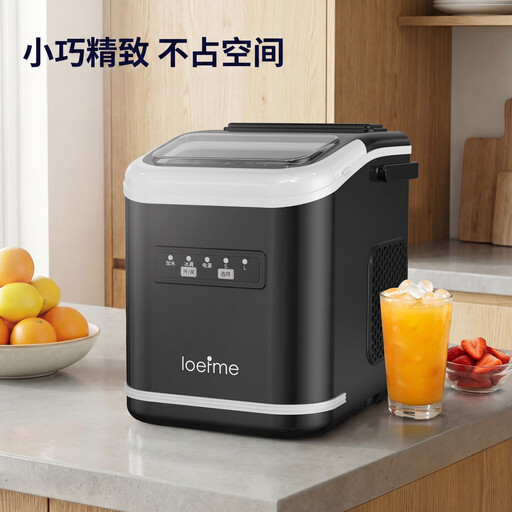 Image unavailable
The Joybuy product description states that it makes nine cubes per 6–13-minute cycle, with two sizes to choose from.
The stated water tank capacity is 1.4 litres; the product description also mentions an automatic cleaning function.
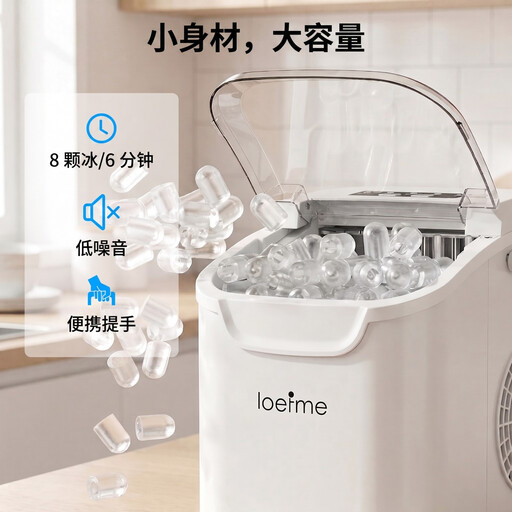 Image unavailable
The Joybuy product description states that it makes nine cubes per 6–13-minute cycle, with two sizes to choose from.
The stated water tank capacity is 0.8 litres; the product description also mentions an automatic cleaning function.
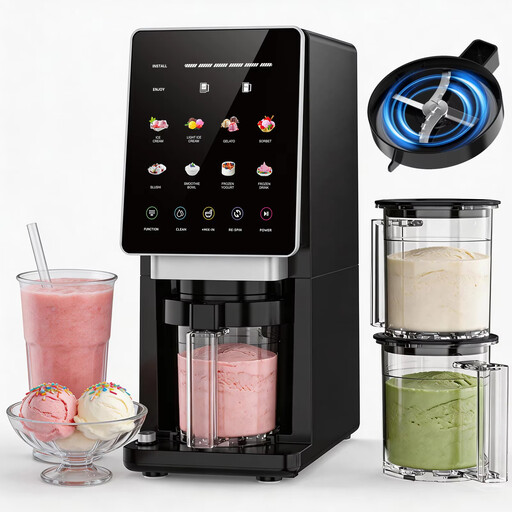 Image unavailable
The product title describes this model as a countertop ice maker.
The product title lists eight preset programmes, a self-cleaning function, and mix and restart functions.
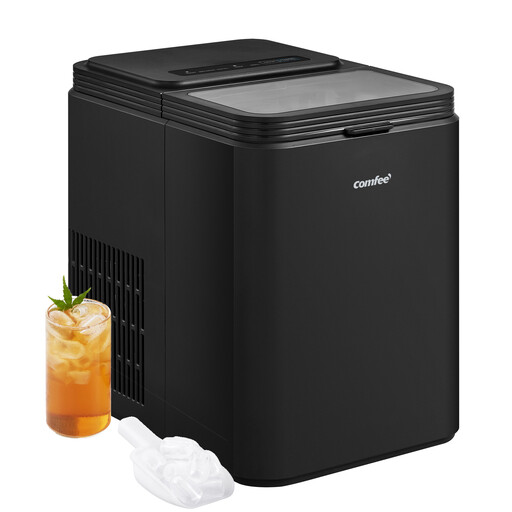 Image unavailable
The Joybuy product description states that the first batch of eight ice cubes takes six minutes.
It also lists two cube sizes, a 1.3-litre reservoir and a self-cleaning function. The stated capacity is 12 kg per 24 hours; that daily figure alone says little about how convenient the machine is for a single glass.
Not in general: the Netherlands Nutrition Centre says that Dutch tap water meets strict requirements. Also follow the instructions for your exact appliance; DOMO, for example, recommends spring water for the DO9220IB, while KitchenBrothers specifies tap water for the KB1000692.
Don’t assume so unless the model-specific instructions say you can. For the separate DO9200IB model, DOMO recommends transferring a larger quantity of ice from the basket to a freezer bag; don’t automatically apply this advice to other models.
Follow the manual for the exact model. The manual for the KitchenBrothers KB1000692 covers maintenance and self-cleaning separately; DOMO states that the DO9220IB has a removable basket and a drain opening. A feature labelled ‘self-cleaning’ doesn’t mean you can skip the manual.
According to the Dutch government, when you buy online from a business you have 14 days to change your mind in many cases. You’re also entitled to a product that is of satisfactory quality; the Netherlands has no fixed statutory two-year guarantee period, and if something is faulty, the retailer is your point of contact. Check the terms that apply to your specific purchase.
No. According to the Dutch government’s Business.gov.nl, after assessing the applicable European requirements, the manufacturer must draw up and sign an EU Declaration of Conformity; CE is not an independent safety test. For a specific offer, check the product identity and relevant documentation.