
Host serving drinks throughout the meal
Wants to make fresh batches of ice during the meal and compares cycle time with production per 24 hours, without treating them as equivalent measures.


A countertop ice maker that produces ice while you eat could be a good fit if you can keep operating it between servings. For a busy serving period, it may be more convenient to make ice in advance and store it in the freezer. Compare cycle time, production per 24 hours and basket capacity as separate figures, and also check the available space, cleaning instructions and the information on safety and food contact for the exact model.
Wants to make fresh batches of ice during the meal and compares cycle time with production per 24 hours, without treating them as equivalent measures.
Wants to have ice ready before the meal in case several guests are served drinks at around the same time.
Needs to leave enough room around the machine to refill the water, remove the basket and clean the appliance.
First, decide whether you mainly want to top up the ice during the meal or have a batch ready before the busiest serving period. Then consider maintenance and where the machine will sit on your worktop.
| What to consider | What should you check? | Who is this important for? |
|---|---|---|
| Topping up ice during the meal | Compare cycle time and production per 24 hours separately. Princess states that model 283069 makes up to 9 cubes per 10 minutes; CASO states that the IceMaster Pro 3301 makes around 12 kg per 24 hours, with a cycle time of 6–13 minutes. | If I’m serving more drinks during the meal, I want to know when the next batch might be ready. Around 36% of consumers prioritise being able to top up ice during a meal. |
| Having ice ready for serving | Check the basket capacity and, if needed, plan ahead for production and freezer space. Princess specifies a basket capacity of 800 grams for model 283069; DOMO describes freezing ice made with model DO9200IB. | If several guests want drinks at the same time, I want to have ice ready rather than just know how quickly a machine makes new cubes. Around 29% of consumers prioritise having a supply ready for the busiest serving period. |
| Cleaning and food contact | Check the cleaning instructions and information about the parts that come into contact with food for the exact model. The European Commission cites Regulation (EC) No 1935/2004 for applicable food-contact materials; DOMO lists a drain opening for the DO9220IB. | I want to make ice for drinks and know how to empty and clean the appliance properly afterwards. Around 21% of consumers prioritise maintenance and the suitability of food-contact parts. |
| Worktop space and operation | Measure the space where you plan to put the machine and check that there’s room to refill the water and remove the basket. CASO gives the IceMaster Pro 3301’s dimensions as 240 × 320 × 360 mm and its tank capacity as 2.2 litres; DOMO states that the DO9220IB has a 1.5-litre tank. | If I have limited worktop space, I want to know whether the machine will still be accessible while serving and cleaning. Around 14% of consumers give placement and ease of use top priority. |
A stated quantity per 24 hours doesn’t tell you how much ice is in the basket when the meal starts.
Compare daily production, cycle time and basket capacity as three separate figures.
For the Princess 283069, Princess specifies a 2.8-litre water tank and an ice basket capacity of 800 grams. These are different parts with different functions.
Look for tank capacity and basket capacity separately in the specifications.
The Consumers’ Association (Consumentenbond) test from March 2026 covers non-self-freezing machines for making products such as ice cream, sorbet and frozen yoghurt, not countertop machines for making ice cubes for drinks.
Before using a test or review, check that the machine has the same function as the one you’re looking for.
The details below can help you compare specific models; manufacturers’ figures aren’t measurements taken over the course of a party. For each model, also check the information on its intended use and the applicable safety and food-contact requirements.
The Princess 283069 is worth considering if you want to factor in its stated basket capacity and choice of three ice cube sizes.
The IceMaster Pro 3301 gives you figures for daily production, cycle time, tank capacity and external dimensions to compare with your needs.
The DO9220IB is worth considering if a drain opening matters to you. The DO9200IB is a separate model that DOMO describes as suitable for making ice in advance and freezing it.
These countertop ice makers are designed to make more ice during a meal. Don’t treat stated cycle times and daily production as the amount of ice already in the basket; also check the manual and the electrical safety and food-contact information for the exact model.
 No image available
The stated cycle time may be useful if you want to make more ice cubes while serving.
The product name states 9 cubes per 6–9 minutes, production of 12 kg per 24 hours, two ice sizes and a 1.3-litre water tank.
 No image available
The stated cycle time may be useful if you want to top up the ice during a meal.
The product name states 9 cubes per 9 minutes, production of 12 kg per 24 hours, two ice sizes, a self-cleaning function and a 2.2-litre water tank.
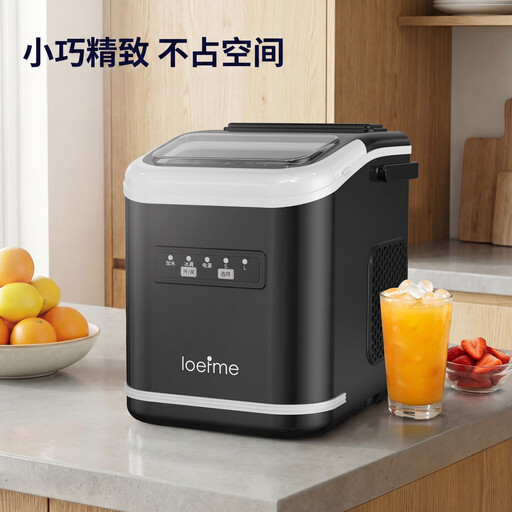 No image available
The stated cycle time is useful if you want to make more batches during the meal.
The product name states 9 cubes per cycle of 6–13 minutes, production of 12 kg per 24 hours, two ice sizes, automatic cleaning and a 1.4-litre water tank.
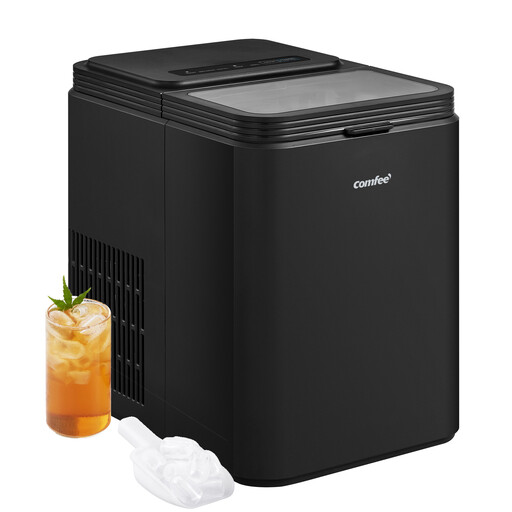 No image available
The stated first-cycle time may be useful if you want to make a fresh batch quickly while serving.
The product name states 8 cubes in 6 minutes and production of 12 kg per 24 hours. The product description lists two ice sizes, a removable basket, a scoop and a self-cleaning function.
 No image available
The stated cycle time may be useful if you want to top up the ice during a meal.
The product name states 9 bullet ice cubes per 6 minutes, daily production of 26,5 lb and two ice sizes. The product description lists a self-cleaning function and a drain opening.
No. For the CASO IceMaster Pro 3301 and DOMO DO9220IB, 12 kg per 24 hours is the manufacturer’s stated production over that period, not the amount already in the basket. The only basket capacity specified here is 800 grams for the Princess 283069.
If needed, make ice in advance and store it in the freezer, provided the instructions for the model and your available freezer space allow this. DOMO describes this approach for the DO9200IB; the guidance doesn’t automatically apply to the DO9220IB.
Electrical equipment that falls within the scope of Directive 2014/35/EU must meet the applicable electrical safety requirements and CE obligations. Materials that come into contact with ice intended for drinking must comply with the applicable EU food-contact rules, including Regulation (EC) No 1935/2004. The European Commission outlines these requirements. Check the documentation for the exact model, as a CE marking alone doesn’t confirm that all food-contact parts are suitable.
For the DO9220IB, DOMO explains that you can remove the basket and empty the appliance through the drain opening. Follow the manual for the exact model when cleaning it; a drain opening doesn’t replace those instructions.
The Government of the Netherlands describes Dutch drinking water as clean and safe to drink. Also follow your machine’s water instructions: DOMO specifically recommends spring water for the DO9220IB.