
Vandaag of morgen in huis

Kwaliteit gegarandeerd

Welkomstaanbiedingen ontgrendelen: GRATIS bezorging | Tot 80% korting | Gratis 30 dagen JoyPlus-proefperiode
Download de app
A hands-free hair dryer can be useful if you want to keep both hands free while drying your hair. This is particularly helpful for people with long or thick hair, families with children and users with limited hand mobility. Anyone who wants to apply styling products while drying may also benefit from a standing hair dryer.
However, not every hands-free hair dryer is automatically suitable for everyday use. Marketing copy often focuses on high motor speeds, millions of ions or low noise levels. These figures do not always tell you how comfortable, safe and practical the appliance will be in your bathroom.
A motor rated at 100,000 or 120,000 rpm sounds impressive, but drying time also depends on air volume, air speed, outlet design and the distance from the hair. Check whether the product information also includes practical details such as m/s, air outlets or adjustable airflow.
According to the product description, an ionic hair dryer may help reduce static electricity and frizz. However, its performance varies depending on hair type, moisture levels and styling technique. Claims about smoother or shinier hair are brand claims, so do not treat them as guaranteed results. Alongside ionic technology, look for temperature control, a cool-air setting and a diffuser.
A quiet hair dryer can be more comfortable in a household with children or when used in the evening. Check the stated noise level in decibels and find out under what conditions it was measured. A rating of 55 or 59 dB is a useful indication, but it does not tell you exactly how loud the appliance will be in your bathroom.
For hands-free drying, air distribution is more important than wattage alone. A model with a dual air outlet can direct air at the hair from two sides. An oscillating head or airflow can help prevent the same section of hair from being exposed to heat continuously.
Check:
The PINSSLE C4DS is listed with a 30-degree oscillation angle and broad head coverage. The specifications also mention dual airflow. However, the product information contains different motor figures: 120,000 rpm in the highlights and 100,000 rpm in the specifications. Always check the current product page before ordering.
A fast hair dryer is not automatically suitable for fine hair or children. Multiple settings give you greater control. A hair dryer for children should always be used under adult supervision; a child mode is not a substitute for supervision.
Look for:
An automatic warm-to-cool cycle can be convenient if you do not want to keep changing the setting manually. During use, keep the appliance clear of towels, clothing and other materials that could block the air intake.
A standing hair dryer takes up more space than a traditional handheld model. Measure the available space beforehand and check that the mains cable is long enough. Do not use the appliance near a bath, shower, washbasin or any other source of water. Unplug it after use, even when it has been switched off.
A removable filter makes regular cleaning easier. Lint, dust and hair can restrict airflow. Also check that the model has an EU plug and a voltage suitable for the Netherlands. According to the product information, the hands-free models mentioned operate at 220–240 volts, but always check the current specifications.
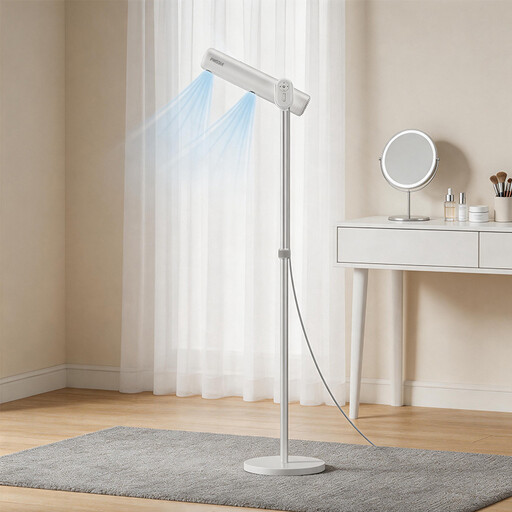
Why it suits this profile: This model is designed for easy hands-free drying, with five speed settings, warm and cool air and a wireless remote control.
The product information mentions dual air outlets and a removable rear cover for maintenance. The stated ion count is 100 million; treat this as a product specification, not a guaranteed effect on your hair.
Hands-free design, five speed settings, warm and cool air and a remote control.
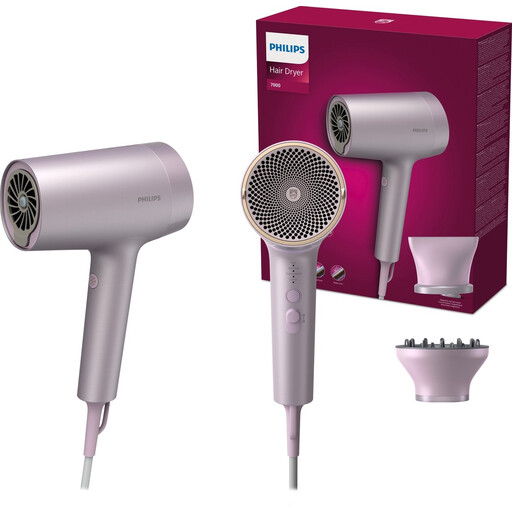
Why it suits this profile: This is not an automatic standing hair dryer, but it is a good alternative for anyone who values controlled temperature and styling attachments more than completely hands-free use.
The description mentions temperature control, a diffuser and four heat settings. Claims about faster drying and ions come from Philips’ product information.
1800 W, diffuser, temperature control and an ionic function.
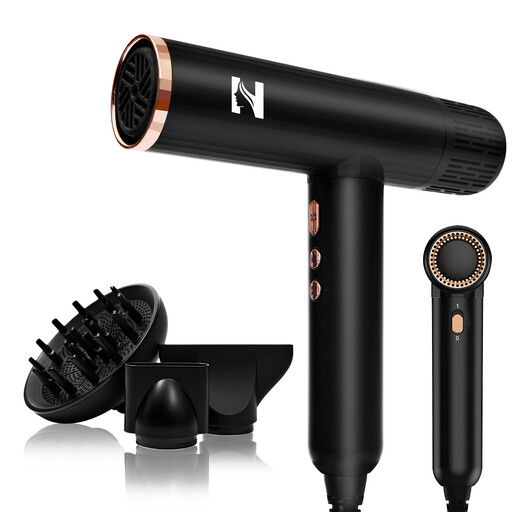
Why it suits this profile: For long, thick or curly hair, this handheld model offers a diffuser, several attachments and powerful airflow. You will still need to hold the appliance yourself.
The combination of a diffuser, two concentrators, four temperature settings and three speeds means you do not have to rely solely on the rpm figure.
1900 W, stated airflow of 23 m/s, ionic function and a weight of 0.57 kg.
We have put together a complete, up-to-date list of products that fully meet these strict selection criteria and the applicable European safety regulations.
Place a hands-free hair dryer on a flat, stable surface and keep the ventilation openings clear. Do not direct warm air at one spot for an extended period and do not touch the air outlet. Allow the appliance to cool completely before moving or storing it.
Extra care is needed when children are involved. The PINSSLE C4DS is listed as suitable from the age of 8 under adult supervision. This does not mean that children may operate the appliance independently. Keep the cable and remote control out of reach when the hair dryer is not in use.
It can be, but check whether the model has a diffuser or whether its airflow can be adjusted gently enough. A stand with a broad air outlet can be practical, while a handheld model with a diffuser gives you greater control over curl formation. You can also view our selection of hair dryers for natural hair.
Energy consumption mainly depends on the rated power, drying time and how often you use the appliance. A 1650 W model theoretically uses 1.65 kWh in one hour, but in practice it is usually used for less time. Compare both wattage and drying time rather than looking only at the highest power rating.
Its lifespan depends on the motor, ventilation, frequency of use and maintenance. Clean the filter regularly, do not block the air intake and do not use the appliance if the cable or plug is damaged. Automatic shut-off in the event of overheating is a useful safety feature, but it is not a reason to neglect maintenance.
