
Vandaag of morgen in huis

Kwaliteit gegarandeerd

Welkomstaanbiedingen ontgrendelen: GRATIS bezorging | Tot 80% korting | Gratis 30 dagen JoyPlus-proefperiode
Download de app
A hands-free hair dryer can be useful if you want to keep your hands free while drying your hair. It’s a good option for busy mornings, parents helping a child, people with long or thick hair, and anyone who wants to style their hair while it dries. However, a standing hair dryer and a regular hairdryer can differ considerably in ease of use, noise levels and how they distribute air.
Marketing copy often focuses on ions, high motor speeds or a “salon finish”. These claims only tell you so much unless you also consider the specific features, safety information and how you plan to use the appliance.
According to the product description, an ionic hair dryer may help to reduce static and frizz. However, the results also depend on your hair type, humidity, temperature, how far the dryer is from your hair and the styling products you use. A claim such as “millions of ions” isn’t, by itself, a good reason to buy a particular model.
Also check whether you can switch the ion function on and off, which temperature settings are available and whether a diffuser is included.
A power rating of, say, 1,700 or 2,000 watts tells you how much electrical power the appliance uses. It doesn’t give you the full picture of how powerful the airflow feels. The motor type, air outlet and shape of the airflow also affect drying time.
With a hair dryer with dual air outlets, the key thing is whether the air is distributed around your head. Also check whether you can adjust the height and direction. A model that isn’t suited to your height or hair length may be less practical than a regular hairdryer.
It’s difficult to compare quiet hair dryers without a decibel rating. The PINSSLE C4DS product information gives a noise level from 57 dB, while other models simply claim to be “quiet” or “low noise”. Check whether the rating was measured under specific conditions and whether the setting used is stated.
A lower stated noise level may be useful if you’ll be using the dryer in the evening, in a household with children or in a shared bathroom. However, you’ll still be able to hear the airflow and motor.
Positioning matters more with a hands-free dryer than with a handheld model. Check:
A model with dual air outlets can be useful if you want both hands free to use a brush, hair clips or styling products. For curls, a diffuser is often more important than a high airflow speed alone.
Ideally, choose an appliance with several settings, including cool air or a warm-to-cool cycle. This lets you adjust the heat to suit fine, thick, straight or curly hair. The highest setting isn’t necessary for every hair type.
Pay attention to the difference between, for example, 5 temperature settings × 3 speeds and an appliance with just a few combined settings. More settings give you more choice, but can make the control panel less straightforward to use.
A hair dryer needs clear air inlets and outlets. Fluff and hair can restrict the airflow. A removable back cover or filter makes cleaning easier. Also check for:
Don’t use an electrical appliance next to a bath, shower, washbasin or other source of water. Unplug it after use, especially in the bathroom. Warm air outlets and attachments can get hot, so let the appliance cool down before moving or storing it.
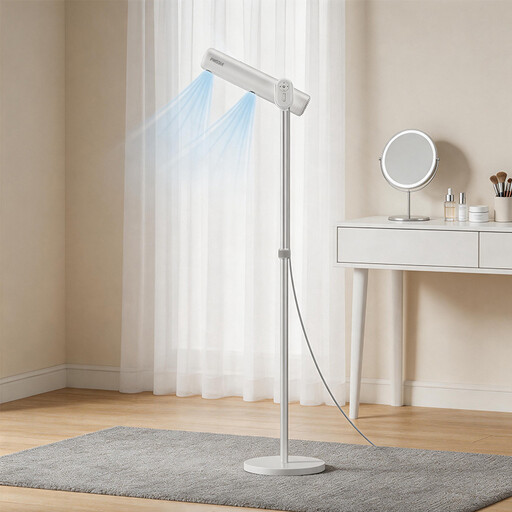
Why it suits this profile: This model combines an adjustable stand with remote control. According to the product information, it has 5 speeds, warm and cool air, and dual air outlets.
The stated settings let you adjust the airflow and temperature rather than relying on the highest setting alone.
Adjustable stand, magnetic remote control and dual air outlets, according to the product specifications.
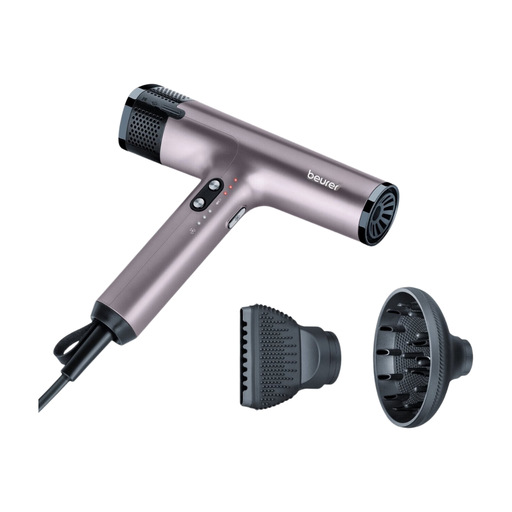
Why it suits this profile: This isn’t a standing hair dryer, but a lightweight handheld model for anyone looking for an ergonomic hairdryer with attachments and adjustable airflow.
The product information lists a diffuser, styling nozzle, 4 heat and airflow settings, and a filter-cleaning indicator.
1,700 watts, a 2.80-metre cable and attachments for targeted styling and curly hair.
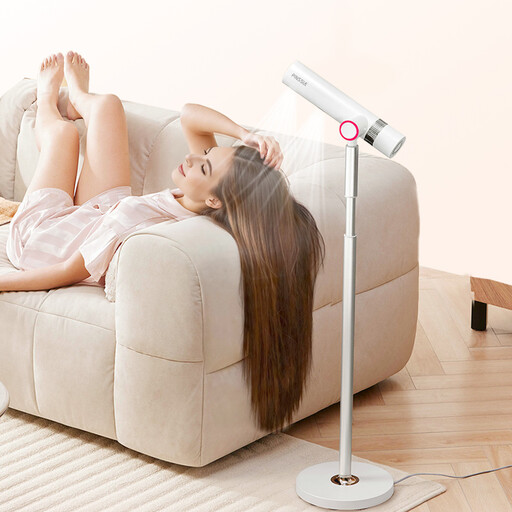
Why it suits this profile: The product description lists an oscillating airflow, a child mode, remote control and several temperature and speed settings.
The stated oscillation and dual air outlets distribute the airflow beyond just one small area of the head.
According to the product information: 5 temperature settings, 3 speeds and a stated noise level from 57 dB.
A hair dryer with a stand is particularly practical when you need both hands free or don’t want to hold an appliance for a long time. For precise styling, such as blow-drying with a round brush, a handheld model is often more versatile. Children must always be supervised, even when a child mode is available.
Have curly hair? Check whether a diffuser is included and whether the lowest heat and speed settings are suitable for you. If you mainly want to dry your hair quickly, look at airflow coverage, motor information and adjustable heat rather than focusing on wattage alone.
We’ve put together a complete, up-to-date list of products that meet these strict selection criteria and the applicable European safety regulations.
Place the stand on a flat, stable surface and keep the air inlet and outlet clear. Don’t use the appliance near water. Adjust the height and airflow so the warm outlet isn’t pointing directly at your skin, face or scalp.
Its lifespan depends on how it’s used, maintained and ventilated. Clean a removable filter or back cover regularly, keep the airways clear and don’t use the appliance if its cable is damaged. Automatic overheating protection is useful, but it doesn’t replace proper maintenance.
Energy use depends on the appliance’s power rating and how long you use it. A 1,700-watt appliance would use 1.7 kWh in one hour, although hair dryers are usually switched on for less time. So don’t compare wattage alone: consider the drying time you need and the setting you use too.
