
Vandaag of morgen in huis

Kwaliteit gegarandeerd

Welkomstaanbiedingen ontgrendelen: GRATIS bezorging | Tot 80% korting | Gratis 30 dagen JoyPlus-proefperiode
Download de app
A hairdryer may seem like a simple appliance, but you notice the difference between models particularly in everyday use. A heavy hairdryer can become tiring, an excessively hot airflow can put unnecessary strain on your hair, and a diffuser that does not fit properly will remain unused in the cupboard. If you only look at wattage or eye-catching marketing claims, you may not always be paying for features that genuinely suit your hair.
This buying guide will help you compare hairdryers by power, airflow, settings, accessories and ease of use. We will focus on practical situations: drying your hair quickly in the morning, defining curls, styling frizzy hair or taking a compact hairdryer with you when travelling.
A powerful hairdryer often has a higher wattage, but wattage does not tell you everything about the actual airflow. The motor design, nozzle and air distribution all help determine how quickly your hair dries. In practice, a 1,800-watt model may be more pleasant to use than a heavier 2,300-watt model if its airflow is easier to control.
As well as power, look at:
A hairdryer with ionic technology is often presented as a solution for frizz and static hair. According to brands’ own research or product information, ionic technology may contribute to smoother-looking styling, but the result varies depending on hair type, brushing technique and humidity. Treat it as a possible extra feature rather than a guaranteed result.
A diffuser is particularly relevant for curly, wavy or voluminous hair. The shape and diameter of the attachment determine how easily you can use it. A concentrator, on the other hand, produces a narrow airflow for blow-drying with a brush or targeted styling. Always check whether both accessories are included if you want to create different styles.
Fast drying requires a good balance between power and control. The models in this selection range from 1600 to 2300 watts. A powerful hairdryer is useful for long or thick hair, while fine hair will generally benefit more from several lower settings.
Also look for specific airflow data where available. For example, the Nicebay DW-9041 lists an airflow speed of 23 m/s. The Remington D6077 is stated to have an airflow of 120 km/h. Figures like these are more useful than a general term such as ‘high speed’, but only compare measurements when the manufacturer has used the same measurement method.
At least two speeds and several heat settings give you more control. Use a lower temperature for fine or fragile hair and keep the hairdryer moving continuously. A distance of around 15 to 20 centimetres is mentioned in several sets of usage instructions.
A cool-air button is useful for finishing a style. Cool air does not replace careful heat control, but it prevents you from relying solely on a high temperature.
A lightweight hairdryer is more comfortable when fully drying long hair or regularly working with a round brush. Check the stated weight: some models list their weight without the cord, so comparisons are not always like for like.
A cord of around two metres gives you more freedom of movement if your mirror is not directly next to the socket. A removable filter makes maintenance easier. Clean the filter regularly and keep the air intake free from hair and dust to help prevent overheating.
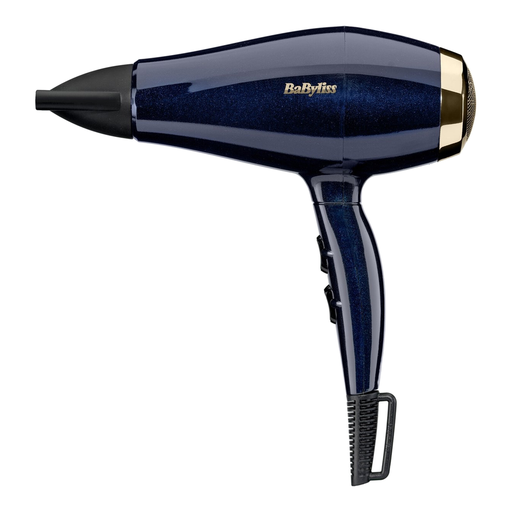
Why it suits this profile: An accessible choice for everyday drying, with a folding handle for easy storage or occasional travel.
You are not reliant on high heat alone: this model has 2 speeds, 3 temperature settings and a cool-air option.
2200 watts, diffuser and concentrator included, folding design and removable filter.
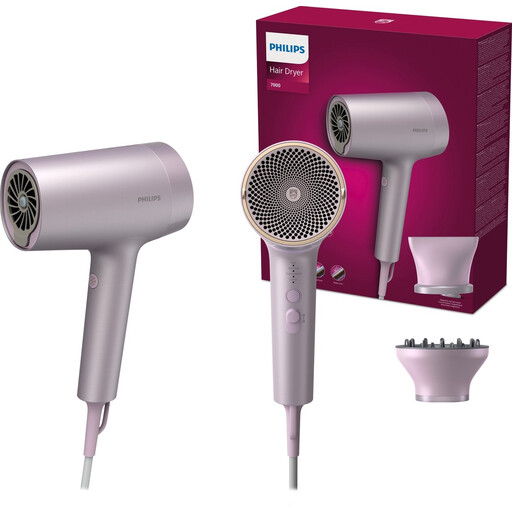
Why it suits this profile: Ideal for users who value temperature control, a lightweight design and a hairdryer with a diffuser for everyday styling.
The product description mentions ThermoShield Advanced with automatic temperature control. Check the manual for details of how it works and use the settings that suit your hair.
1800 watts, diffuser, 20% lighter according to Philips and an ionic function according to the product information.

Why it suits this profile: Designed for long, thick or curly hair, and for users looking for a quiet hairdryer with plenty of combinations.
Alongside ionic technology, this model offers 4 temperature settings, 3 speeds and a diffuser. The stated noise level of less than 65 dB is a manufacturer specification.
1900 watts, stated airflow of 23 m/s, 2 concentrators and 1 diffuser; weight of approximately 0.57 kg according to the product details.
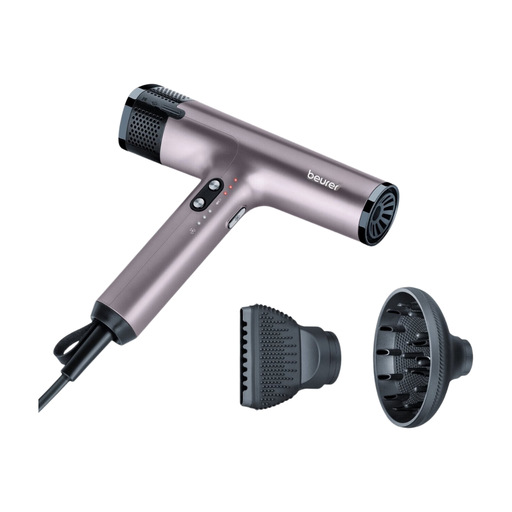
Why it suits this profile: Useful for anyone looking for a lightweight hairdryer with a long cord, diffuser and precision styling nozzle.
The model has four combinations of temperature and airflow, a memory function and a filter-cleaning indicator for regular maintenance.
1700 watts, approximately 360 grams excluding the cable, 2.80-metre cord, plus diffuser and magnetic styling nozzle.
We have put together a complete, up-to-date list of products that fully meet these strict selection criteria and the applicable European safety regulations.
Many models in this selection come with a minimum two-year statutory guarantee, according to the product information. Keep your proof of purchase and check the guarantee terms for the specific product.
Choose a hairdryer for curls with a supplied diffuser, several low speed and temperature settings and, preferably, a cool-air function. A diffuser distributes the airflow more widely, allowing you to dry your curls more precisely without constantly blowing them out of shape.
Its lifespan depends on use, storage and maintenance. A clean filter and unobstructed air intake help the appliance to function normally. With intensive use, look for a sturdy cord, good ventilation and a motor that does not repeatedly overheat. If the appliance develops a fault, consult the manual and stop using it if it is damaged.
Consumption depends on the wattage and how long the appliance is used. In theory, a 2200-watt model uses more power per minute than a 1700-watt model, but a shorter drying time may partly offset the difference. Therefore, only use the highest setting when necessary and choose a temperature that suits your hair type.
