
Vandaag of morgen in huis

Kwaliteit gegarandeerd

Welkomstaanbiedingen ontgrendelen: GRATIS bezorging | Tot 80% korting | Gratis 30 dagen JoyPlus-proefperiode
Download de app
A desk may seem simple, but you quickly notice when you have made the wrong choice. A tabletop that is too small does not provide enough room for a monitor and laptop. A wobbly frame makes writing and gaming uncomfortable. And a desk with barely any storage space can soon turn into a pile of cables, papers and accessories.
So do not focus only on colour or price. Above all, check the dimensions, construction and layout. With these points, you can compare a computer desk, home office desk or study desk based on verifiable product information.
The stated width is not always the usable space. A desk with a deep rear edge, built-in shelf or drawers may offer less workspace than expected. So measure not only the space in the room, but also the room needed for your chair, legs and cables.
For laptop use and writing, a compact desk measuring 80 x 50 cm can be practical. If you use multiple screens, a printer or speakers, a large desk measuring 160 x 80 cm is likely to be a better choice.
A manufacturer may state a maximum static load, but that does not mean the desk will remain stable with every weight distribution. A heavy monitor on one side, an uneven floor or an improperly secured frame can still cause problems.
So check:
The brand’s product description specifies the relevant model’s capacity. Use the desk within the stated limit and distribute heavy equipment evenly.
A desk with drawers is useful for documents and small accessories, but drawers also take up space beside your legs or on one side of the tabletop. With a corner desk, you should also check whether the long and short sides fit properly in the room.
A reversible L-shaped design can offer greater flexibility here. However, pay attention to the assembly instructions and decide in advance which side you want the storage on.
Most models in this selection are approximately 75 to 76 cm high. This is a common height for a seated workstation, but the right choice depends on your chair and height. Your forearms should be able to rest roughly horizontally while typing, without your shoulders constantly lifting.
Measure the available width, depth and walkways at home. Also take sockets, skirting boards and any cupboard doors into account.
A chipboard or laminated board tabletop can be suitable for everyday work, writing and light equipment. Quality depends, among other things, on the board thickness, edge finish and joints. A steel frame can provide additional support, but only if the legs are securely attached.
The term E1 chipboard refers to a formaldehyde emissions class. Always check the current product specifications and the information supplied with the product when buying; a product listing alone is not a substitute for complete conformity documentation.
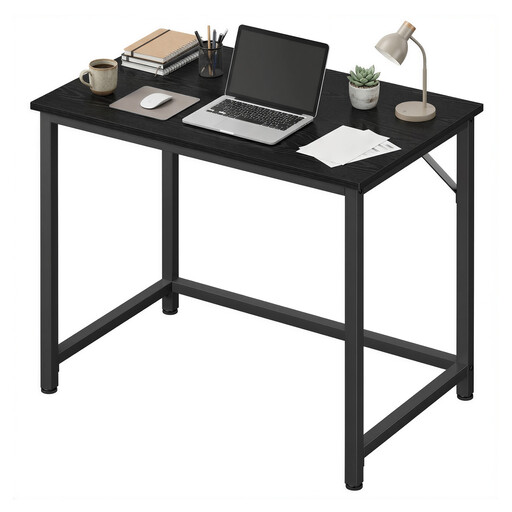
Why it suits this user profile: This compact desk fits in a bedroom, student room or small office. The 80 x 50 cm tabletop provides room for a laptop, monitor or writing without taking up much floor space.
The product listing mentions adjustable feet for positioning on an uneven floor. The dimensions and maximum static load of 50 kg are also stated, allowing you to check in advance whether it is suitable for your equipment.
Compact size, steel frame, chipboard and adjustable feet. According to the product description, assembly with labelled components is designed to make installation straightforward.
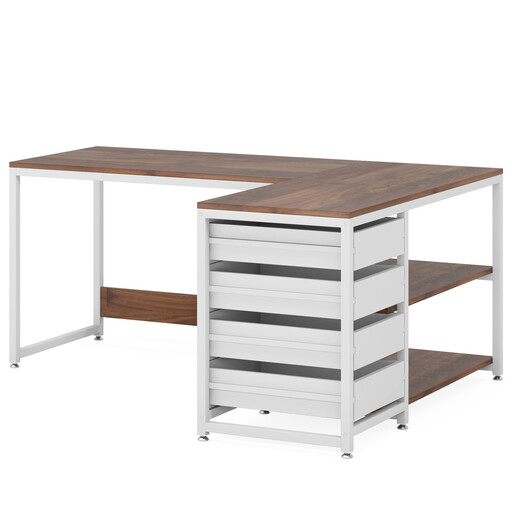
Why it suits this user profile: This corner desk is designed for users who want to combine workspace and storage. The L-shape can work well in a home office with multiple devices or two separate work zones.
According to the product description, the reversible layout allows the drawers to be fitted on the left or right. This lets you adapt the arrangement to the room, but measure the available corner carefully beforehand.
Dimensions of 150 x 110 x 75 cm, four drawers, two open shelves and adjustable feet. According to the product information, the tabletop is made from E1 chipboard with a metal frame.
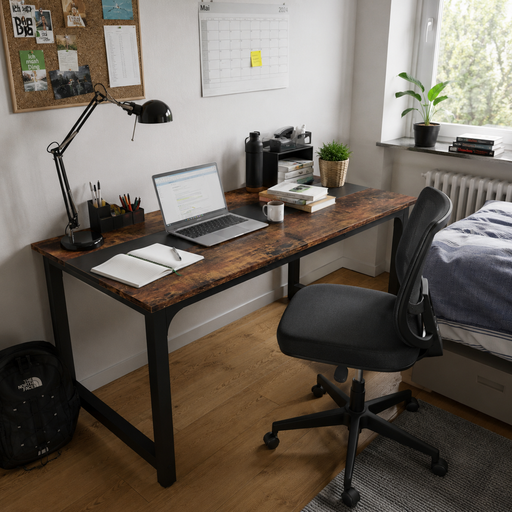
Why it suits this user profile: The wide tabletop is designed for multiple screens, a printer, writing or an extensive gaming setup. This size can also be practical as a home workstation or meeting table, provided the room has enough space.
According to the product description, the frame has additional steel supports and adjustable foot pads. The stated load capacity of 400 kg is a product specification; distribute the load evenly and do not exceed the limit.
Workspace measuring 160 x 80 cm, metal frame, additional support structure and adjustable legs. The product listing states a height of 75 cm and a weight of 26 kg.
We have put together a complete, up-to-date list of products that fully meet these strict selection criteria and the applicable European safety regulations.
Place the desk on a level, stable surface and adjust the feet before putting monitors or other equipment on it. Check all screws and connections after assembly. With a large desk, it is a good idea to measure the free space behind the tabletop so that cables do not become trapped.
Treat the maximum static load as an upper limit, not as the recommended everyday weight. A monitor arm, desktop computer and printer may be heavier together than expected. Ideally, place heavy devices above the load-bearing parts of the frame.
For a laptop and one screen, 80 x 50 cm may be sufficient. For a monitor, keyboard, mouse and documents, greater depth is more comfortable. If you use two screens, a printer or lots of accessories, you could consider a desk 140 to 160 cm wide.
It can be, but measure the drawer clearance and legroom carefully. A corner desk with drawers can make efficient use of floor space, while a compact straight desk is often easier to fit against a wall.
Assemble the frame on a level surface, tighten all connections evenly and use adjustable feet if provided. If the desk continues to move, check that the tabletop is correctly positioned on the frame and whether the floor itself is uneven.
