
Vandaag of morgen in huis

Kwaliteit gegarandeerd

Welkomstaanbiedingen ontgrendelen: GRATIS bezorging | Tot 80% korting | Gratis 30 dagen JoyPlus-proefperiode
Download de app
A cordless tool can seem like the obvious choice: no extension lead, more freedom to move around and one battery platform for several machines. Yet DIYers and professionals often buy cordless tools that aren’t right for the job. The main issues usually aren’t about appearance, but about the battery, accessories and specification.
Look out for these three common pitfalls:
“20 V” doesn’t tell you everything about performance
Voltage gives you an indication of the electrical system, but it doesn’t automatically tell you how well a machine cuts, how long it runs or how durable it is. The motor, speed control, battery capacity and workload all affect how a tool performs.
A tool without a battery and charger may not be as cheap as it looks
Models labelled “bare tool” or “solo” are often supplied without a battery and charger. So check the total purchase price. A tool that’s part of a battery platform you already own may still be a good option, as you may already have a compatible battery.
More accessories aren’t always more practical
A comprehensive accessory set can look appealing, but check that the discs, blades or sanding sheets are suitable for your material and tool. With a cordless multi-tool, for example, a quick-change system is more useful than a large set of accessories you won’t use.
18V tools and 20V tools are often sold alongside each other. The difference in nominal voltage doesn’t automatically mean a 20V machine is more powerful. Also check the battery capacity, measured in Ah. A 2.0 Ah battery is compact and relatively light, while a battery with a higher Ah rating will usually run for longer but will also be heavier.
Also check compatibility:
Batteries from different brands aren’t automatically interchangeable, so don’t choose a tool based on voltage alone.
A brushless motor has no carbon brushes and is often associated by brands with a longer service life or more efficient operation. According to the brands’ own information, a brushless motor can offer benefits in terms of power and maintenance. However, actual runtime also depends on the material, pressure, accessory and battery.
Adjustable speed is particularly useful for sanding, polishing and multi-tool work. Here are some examples from the range:
Use speed as a point of comparison, not as proof on its own that a tool will deliver better results.
A cordless angle grinder typically takes a 115 or 125 mm disc. A 125 mm disc may be suitable for grinding, deburring and cutting metal or stone, but always check the maximum disc size and the type of accessory.
Also look for:
A CE marking indicates that the manufacturer declares the product meets applicable EU requirements. It isn’t a quality rating and doesn’t replace safe use. When grinding or sanding, wear safety goggles and suitable ear protection, among other protective equipment. Remove the battery from the tool before maintenance or changing accessories.
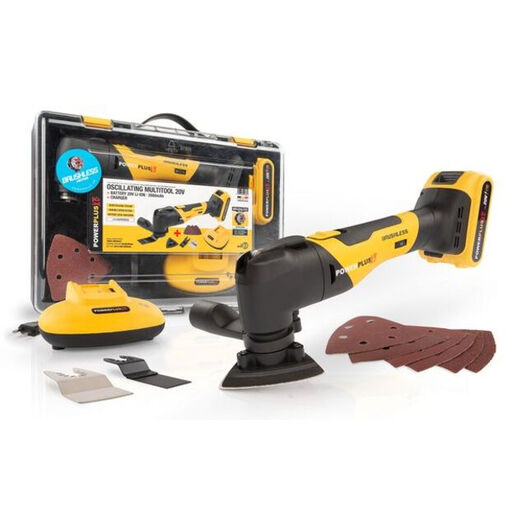
Why it suits this user: According to the product information, this complete set includes a 2,000mAh battery, charger, accessories and case. It’s a practical choice for small renovation, cutting and sanding jobs, without having to gather separate parts first.
The battery and charger are included. The six speed settings and tool-free accessory change make it easier to handle a range of simple jobs.
20V system, brushless motor, six speed settings, and case, battery and charger included.
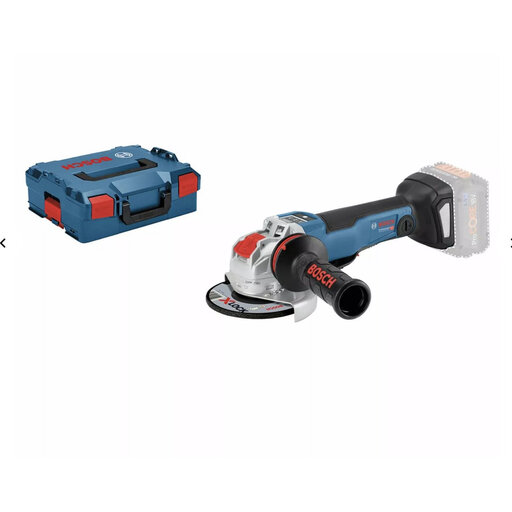
Why it suits this user: This Bosch Professional cordless angle grinder is designed for grinding metal, stone and concrete. The product information specifies a brushless motor, X-LOCK change system and compatibility with ProCORE18V batteries.
The specifications identify both the battery platform and accessory size. Before buying, check whether you already have the battery and charger you need.
18V Professional platform, 125mm disc, X-LOCK and a stated no-load speed of 9,000 revolutions per minute.
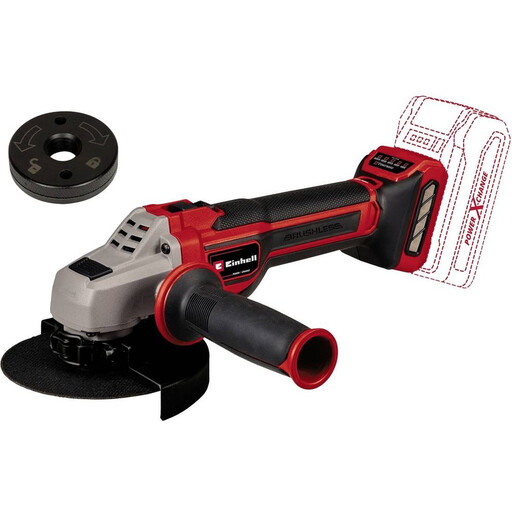
Why it suits this user: A complete set is practical if you grind regularly. According to the product information, it includes two 18V 5.2 Ah batteries, a charger, guard and storage case.
The contents of the pack are clearly listed. The product specifications also mention soft start and an electronic safety cut-out.
Two 5.2Ah batteries, 125mm disc size, tool-free change and a weight of 1.60 kg according to the product information.
We’ve put together a complete, up-to-date list of products that meet these strict selection criteria and the applicable European safety regulations.
For detailed work in corners, a cordless sander with a delta-shaped base is practical. According to the product details, the Powerplus POWDP50200 has a delta-shaped sanding plate, hook-and-loop fastening and a dust bag. For larger flat surfaces, the Bosch UniversalOrbit 18V-20 is specified with a variable speed of 10,000 to 23,000 revolutions per minute and a microfilter dust box.
If you mainly work on paintwork, plastic or car parts, you could consider a cordless polisher with small backing pads. Check the pad diameter, speed range and how many batteries are included. Mains-powered tools may be more economical for a permanent workshop, while cordless tools offer more flexibility when working on the move.
Not necessarily. Voltage is just one part of a tool’s performance. Also compare the motor, speed, battery capacity, overload protection and the material you plan to work with.
Runtime depends on battery capacity, workload, material and how you use the tool. A battery with a higher Ah rating may run for longer, but it’s often heavier. A spare battery is useful for longer jobs.
It can be if you already use a compatible battery platform. If you don’t own anything from that system yet, include the cost of a battery and charger in the total before comparing models.
