
Student who wants to study in peace
Wants to warm the room during longer study sessions without constant fan noise. So check how the heater works and whether you can switch off any fan separately.


A convector heater is a good choice if you want to warm the room during longer study sessions and can place the heater in a clear spot, as instructed in the manual. If you usually sit in one place, targeted heat, such as an infrared panel, may suit you better. It heats the area it’s directed at rather than warming the room in the same way. When comparing convector heaters, check the power rating, thermostat, any fan and how long you’ll use it. A lower power setting alone doesn’t tell you how much electricity you’ll use overall.
Wants to warm the room during longer study sessions without constant fan noise. So check how the heater works and whether you can switch off any fan separately.
May have bedding, curtains, paper or furniture close to the desk. Check whether you can place the heater somewhere safe, with its air vents unobstructed, as instructed in the manual.
Wants heat during specific study hours and compares the power rating with actual usage time. A lower power setting alone doesn’t prove that total consumption will be lower.
A good choice when: you want to warm the air in the room during longer study sessions.
Check: the thermostat, settings and safety features of the specific model, as these aren’t the same for every convector heater.
A good choice when: you want a setting that moves warm air as well as providing convection heating; Eurom and Mill list this feature on specific models.
Check: the noise level in fan mode and whether you can switch the fan off.
A good choice when: you mainly sit in one place and don’t need to warm the air throughout the room.
Check: Milieu Centraal explains that you mainly feel the heat in the area the panel is directed at, and it no longer reaches you when you move away.
| What to consider | What should you check? | Who is this most relevant to? |
|---|---|---|
| Quiet room heating | Check whether the model has a fan, whether you can switch it off, and how the thermostat and heat settings work. | When I study for a long time, I want to warm the room without being distracted by a fan. Quiet room heating is the top priority for around 29% of consumers. |
| Safe positioning | Follow the model-specific clearance requirements, keep air vents unobstructed and check whether you can plug the heater directly into a wall socket. | With paper, curtains or furniture near my desk, I first want to check whether I can position the heater safely, as instructed in the manual. Safe positioning comes first for around 29% of consumers. |
| Electricity use | Compare the power rating with the time the heating element is actually switched on; a thermostat can affect how long this is. | If I only use the heater during study hours, I want to estimate how much electricity it will use during that time. This is the top priority for around 24% of consumers. |
| Space required | Measure the full setup, including the feet, and check the cord length and any installation requirements. | In a small room, I want to know in advance where the heater can go without blocking the walkway. Compact positioning is the main consideration for around 18% of consumers. |
Total consumption also depends on how long the heating element is switched on. A thermostat can change this.
Compare the power rating with how long you expect to use the heater during your study hours. First decide whether you want to warm the room or just the area around your desk.
A heater may look as though it will fit, but nearby fabric or blocked air vents may mean you can’t position it as instructed in the manual.
Measure the full setup and check the required clearances, as well as whether a wall socket is within reach.
A manufacturer may describe convection mode and fan mode separately; what it says about one mode doesn’t automatically tell you how noisy the other is.
Check whether you can switch the fan off if you want as little noise as possible while studying.
The features and dimensions listed apply to the product ranges or models described. Always compare the exact version and its accompanying manual.
Its range includes the freestanding AU1003169 convector heater, with three power settings and a rotary thermostat.
The Edge range includes slim convector heaters for freestanding use or wall mounting. Check the specific version and power rating separately.
The Safe-T-Convect 2400 combines convection heating with a separate turbo setting that uses a fan.
The SG2000LED is a portable convector heater with an electronic thermostat and built-in fan.
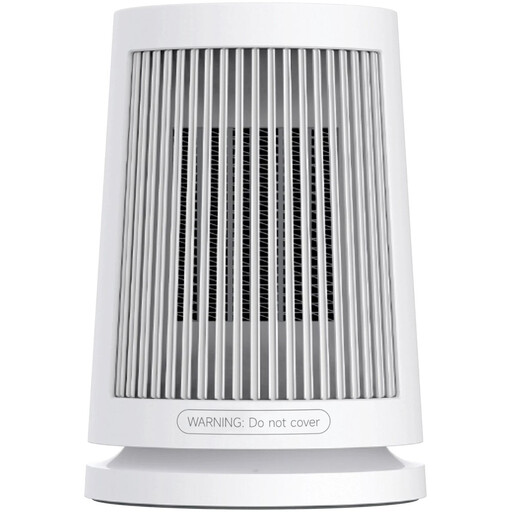
Below is a Joybuy option for targeted heat at your desk, alongside the convector heaters discussed above.
 No image available
According to the product description, this compact electric heater is designed for use at a desk.
The description lists 45° oscillation, a thermostat, tip-over and overheat protection, and dimensions of 142 × 132 × 188 mm.
Keep flammable materials away, don’t cover the heater and don’t use it in a damp environment. The product description advises avoiding an extension lead where possible.
Multiply the power rating in kW by the number of hours the heating element is switched on at that power setting; the result is the consumption in kWh. A thermostat can change the actual time the element is on, so calculating as if it runs continuously only describes that particular scenario.
The Netherlands Fire Service advises plugging high-power appliances, such as electric heaters, directly into a wall socket rather than into a multi-socket adaptor or cable reel. Keep air vents unobstructed and follow the clearances in the manual for your model. For example, the manual for the Eurom Safe-T-Convect 2400 specifies a minimum distance of 1 m between the air outlet and textiles or other flammable materials.
Follow the manual for your chosen heater. The manual for the Eurom Safe-T-Convect says to switch this model off, unplug it and let it cool down completely before cleaning. Check the instructions for your own model, as these steps are model-specific.
In the Netherlands, you can contact the seller if the product doesn’t meet the reasonable expectations you had of it during normal use. ACM ConsuWijzer says the seller must then provide an appropriate solution free of charge, such as a repair or replacement. There isn’t one fixed statutory guarantee period for every product.
According to the Netherlands Food and Consumer Product Safety Authority, applicable safety requirements apply to electrical appliances, and CE marking is mandatory when the rules require it; a CE mark isn’t proof of an independent inspection. The Dutch Government says the property owner is responsible for ensuring that the legally required smoke alarms are fitted in a home. The Netherlands Fire Service advises students to test smoke alarms regularly and keep escape routes clear. Also check your tenancy agreement for any rules about portable heaters.