
Long sourdough slices
If you want to toast large slices whole, the usable slot length is an important factor. Dualit highlights the length of your bread as something to consider when choosing a toaster.


First, measure the length and thickness of your sourdough slices. A long slot may suit longer slices, while a wide or adjustable slot matters for thick bread. Then choose based on how many slices you want to toast at once, the settings available and the space on your worktop. In a test published on 25 March 2025, the Consumers' Association reported that cheaper toasters sometimes performed better than more expensive ones. The test covered fresh and frozen bread, not sourdough specifically.
If you want to toast large slices whole, the usable slot length is an important factor. Dualit highlights the length of your bread as something to consider when choosing a toaster.
If you toast thick-cut bread, compare the thickness of your slices with the slot width. Dualit highlights wide or adjustable slots as a feature to consider for thick bread.
If you usually toast one or two slices that fit, consider the usable slot size, the controls and the space on your worktop.
Choose this type if: your slices are too long for short slots.
Bear in mind: a long appliance takes up worktop space. Severin says the AT 2509 can accommodate up to four standard slices; this does not confirm that four large sourdough slices will fit.
Consider this type if: you toast both long and thick slices. Smeg lists a slot width of 36 mm for the TSF02BLEU.
Bear in mind: the stated width does not tell you whether your slice will fit lengthways.
Choose this type if: your usual slices fit into the slots without forcing them in, and you usually toast one or two slices.
Bear in mind: Bosch lists two slots for the TAT2M124, but does not confirm that a long sourdough slice will fit.
| Factor to consider | What to look for when buying | Who is this most important for? |
|---|---|---|
| Slot length | Measure your longest usual slice and compare it with the usable internal length, not the appliance’s external dimensions. | If I want to toast my large slice whole, I check the usable length first. Around 42% of consumers prioritise slice length. |
| Slot width and browning | Compare the thickness of your slice with the stated slot width, and check whether you can adjust the browning. | If I cut thick sourdough, I compare the slot width with my own slice and check the browning setting. Around 25% of consumers prioritise thickness and browning. |
| Worktop footprint | Check the internal slot dimensions and whether the appliance will fit in the space you have in mind. | For a quick break with one or two slices, I want an appliance that fits on my worktop and doesn’t trap my bread. Around 17% of consumers prioritise saving space. |
| Number of slices | Compare the number and size of your slices with the slot layout; a capacity stated for standard slices does not automatically tell you whether large sourdough slices will fit. | If I want to toast several slices at once, I want to know how many of my own bread size will fit. Around 16% of consumers prioritise toasting several slices. |
A stated capacity for standard bread does not confirm how many large sourdough slices will fit at once.
Measure your own slices and compare them with the usable slot dimensions.
On 25 March 2025, the Consumers' Association reported that cheaper models sometimes performed better than more expensive ones in a laboratory test. The test covered 13 toasters and fresh and frozen bread, not large sourdough slices specifically.
Choose based on fit and features first. Use test results only for the types of bread and models that were actually tested.
Extra features or a design you don’t use may add little to your everyday choice.
An adjustable or self-centring slot does not confirm that a long slice will fit in the appliance.
Check the usable length and width separately.
The AT 2509 is an example of a toaster with two long slots.
According to Smeg, the TSF02BLEU has extra-long slots with a stated width of 36 mm.
The TAT2M124 is an example of a toaster with two slots.
According to Philips, the 3000 Series HD2511/90 has two variable slots.
These models include toasters with long or wide slots, as well as options for two slices. Check the usable slot dimensions against your bread.
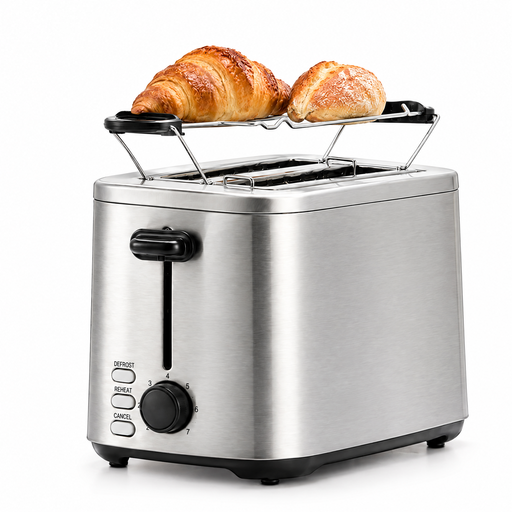 Image unavailable
The wide slots are worth considering if you toast thicker slices; check that your sourdough will fit.
7 browning settings; 800 W; warming rack; uncoated stainless steel housing.
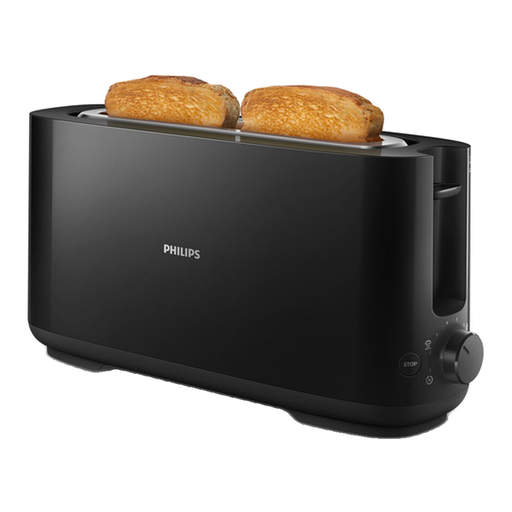 Image unavailable
A long slot makes this model worth considering for longer slices; also check the usable internal length and width.
Long slot; black.
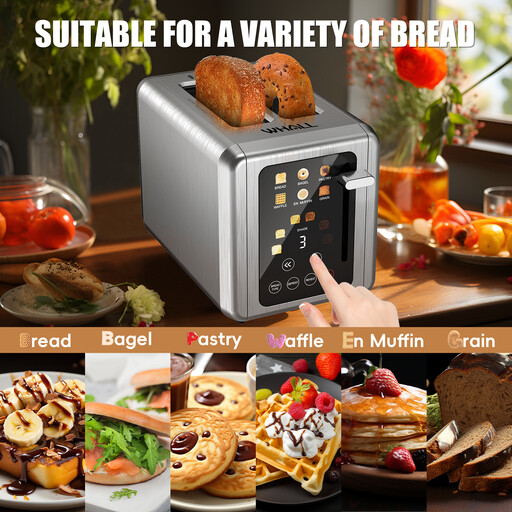 Image unavailable
The stated slot width gives you a specific measurement to compare with the thickness of your slice.
1.5-inch-wide slots; 6 browning settings; 6 bread types.
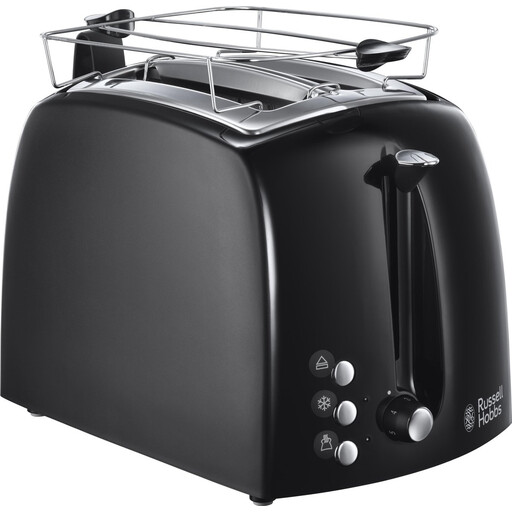 Image unavailable
A two-slice model to consider if you usually toast one or two slices at a time; check that your bread will fit in the slots.
For 2 slices; black.
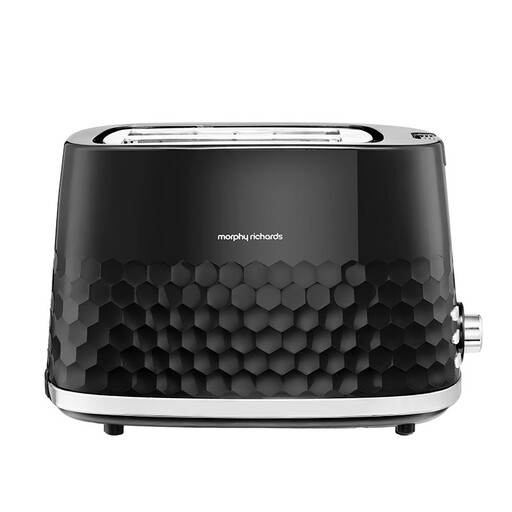 Image unavailable
Variable browning may be useful if you want to adjust the setting for different types of bread.
Variable browning; defrost; reheat; cancel; anti-jam function; removable crumb tray; 850 W; gloss black.
Only if both the internal length and width of the slot are suitable for your slice. Having two slots or looking at the appliance’s external dimensions does not confirm that it will fit.
Leave space above the toaster while it is in use and keep it away from curtains. Dualit gives this as usage advice, not as a legally required clearance in the Netherlands. Follow your model’s manual and remove crumbs as instructed.
No, there is no fixed statutory guarantee period in the Netherlands. According to the Government of the Netherlands, a product must do what you can reasonably expect it to; if something goes wrong, contact the seller. A manufacturer’s guarantee is separate from this.
According to the Netherlands Food and Consumer Product Safety Authority, CE marking is compulsory for electrical products covered by the relevant European rules. The marking is the manufacturer’s declaration that the product complies with those rules, not an independent recommendation of its toasting performance. Check the marking on the product you buy.