What should you look for when choosing?
Start with the amount of batter you’ll mix at a time, then compare the included attachments, cleaning requirements and the space the mixer takes up.
| Consideration |
What should you check? |
Who is this relevant to? |
| Batter per mixing batch |
Work out the quantity in your recipe and compare it with the guidance for the exact model. |
If you’re planning several cakes for a group, you’ll want to know whether to divide the batter into batches. Around 36% of consumers prioritise the amount they can mix at a time. |
| Mixing the batter gently |
Check which whisk or beater is included and follow the mixing point in your recipe. |
If you don’t want to mix the batter for longer than necessary, look at the suitable attachment and the controls. Around 29% of consumers give control over mixing their top priority. |
| Cleaning between cakes |
Check the cleaning instructions for each part and consider whether a second bowl would be useful. |
If you’re baking several cakes one after another, you’ll want to know how many parts need cleaning and changing. Around 21% of consumers prioritise cleaning and getting back to baking. |
| Worktop space and purchase |
Measure the available space, including with the mixer’s head raised, and decide what capacity and attachments you really need. |
If you need to put the mixer away after use, its size and what fits your budget both matter. Around 14% of consumers start by considering space and purchase cost. |
Stand mixers at Joybuy
These Joybuy products are stand mixers worth comparing for cake batter. Pay particular attention to bowl capacity, attachments and the worktop space available.
 No image available
Stand mixer with a 5-litre bowl and 10 speed settings
An option if you’re looking for a large bowl and a range of mixing attachments. The product name lists a 5-litre bowl, 10 speed settings, a dough hook, beater, whisk and splash guard.
The product name also lists 600 W; this figure alone won’t tell you when yoghurt cake batter has been mixed enough.
View at Joybuy
 No image available
AUCMA stand mixer, 5 litres, 10 speed settings
This model is worth comparing if you want to adjust the mixing speed. The product name lists a 5-litre bowl, 10 speed settings, a pulse function, whisk, beater and dough hook.
The product name also mentions a tilt head and 400 W power; use your recipe to judge when the batter is mixed enough.
View at Joybuy
 No image available
Kenwood Go KZM35 stand mixer, grey
A Kenwood Go stand mixer to include in your comparison of mixers for cake batter. Before buying, check the bowl capacity, dimensions and attachments for this exact model.
View at Joybuy
 No image available
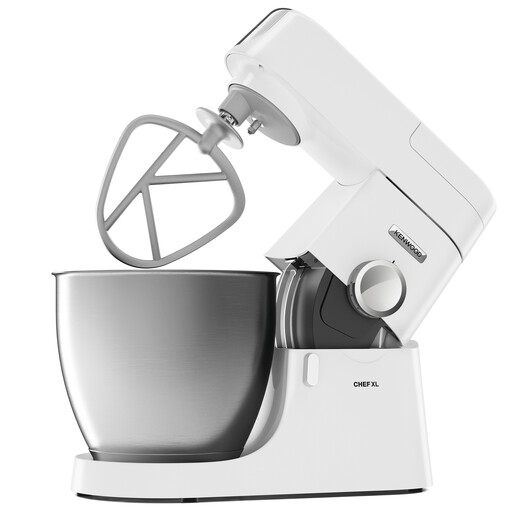
Kenwood Chef XL KVL4100W
A model to consider if you’re looking at a Kenwood Chef XL stand mixer for larger batches of batter. Check the bowl capacity, dimensions and included attachments for the exact model.
View at Joybuy
 No image available
Monsga SM100 stand mixer, 5 litres, 8 speed settings
An option if you want to compare a 5-litre bowl with a range of mixing attachments. The product name lists eight speed settings, a flat beater, whisk and dough hook.
The product name also mentions 1000 W peak power; don’t use this as a measure of when your yoghurt cake batter is mixed enough.
View at Joybuy
Frequently asked questions
How many cakes can I make in one batch?
That depends on the quantities in your recipe and the guidance for the exact model. The yoghurt cake recipe consulted makes about 10–15 slices per cake; you can’t directly convert a 3.8- or 5-litre bowl into a number of cakes.
Which beater should I use for yoghurt cake batter?
Follow your chosen recipe and stop when the batter is smooth. The recipe consulted specifies a whisk or a mixer with beaters; KitchenAid describes its flat beater as suitable for cake batter, but that doesn’t mean it’s essential for every recipe.
Can the bowl and whisk go in the dishwasher?
Check the cleaning instructions for each part. KitchenAid says that a wire whisk that isn’t made entirely of stainless steel isn’t dishwasher-safe, so don’t assume the same rule applies to every whisk or model.
Who can help if a stand mixer breaks down too soon?
If you buy as a consumer, you’re covered by the statutory guarantee as well as any manufacturer’s or retailer’s guarantee. ACM ConsuWijzer states that if a product is faulty under normal use, the seller must put it right free of charge. If you’re buying on behalf of an organisation, check which contractual terms apply.
What food safety rules apply to a coffee morning?
That depends on how the cake is provided. The NVWA says that food sold at an event must be prepared and stored safely and hygienically, including by private individuals. For unpackaged products that are sold or supplied, the NVWA describes ways to tell customers about allergens present; the NVWA also mentions institutions. So first establish whether the cake is being sold, supplied by an institution or shared by a private individual.


