
当日/次日达

品质保障

开启新人专享福利: 全场免邮 | 低至 2 折 | 免费试用 30 天 JoyPlus 会员
下载 Joybuy
A good set of mixing bowls should do more than look smart in your kitchen cupboard. Home cooks use bowls for batters, salads, marinades, meal prep and sometimes storing ingredients. But there are a few common buying pitfalls that can leave you with a bowl that’s less useful than you expected.
A low price or modern colour says little about whether a bowl is suitable for everyday use. Always check that the material is food-safe and what the bowl can be used for. A plastic mixing bowl can be handy for light mixing, but that doesn’t automatically mean it’s suitable for the freezer or oven.
If you’re choosing a dishwasher-safe mixing bowl, check the other parts too. A silicone non-slip base, lid or handle may have different care instructions from the bowl itself.
The stated capacity isn’t always the amount you can mix safely. Liquid is more likely to splash over the sides of a low, rounded bowl. You’ll also need extra room for stirring dough, whipping cream or mixing a large salad.
So check:
A mixing bowl with a non-slip base may stay in place more easily while you whisk, but it won’t stop an overfilled bowl from tipping over. A nesting set saves cupboard space, but check that the bowls fit neatly inside one another and that the handles don’t get in the way.
A stainless steel mixing bowl is usually lightweight, stands up to many kitchen tasks and is easy to clean. Stainless steel isn’t suitable for the microwave. Also check whether the bowl has a silicone base and whether the product information says it’s dishwasher-safe.
A plastic mixing bowl is often lighter and can be a good choice for families or children who like to help. Look for a BPA-free label and check separately whether the bowl is suitable for the microwave, fridge or freezer. For example, Curver Essentials models are listed as suitable for the microwave, fridge and dishwasher, but not the freezer or conventional oven.
Ceramic bowls can be used for serving or breakfast, but they’re usually heavier and less suited to intensive kneading. If you choose this material, always check the stated suitability for the oven, microwave and dishwasher.
For everyday mixing, a selection of sizes is often more useful than one large bowl:
A deeper shape helps when mixing runny batter. A wider bowl is handy for salads, marinating and washing vegetables.
A rolled rim makes a bowl more comfortable to hold. A mixing bowl with a handle is especially useful when you want to pour out batter. Check that the handle is firmly attached and that the bowl can still be stacked.
A silicone base can help prevent slipping and reduce the risk of scratches on your worktop. Even so, use the bowl on a flat surface and don’t fill it above the recommended level. Non-slip performance is a functional feature, not a guarantee that the bowl will stay completely still in every situation.
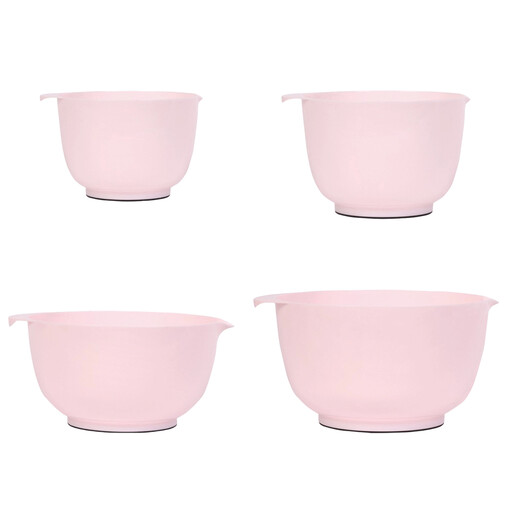
Why it suits this profile: A set of four bowls is handy for beginners who want to prepare several ingredients at once for baking, salads or meal prep.
The product name describes a stackable set with a non-slip base and reusable bowls. Before buying, check the exact capacity and dishwasher information.
Four pieces; stackable design; BPA-free according to the product listing; suitable for a range of food-preparation tasks.
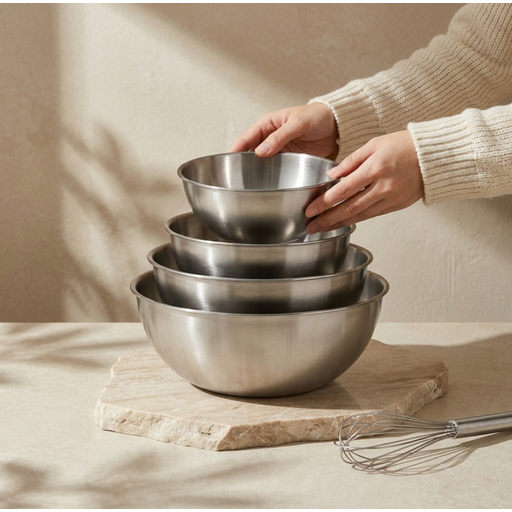
Why it suits this profile: This four-piece stainless steel set suits households looking for different sizes for washing, mixing, marinating and serving.
The set is made from 304 stainless steel and includes nestable bowls measuring 19, 22, 25 and 28 cm. You can see the sizes included in advance and get an idea of how much cupboard space you’ll need.
Four nestable bowls; smooth, rolled rims; dishwasher-safe according to the product information; not suitable for the microwave.
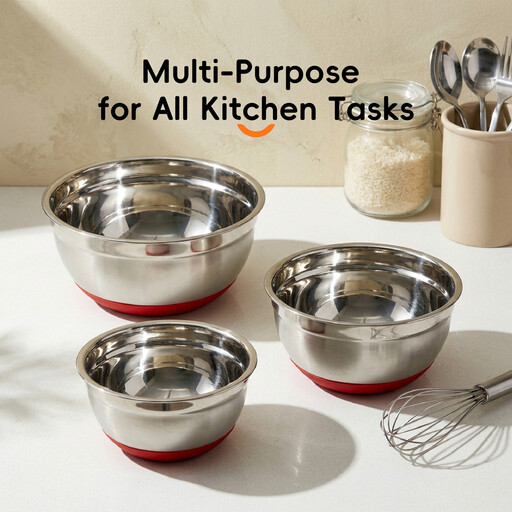
Why it suits this profile: This three-piece stainless steel set is designed for regular mixing, whisking, kneading, marinating and preparing salads.
The three bowls come in different sizes and have a red silicone base, according to the product description. They nest together, making them suitable for kitchens with limited cupboard space.
Sizes of 18, 20 and 24 cm according to the product specifications; non-slip base; dishwasher-safe; not suitable for the microwave or hob.
We’ve put together a complete, up-to-date list of products that meet these strict selection criteria and current European safety regulations.
A bowl of around 2.5 to 4 litres is often a practical choice for batter and dough. Choose a deeper shape if you’re using a whisk or mixer. For larger quantities, a bowl of 5 litres or more may be suitable, but check the recommended fill level.
No. Stainless steel is metal and shouldn’t go in the microwave. Only use a bowl for heating if the manufacturer explicitly says it’s suitable, as is the case with some plastic models. Don’t put a stainless steel bowl on a hob either, unless the product information specifically says you can.
Lifespan depends on the material, how often you use the bowl and how you care for it. A stainless steel bowl can last a long time with normal use, as long as you avoid harsh abrasive cleaners. Plastic may become scratched, discoloured or misshapen over time. Replace a bowl if it develops cracks, becomes badly misshapen or has damaged rims. Always check the manufacturer’s care instructions too.
