
Vandaag of morgen in huis

Kwaliteit gegarandeerd

Welkomstaanbiedingen ontgrendelen: GRATIS bezorging | Tot 80% korting | Gratis 30 dagen JoyPlus-proefperiode
Download de app
An ionic hair dryer could be worth considering if you often struggle with static or frizzy hair. However, the word ‘ionic’ alone tells you little about the overall experience. A hair dryer may advertise negative ions, but still be heavy, noisy or lacking in temperature settings.
So don’t focus on marketing claims alone. Pay attention to the airflow, temperature controls, weight, attachments and safety features. Read on to find out which features matter and which models suit different needs.
A higher wattage doesn’t automatically mean your hair will dry faster. The motor, airflow and shape of the air outlet also play a part. A powerful hair dryer with an efficient motor may be more practical than a heavier model with a high wattage but little else to recommend it.
Check whether the product information also gives an airflow speed, motor type or RPM. Details such as an airflow speed of 20 m/s or a brushless motor give you more to go on than wattage alone.
According to the product description, a hair dryer with negative ions may help reduce static. That doesn’t mean it repairs damaged hair or gives the same results for every hair type. Treat claims about how it works as information from the brand, rather than a guaranteed effect.
Some brands’ own research suggests that ions may reduce frizz or help enhance shine. Also check that the appliance has enough temperature settings, a cool-air button and a nozzle that suits your needs.
A model that promises fast drying on paper may be inconvenient if it’s heavy or noisy. For everyday use, a lightweight hair dryer, a well-balanced handle and a cord that’s long enough are often more important than an exceptionally high RPM.
If you have curly hair, you’ll also need different attachments from someone who mainly blow-dries straight hair. A hair dryer with a diffuser distributes airflow differently from a narrow styling concentrator.
A hair dryer with a brushless motor doesn’t have conventional carbon brushes. Product descriptions often associate this type of motor with high RPM, consistent airflow and a longer service life. Always check the full product specifications, though: RPM alone doesn’t tell you exactly how much air the appliance moves.
For long or thick hair, powerful airflow and multiple speed settings are useful. For fine hair, a lower setting is often more practical, as it gives you better control over the heat.
Ideally, choose a hair dryer with temperature controls and at least two speed settings. Three heat settings give you more control while drying. A cool-air button can help set your style, but still keep the dryer at a distance and keep the airflow moving.
Smart temperature measurement sounds appealing, but check exactly what the product information says. For example, the CONFU F10 lists Dual NTC temperature control and real-time measurement, according to its product information. This is a technical feature, not a guarantee that it will dry every hair type without risk.
A quiet hair dryer can be useful in a household with children or housemates, or if you get ready early in the morning. Check whether a noise level in decibels is given, but bear in mind that measurement conditions can vary.
These attachments may be useful for everyday use:
Never use a hair dryer near water, block the air intake or put it away before it has cooled down. Also check that the plug is suitable for Dutch sockets and that the manufacturer provides clear safety information.
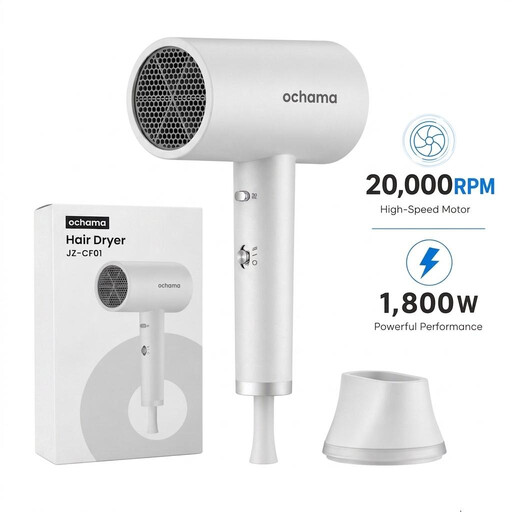
Why it suits this profile: Weighing around 480 g and supplied with a nozzle, this model is suitable for everyday use at home or in student accommodation.
The product specifications list more than just 1800W: they also give an approximate weight of 480 g, 20,000 RPM and temperature and speed settings. This makes it easier to assess than a model described by wattage alone.
Around 480 g; 1800W; nozzle for focused styling; suitable for home or student accommodation.
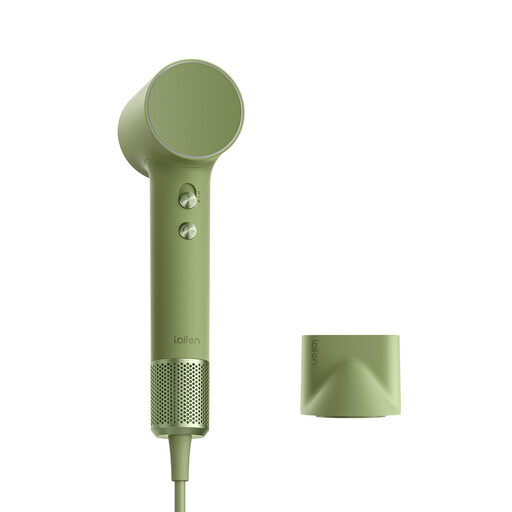
Why it suits this profile: Its mini design and brushless motor make this a good fit for anyone looking for a compact, quick and relatively quiet hair dryer for home or travel.
The product name specifies the motor type, 110,000 RPM, negative ions and a travel-friendly design. Before buying, check the product page for the available temperature settings and attachments.
Brushless motor; 110,000 RPM according to the product listing; compact design; ionic function.
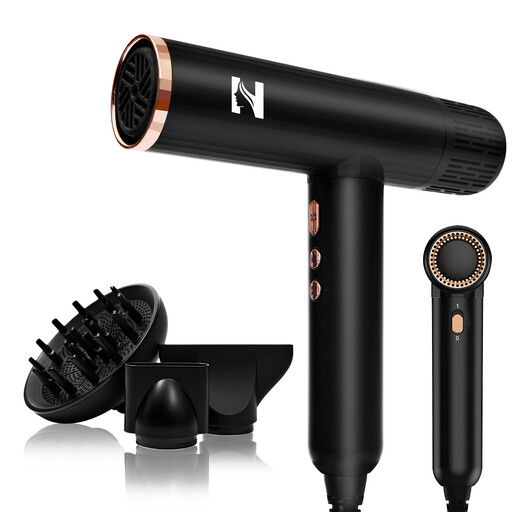
Why it suits this profile: This model is designed for people with long or curly hair who want to combine a diffuser and multiple settings with a long cord.
The description lists three speed settings, four temperature settings, two concentrators and a diffuser. This means you’re not limited to one fixed hot-air setting.
1900W; 110,000 RPM according to the product information; diffuser; 3 speeds and 4 temperature settings; around 0.57 kg.
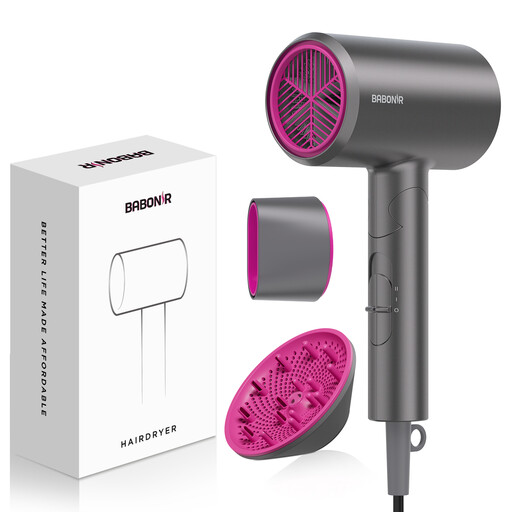
Why it suits this profile: The foldable handle and listed weight of 330 g make it practical for a weekend bag, while the diffuser is useful for curls and volume.
This model combines a diffuser and concentrator with 3 heat settings and 2 speeds. So you don’t have to give up styling options just because you’re travelling.
330 g according to the product listing; foldable handle; diffuser and concentrator; 1800W.
We’ve put together a complete, up-to-date list of products that meet these strict selection criteria and current European safety regulations.
It mainly depends on the airflow and attachment. A diffuser is generally more useful for curls than a narrow concentrator. Also choose a low speed and moderate temperature. According to a brand’s own research, ionic technology may help reduce static, but results vary depending on your hair texture and styling method.
This varies by model and measurement method. Some product descriptions, for example, state less than 65 dB or around 57 dB. Treat these figures as a guide and check whether the noise level is actually included in the specifications. A brushless motor and sound insulation may help make a hair dryer quieter, but they won’t make it silent.
Energy consumption depends on the wattage and how long you use the appliance. An 1800 W model theoretically uses 1.8 kWh when used for one hour, but hair dryers are usually switched on for much less time. A fast-drying hair dryer may reduce the total time you need to use it. So consider the combination of power, airflow and drying time rather than wattage alone.
