
Vandaag of morgen in huis

Kwaliteit gegarandeerd

Welkomstaanbiedingen ontgrendelen: GRATIS bezorging | Tot 80% korting | Gratis 30 dagen JoyPlus-proefperiode
Download de app
An ionic hairdryer may sound appealing if you want to reduce static or frizz, but the term does not tell you everything about everyday use. For example, a hairdryer with a high wattage is not automatically faster. A lightweight model can also be awkward to use if the controls, cable or nozzle do not suit your routine.
When comparing models, pay particular attention to these three common pitfalls:
For everyday use, many models offer between 1200 and 2400 W. A powerful 1800 W hairdryer may be suitable for thicker or longer hair, while a 1200 W travel hairdryer is mainly practical for short hair and use on the go.
The wattage partly determines how much energy the appliance uses. The final drying time is also affected by:
A high rotational speed, such as 20,000 or 110,000 RPM, is a motor specification. It is not, by itself, a guarantee of a shorter drying time. Check whether the manufacturer also states the airflow, noise level and heat settings.
A good hairdryer should be adjustable to suit your hair and styling goals. Two speeds and two temperature settings are enough for straightforward drying. For greater control, three speeds, three or four heat settings and a cool-shot button are more practical.
Use a lower temperature when you want to dry your hair gently or are using a diffuser. A cool-air setting can help to finish a style. Do not hold the hairdryer too close to your hair and keep it moving. No technology makes prolonged exposure to very hot air advisable.
A lightweight hairdryer weighing around 330 to 480 grams can be comfortable if you have long hair or spend a long time styling it. Also pay attention to the balance of the handle. A heavier model can still feel comfortable when the weight is well distributed.
A hairdryer with a concentrator nozzle directs the airflow at a narrow section and is useful for straightening as you dry. A hairdryer with a diffuser spreads the air over a larger area and is practical for curls and added volume. Check whether the accessories are magnetic, rotatable or removable, and whether they stay securely in place.
For travelling, a folding handle and compact body are useful. If you travel outside Europe, you should also check whether the model is suitable for different mains voltages. A European model rated at 220–240 V is not automatically suitable for use worldwide.
The following selection is based on verifiable product information, such as power, weight, settings and included accessories. Claims made by brands about ions, temperature control or hair care are not presented here as guaranteed results.
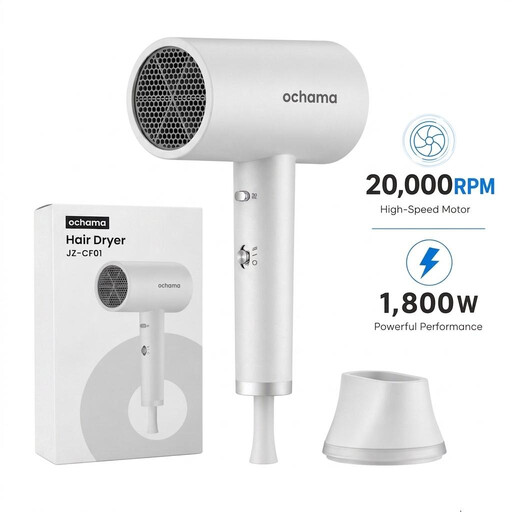
Why it suits this profile: This model combines 1600–1800 W, a weight of around 480 grams and a concentrator nozzle. That makes it a straightforward choice for use at home, in student accommodation or for everyday basic styling. According to the product description, it features ionic technology.
The specifications state both the power and the weight. You therefore do not have to rely solely on a general claim about fast drying.
Around 480 g, 1.8 m cable, 1800 W maximum power and a concentrator nozzle included.
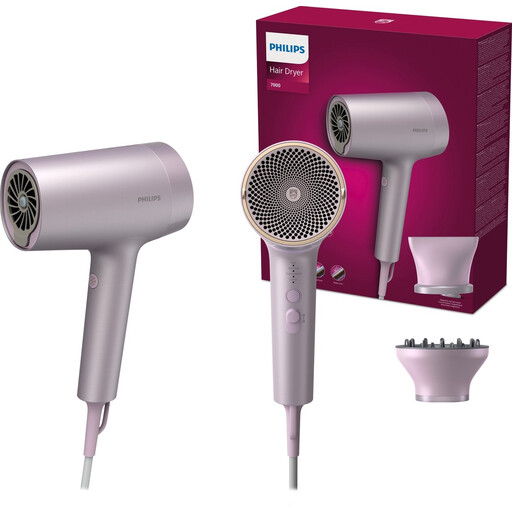
Why it suits this profile: The Philips 7000 Series offers 1800 W, a diffuser and temperature control that, according to Philips, adjusts automatically. If you value controlled drying and styling for different hair types, you get several functions in one appliance.
The choice is not based on ions alone: a diffuser, warm and cool air function and temperature control are also listed. According to Philips’ own research, the temperature is measured and adjusted during use.
1800 W, diffuser, Mineral-ion technology according to Philips and information on a minimum two-year statutory warranty.
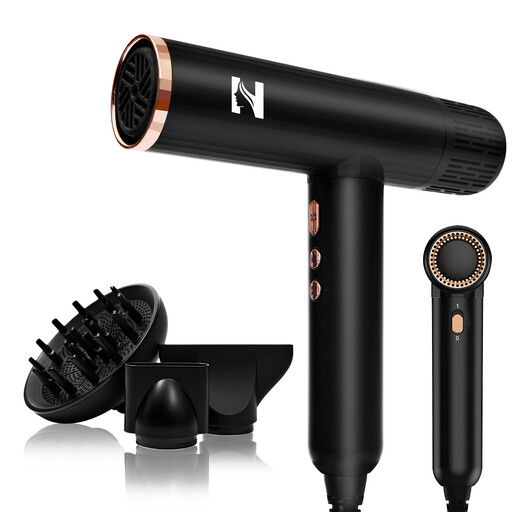
Why it suits this profile: This model is aimed at users who dry their hair frequently or style curly hair. The product information lists 1900 W, a brushless motor, three speeds, four temperature settings, two concentrator nozzles and a diffuser.
The extensive range of settings reduces the need to use maximum heat all the time. The diffuser is also a specific accessory for curls, rather than just a general styling claim.
1900 W, 110,000 RPM according to the product specification, 0.57 kg, three speeds and three styling attachments.
We have put together a complete, up-to-date list of products that fully meet these strict selection criteria and the applicable European safety regulations.
According to product information from various brands, negative ions may help to reduce static electricity and frizz. The visible effect varies from person to person. For fine, straight, thick or curly hair, the right temperature, airflow and drying technique remain important. For curls, a diffuser is often more relevant than the ionic function alone.
First, pat your hair dry with a towel and keep the hairdryer moving while you use it. Start with a lower heat setting and increase it only when necessary. Hold the hairdryer around 10 to 20 centimetres away and use the diffuser on a moderate setting. Also check that the air inlet is clear; a blocked filter can affect performance and safety.
Energy consumption depends on the wattage and how long the appliance is used. An 1800 W hairdryer running for ten minutes theoretically uses 0.3 kWh. Calculate the actual cost by multiplying this consumption by your current electricity tariff. A fast hairdryer may require more power per use, but it may also run for less time. So consider your complete drying routine rather than looking at the wattage alone.
