Yoghurt makers at Joybuy
This selection includes yoghurt makers for overnight preparation with individual jars, as well as models with larger containers for making a batch to share.
 No image available
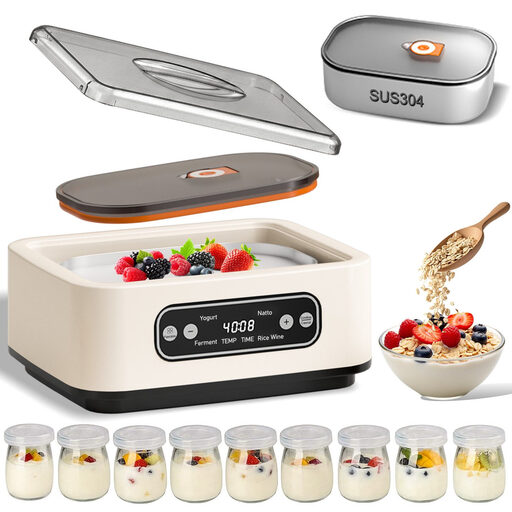
Yoghurt maker with 1.6 l inner container, SUS304, temperature and timer controls, and 9 glass jars
The combination of an inner container and individual glass jars could suit anyone considering both making a batch to share and dividing it into portions.
The product name lists a 1.6 l inner container, temperature and timer controls, an OLED display and nine borosilicate glass jars.
View at Joybuy
 No image available
FOHERE yoghurt maker with 8 jars (1,440 ml), digital temperature control and 48-hour timer
The eight individual jars are useful if participants want to make their yoghurt in separate portions.
The product name lists digital temperature control and a 48-hour timer.
View at Joybuy
 No image available
Rommelsbacher JG 40 yoghurt maker
A good fit for workshops where participants make individual portions and the host wants to set the running time in advance.
Rommelsbacher lists eight 150 ml glass jars, a timer of up to 18 hours and automatic shut-off. According to the manual, the yoghurt must then be kept in the fridge for at least four hours.
View at Joybuy
 No image available
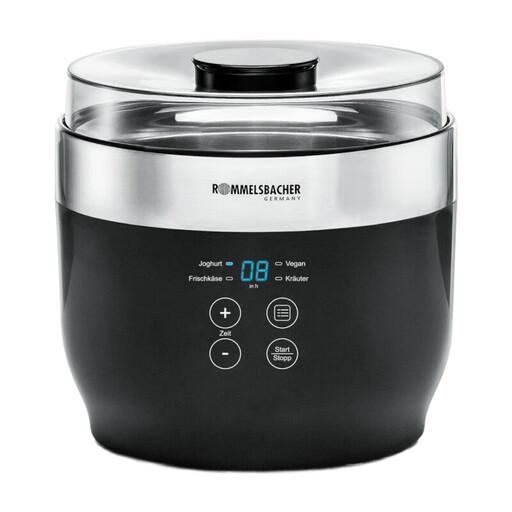
Rommelsbacher JG 80 yoghurt and cream cheese maker
The combination of larger containers and smaller cups suits a shared batch, while still giving you the option to make individual portions.
Rommelsbacher lists four 125 ml ceramic cups and two 1.2-litre glass containers with lids. The manufacturer describes programmes for different recipes for the JG 80.
View at Joybuy
Frequently asked questions
Can I leave yoghurt in the switched-off yoghurt maker until the next morning?
Set the finish time so someone can chill the yoghurt once it’s ready; automatic shut-off doesn’t mean it will be cooled. The Rommelsbacher JG 40 manual says to put the yoghurt in the fridge for at least four hours once it’s ready. The Netherlands Nutrition Centre recommends keeping chilled dairy products at 4 °C.
How should I prepare the jars and ingredients?
Wash your hands and use clean surfaces and utensils. Ideally, use pasteurised or sterilised milk; the Netherlands Nutrition Centre recommends boiling raw farm milk before use. A yoghurt maker doesn’t replace this step.
Can I use the same setting for every type of yoghurt?
No. Follow the settings for the specific recipe and ingredients. For example, Rommelsbacher lists 42 °C for natural yoghurt and 38 °C for the vegan or lactose-free setting on the JG 80. The programme description alone doesn’t guarantee the same result for every recipe.
What should I check about servicing and the guarantee?
Check which jars are included and read the retailer’s and manufacturer’s terms and conditions. According to the Dutch government, there is no fixed statutory guarantee period in the Netherlands. The product’s expected lifespan is relevant, and you should contact the retailer if something goes wrong. A manufacturer’s guarantee is an additional benefit.
What food regulations might apply if I serve yoghurt at a paid workshop?
This depends on the activity and whether food is being sold. The Netherlands Food and Consumer Product Safety Authority (NVWA) explains that businesses must register if they sell food several times a year. Business.gov.nl explains the requirement to draw up a food safety plan based on HACCP or use an approved hygiene code. Check how your workshop is organised and confirm the applicable requirements using the NVWA’s guidance; this is not a general requirement for every private cookery workshop.


