First, measure the space on your worktop and in your fridge. A compact appliance with larger tubs and one with individual portion pots solve different storage challenges. A timer with automatic shut-off is useful if you want to plan the preparation in advance; extra programmes matter most if you want to try making other things. Also check that the specific model carries the CE mark.
Who is a yoghurt maker suitable for?
Breakfast maker with limited worktop space
Wants to check that the appliance will fit on the worktop first. Compare the footprint of a model with larger tubs with that of one with individual pots. Severin and Rommelsbacher provide dimensions for the models mentioned.
Planner who prepares individual breakfast portions
Wants to make several portions at once and keep them chilled afterwards. Check the number and capacity of the pots, the timer and whether there’s an automatic shut-off; Rommelsbacher lists these features for the JG 40.
Yoghurt-making experimenter
Wants to try making other things too, so programmes designed for this are more useful than extra pots. Severin lists five automatic programmes for the JG 3521; Rommelsbacher lists four programmes for the JG 80.
What should you look for when choosing?
First, measure the space for the appliance and the storage space for the filled pots or tubs. Then choose a capacity and controls that suit your breakfast routine.
| What to consider |
What should you check? |
Who is this important for? |
| Worktop and fridge space |
Measure the appliance’s width and depth, and think about where you’ll store the filled tubs or pots in the fridge. |
If I have limited worktop space, I also want to know how much room the contents will take up later. Around 36% of consumers prioritise space for the appliance and storage. |
| Portions and capacity |
Compare the number of pots and the capacity of each with the capacity of any larger tubs; these are different ways of portioning yoghurt. |
If I want to portion out breakfast in advance, I look at the number and size of the containers. Around 29% of consumers prioritise portioning. |
| Planning ahead |
Check the timer and automatic shut-off on the specific model. Allow time to put the yoghurt in the fridge once it’s ready, too. |
If I want to plan preparation around my morning routine, an adjustable timer is useful. Around 21% of consumers prioritise planning. |
| Making other things |
Check which programmes the model actually has and follow the instructions for each one. |
If I want to try making things other than plain yoghurt, I check which programmes are designed for that. Around 14% of consumers prioritise having options to experiment. |
Common buying mistakes
-
Comparing only the appliance dimensions
A small appliance doesn’t necessarily take up little space once you’ve filled the tubs or pots it comes with.
Measure the available width and depth, and decide in advance where you’ll put the filled containers.
The pots or tubs will also need space of their own in the fridge or cupboard.
-
Assuming automatic shut-off means the yoghurt is chilled
Automatic shut-off doesn’t replace chilled storage. The Voedingscentrum describes dairy products as perishable.
Plan to transfer the yoghurt to the fridge, too; don’t let the shut-off function replace this step.
-
Assuming a product title confirms what’s included
A Joybuy page with JG 80 in the title describes a freezer basket with model number IB 05 elsewhere on the page.
Before ordering, compare the title, model number, specifications and included parts on the same product page.
If the details don’t match, you could end up ordering an accessory instead of the yoghurt maker you wanted.
Brands and models to consider
Rommelsbacher
The JG 80 combines a compact stated footprint with larger tubs, while the JG 40 is designed for individual portions.
- Rommelsbacher lists four programmes for the JG 80, and a timer of up to 18 hours with automatic shut-off for the JG 40.
- According to the manufacturer, the JG 40 is 34,5 cm wide. Measure the available space before choosing this model.
Severin
The JG 3518 has simple controls and no display, while the JG 3521 adds automatic programmes.
- Severin gives the JG 3518 a footprint of 24 × 24 cm and lists dimensions of 23,8 × 25,4 cm for the JG 3521.
- Compare the stated width and depth with the space on your worktop; the word ‘compact’ is no substitute for checking the measurements.
Moulinex
The Yogurteo YG231E32 is described as having individual glass pots and a timer.
- Moulinex lists seven 160 ml pots, a timer of up to 15 hours and automatic shut-off.
- Check that the version on offer and its delivery arrangements suit your needs.
Steba
The JM 3 is designed for anyone looking for glass pots and an adjustable temperature.
- Steba lists eight 180 ml glass pots and an adjustable temperature range of 20–55 °C.
- The stated width is 36,5 cm, so measure the available worktop space first.
Lagrange
The Ligne 459002 is described as having larger individual glass pots.
- Lagrange lists nine 220 ml pots, a timer of up to 15 hours and automatic shut-off.
- Check the dimensions of the specific version before deciding whether it will fit on your worktop.
Yoghurt makers at Joybuy
These models are suited to anyone who wants to make individual breakfast portions or is looking for a compact yoghurt maker with larger tubs.
 No image available
Rommelsbacher yoghurt maker JG 40
Ideal if you want to portion yoghurt into individual servings for breakfast in advance.
Eight 150 ml glass pots; timer adjustable from 1 to 18 hours and automatic shut-off, according to the product description.
Refrigerate the sealed pots after fermentation. Also check that the specific version carries the CE mark; the Dutch government states that electrical appliances placed on the market in the EU must have it.
View at Joybuy
 No image available
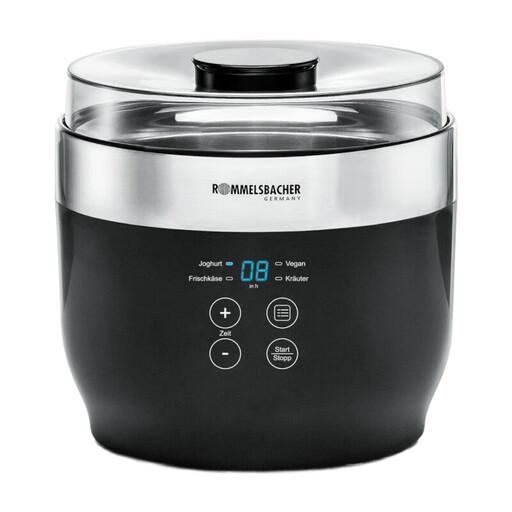
Rommelsbacher yoghurt and cream cheese maker JG 80
Ideal if you want a compact stated footprint and the option of using small portion cups or larger tubs.
The manufacturer gives a footprint of 19,5 × 19,5 cm. The included containers are four 125 ml ceramic cups and two glass tubs, each with a capacity of 1,2 litres; Rommelsbacher lists four programmes.
Also check that the specific version carries the CE mark; the Dutch government states that electrical appliances placed on the market in the EU must have it.
View at Joybuy
Frequently asked questions
Do you need a yoghurt maker to make yoghurt at home?
No, you can make yoghurt at home without a yoghurt maker. A recipe published by Rutger bakt explains how to make yoghurt with milk and a yoghurt starter; an appliance provides a dedicated space and controls during preparation, but it doesn’t replace the ingredients.
Can I use raw milk directly in a yoghurt maker?
Pasteurised milk is preferable. The Voedingscentrum advises boiling raw milk before drinking it or using it in a dish; fermentation doesn’t replace this step.
Where should I store the yoghurt once it’s ready?
Refrigerate the yoghurt once it’s ready, as dairy products are perishable. The Voedingscentrum gives 5–7 days at 4 °C as a general guide for opened full-fat yoghurt; this doesn’t guarantee the shelf life of every homemade batch.
What can I do if the appliance breaks down quickly?
For consumer purchases in the Netherlands, statutory rights apply alongside any manufacturer’s warranty. If the product doesn’t meet what you could reasonably expect under normal use, the seller must offer an appropriate free remedy, according to ACM ConsuWijzer; this doesn’t automatically mean a fixed period of exactly two years.
Which safety marking should I check on an electrical appliance?
Check that the specific version carries the CE mark. The Dutch government states that electrical appliances placed on the market in the EU must have this marking.


