Who is this choice relevant to?

Host with a crowd to feed

Wants to make enough yoghurt for the gathering in as few batches as possible. Lacor lists a capacity of 2.0 litres for the Maxi 69243, while Rommelsbacher specifies a maximum of 1.2 litres of natural yoghurt per batch for the JG 80.

Planner

Plans to make yoghurt overnight and wants to know when the programme will stop, so it can be chilled afterwards. Lacor and Rommelsbacher list a timer and automatic shut-off for various models. The Netherlands Nutrition Centre recommends keeping dairy products chilled.

Portion and variety seeker

Wants to portion yoghurt in advance or make a different texture. Rommelsbacher and Severin offer models with individual jars, while Rommelsbacher and Ariete also list options for straining or draining yoghurt.

What should you look for when choosing?

One large bowl

Suitable if: you mainly want to make one larger batch for the gathering. Lacor lists a capacity of 2.0 litres for the Maxi 69243, with an adjustable timer and automatic shut-off.

Trade-off: you’ll need to serve the yoghurt yourself and make room to store it chilled. The stated capacity doesn’t equate to a set number of portions.

Individual portion jars

Suitable if: you want to portion the yoghurt in advance. According to the manufacturer, the Rommelsbacher JG 40 comes with eight 150 ml jars, while the Severin JG 3518 has seven 150 ml jars.

Trade-off: the total amount per batch is smaller than with a 2.0-litre bowl. If you plan to use it overnight, check the controls and instructions for your chosen model too.

More ways to prepare yoghurt

Suitable if: you want to strain yoghurt or try other preparations as well as making regular yoghurt. Rommelsbacher lists four programmes and a strainer for the JG 80. Ariete lists a filter basket for the Yogurella 0621/10.

Trade-off: extra features don’t automatically mean more yoghurt per batch. The JG 80 is specified for a maximum of 1.2 litres of natural yoghurt per batch, even with its two included containers.

What to consider What to look for Who is this important to?
Amount per batch Compare the stated yield per batch with your portion plan; don’t just look at the number of containers included. If I’m making yoghurt for family, I want to know whether one batch will be enough. Around 36% of consumers prioritise having enough capacity per batch.
Overnight planning Check the adjustable timer, automatic shut-off and instructions. Plan when you’ll be able to chill the yoghurt once it’s ready. If you’re leaving the yoghurt to make overnight, you’ll want to time the finish so you can put it in the fridge. Around 29% of consumers make this a priority.
Portioning and storage Check the number and capacity of the jars, whether lids are included and whether you have room in the fridge. If I want to store yoghurt in individual portions in advance, separate jars are practical. Around 21% of consumers prioritise individual portions.
Other textures or preparations Check whether the programme, strainer or filter you want is included with the model you’ve chosen. If you enjoy straining yoghurt or want to try a different preparation, the right accessories can help. Around 14% of consumers prioritise this variety.

Common pitfalls

  • Assuming two containers double the batch capacity

    For the Rommelsbacher JG 80, the manufacturer lists two containers, each with a capacity of 1.2 litres, but specifies a maximum of 1.2 litres of natural yoghurt per batch. So the capacity of the included containers doesn’t tell you how much yoghurt the appliance can make at once.

    Compare the stated yield per batch with the amount you need for your gathering.

  • Assuming automatic shut-off keeps yoghurt chilled

    Switching off ends the programme, but it doesn’t chill the yoghurt. The Netherlands Nutrition Centre recommends keeping dairy products chilled and gives 4 °C as the fridge temperature for fresh milk products.

    Plan the preparation so you can move the yoghurt to the fridge once it’s ready, following the recipe and the appliance instructions.

  • Assuming every model from a brand has the same features

    The Rommelsbacher JG 40 and JG 80 come with different jars, containers and programmes. Accessories or controls listed for one model won’t necessarily be included with another.

    Check the full model number and what’s included in the box before you choose.

Brands to compare

Lacor

The Maxi 69243 is worth comparing if you want to make one larger batch.

  • Lacor lists a 2.0-litre capacity, a timer and automatic shut-off.
  • The stated container capacity doesn’t tell you how many individual portions you can serve; individual jars aren’t confirmed as an included accessory.

Rommelsbacher

The JG 40 is designed for individual jars, while the JG 80 offers several programmes and a strainer.

  • According to Rommelsbacher, the JG 40 comes with eight 150 ml jars and switches off automatically when the timer ends. The JG 80 has four programmes.
  • The JG 80 is specified for a maximum of 1.2 litres of natural yoghurt per batch; its two included containers don’t increase the batch yield.

Severin

The JG 3518 is a jar model worth comparing if seven portions are enough.

  • The Dutch manufacturer’s website lists seven 150 ml jars and compatible replacement jars.
  • Don’t assume it has a display or features found on other Severin models; check the controls on the JG 3518 itself.

Ariete

The Yogurella 0621/10 is a compact bowl option for anyone who wants to drain yoghurt.

  • Ariete lists 1-litre containers and a filter basket for yoghurt.
  • This information doesn’t confirm a larger amount per batch or automatic shut-off.

Yoghurt makers on Joybuy

This selection includes yoghurt makers with individual jars for separate portions, as well as a model with several programmes and a strainer. Compare the capacity per batch and the timer with your own plans.
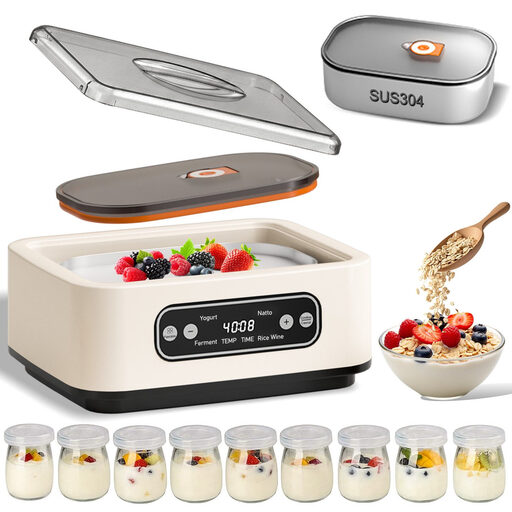
Yoghurt maker with 1.6-litre inner container and 9 glass jars

Yoghurt maker with 1.6-litre inner container and 9 jars

A good fit if you want to portion yoghurt into individual jars in advance. The product information lists nine 100 ml glass jars, an adjustable timer from 1–99 hours and automatic shut-off.

The yoghurt will still need chilling once it’s ready.

View on Joybuy

FOHERE yoghurt maker with 8 jars

FOHERE yoghurt maker with 8 jars (1,440 ml)

Suitable for portioning yoghurt in advance. The product name lists eight jars with a total capacity of 1,440 ml, digital temperature control and a timer of up to 48 hours with automatic shut-off.

Automatic shut-off won’t chill the yoghurt, so remember to store it in the fridge after preparation.

View on Joybuy
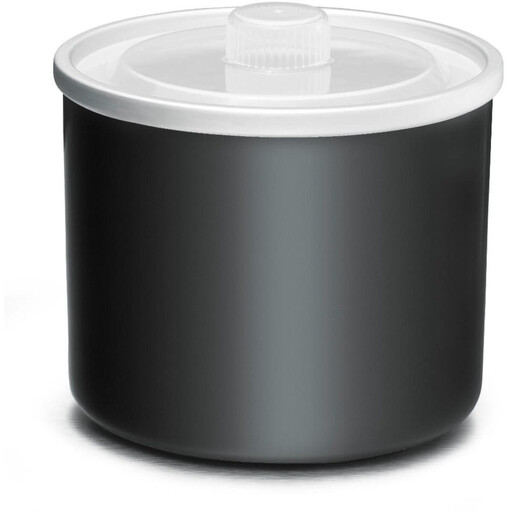
Rommelsbacher JG 80 yoghurt and cream cheese maker

Rommelsbacher JG 80 yoghurt and cream cheese maker

Worth considering if you want to try different preparations: Rommelsbacher lists four programmes and a strainer. The manufacturer specifies a maximum of 1.2 litres of natural yoghurt per batch; the two included containers don’t double that yield.

The product information also lists a timer and automatic shut-off. The yoghurt will still need chilling once it’s ready.

View on Joybuy

Rommelsbacher JG 40 yoghurt maker with 8 jars

Rommelsbacher JG 40 yoghurt maker

A good fit if you want to portion yoghurt in advance. Rommelsbacher lists eight 150 ml glass jars, a timer of up to 18 hours and automatic shut-off.

You may need to make an extra batch if you need a larger amount. The yoghurt will still need chilling once it’s ready.

View on Joybuy

Frequently asked questions

Can yoghurt stay in the appliance after automatic shut-off until it’s time to serve?

No. Switching off isn’t the same as chilling. Plan the preparation so you can move the yoghurt to the fridge once it’s ready. The Netherlands Nutrition Centre recommends keeping dairy products chilled and gives 4 °C as the fridge temperature for fresh milk products.

Which milk and hygiene practices matter when making yoghurt?

Use clean hands, surfaces and kitchen utensils, and follow the recipe and the appliance instructions. According to the Netherlands Nutrition Centre, supermarket milk is pasteurised or sterilised; always boil raw milk from a farm before use.

Do electric yoghurt makers have to meet product regulations in the Netherlands?

Yes. The Netherlands Food and Consumer Product Safety Authority (NVWA) says CE marking is compulsory for electrical products and gives kitchen appliances as an example. A listing in an online shop doesn’t, on its own, prove that a particular item meets all applicable requirements.

Does my statutory guarantee automatically end after two years?

No, not automatically. ACM ConsuWijzer distinguishes between the statutory guarantee and any manufacturer’s or seller’s guarantee. If a product used normally breaks down sooner than you could reasonably expect, the seller is responsible for providing an appropriate solution.
