Choose a spot that has room for both the yoghurt maker and the prepared portions. Individual jars are handy for storing separate breakfasts, while a large container may take up more fridge space. A timer with automatic shut-off helps you plan the preparation, but it won’t cool the yoghurt; once it’s ready, it needs to be refrigerated. For electric models, also check the applicable CE marking: according to the NVWA, this is required for electrical equipment covered by the relevant regulations.
Who is a yoghurt maker suitable for?
Student with limited kitchen space
Wants to make yoghurt at home, but needs to consider worktop space, storage and a shared fridge. Severin provides model dimensions and portion sizes; the Voedingscentrum advises keeping chilled dairy products refrigerated.
Time-poor breakfast planner
Wants to prepare portions in advance and is considering the difference between individual jars, a timer and automatic shut-off. Rommelsbacher lists these features for the JG 40.
Maker who likes to experiment
May want to make kefir, cream cheese or another type of yoghurt as well as plain yoghurt, and checks which recipes and ingredients are supported by the chosen model. Rommelsbacher and Lékué describe different options.
What should you look for when choosing one?
Start by checking there’s room for the maker and the filled jars or containers. Then decide whether you need a timer, individual portions or extra preparation programmes.
| What to consider |
What should you check? |
Who is this most important for? |
| Space and batch size |
Measure the space for the appliance and the filled jars. According to Severin, the JG 3518 measures 12,8 × 24 × 24 cm and comes with seven 150 ml jars. |
If I have limited worktop space or share a fridge, I don’t want to make more yoghurt than I can store. Around 33% of consumers prioritise space and batch size. |
| Individual breakfast portions |
Check how many jars and matching lids are included, and whether there’s room to store them in the fridge. The Voedingscentrum advises storing chilled milk products at 4 °C. |
If you want to portion out breakfast for several days, jars that can be stored separately are useful. Around 27% of consumers prioritise portion sizes. |
| Planning the preparation |
Check the exact model to see whether it has a timer and automatic shut-off. According to Rommelsbacher, the JG 40 has a timer of up to 18 hours and automatic shut-off; the yoghurt still needs to be chilled afterwards. |
If I want to plan preparation around my daily routine, I look for a timer and automatic shut-off. Around 20% of consumers prioritise planning. |
| Other preparations |
Check the programmes and recipes for the specific ingredients you want to use. Rommelsbacher describes programmes for yoghurt and cream cheese, among other things, for the JG 80; Lékué describes a set for making yoghurt and kefir. |
If you want to try making things other than plain yoghurt, check that the instructions are suitable. Around 13% of consumers prioritise variety. |
| CE marking |
According to the NVWA, CE marking is required for electrical equipment covered by the Low Voltage Directive, with a rated AC voltage of 50 to 1.000 V. Check the marking on the specific electrical appliance. |
If I’m buying an electrical appliance, I want to be able to check which markings it carries. Around 7% of consumers prioritise product marking. |
Common buying mistakes
-
Only considering the empty yoghurt maker
The filled jars or containers will also take up space in a shared fridge. Models also differ in the number of jars they include and their capacity.
Choose a batch size that suits how much yoghurt you eat for breakfast and the space you have available to store it.
-
Confusing automatic shut-off with cooling
According to the manufacturer, the automatic shut-off on the Rommelsbacher JG 40 ends the programme, but it doesn’t cool the yoghurt.
Remember to plan when you’ll put the prepared yoghurt in the fridge, too.
-
Assuming an extra programme works with every ingredient
A programme for, say, a plant-based yoghurt alternative doesn’t automatically mean it’s suitable for every drink or culture.
Before buying, check the recipe for the specific drink and culture you want to use.
Brands to consider
Severin
The JG 3518 is an electric yoghurt maker with seven 150 ml glass jars. Severin also lists compatible replacement jars.
- Severin describes the lids as leak-proof.
- Check the features of the exact model before expecting a timer or automatic shut-off.
Rommelsbacher
According to the manufacturer, the JG 40 has eight portion jars and a timer; the JG 80 has large containers and separate programmes. These are different models with different designs.
- Rommelsbacher lists automatic shut-off for the JG 40 and four programmes for the JG 80.
- Features of one model don’t automatically apply to another, and manufacturer information isn’t an independent performance test.
Steba
According to Steba, the JM 2 is designed for larger batches in individual portions, with twelve 0,2 l glass jars and a total capacity of 2,4 l.
- Steba lists a timer with shut-off at the end of the programme.
- Allow for the space the filled jars will take up, and choose an amount that suits how much you use.
Lékué
The Kefir & Yogurt Maker is a non-electric set for making yoghurt and kefir.
- Lékué describes the set as requiring no electricity during fermentation.
- Lékué’s yoghurt recipe involves heating milk in a microwave first, so non-electric doesn’t mean every preparation step can be done without a heat source.
Yoghurt makers on Joybuy
This selection focuses on electric yoghurt makers with individual portion jars, or a combination of portion cups and larger containers.
 No image available
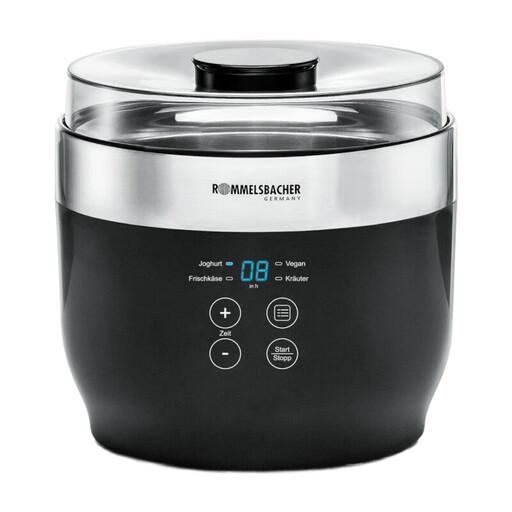
Rommelsbacher JG 40 yoghurt maker
Ideal if you want to divide yoghurt into individual breakfast portions in advance.
Eight 150 ml glass jars with lids; timer adjustable from 1 to 18 hours and automatic shut-off, according to Rommelsbacher. Dimensions: 31,5 × 17,5 × 12,5 cm.
The yoghurt still needs to be chilled once it’s ready.
Joybuy
 No image available
Rommelsbacher JG 80 yoghurt and cream cheese maker
Ideal if you want to combine portion cups with larger containers and try making other things.
The listed set includes four 125 ml cups, two 1,2 l glass containers and a strainer. Rommelsbacher describes four programmes, including programmes for yoghurt and cream cheese.
The two large containers will need space in a shared fridge; check the model’s recipes for the ingredients you want to use.
Joybuy
Frequently asked questions
How should I store yoghurt portions after preparation?
Use clean hands, surfaces and utensils, and refrigerate the prepared yoghurt. The Voedingscentrum recommends keeping chilled milk products in a fridge at 4 °C. The storage period given by the Voedingscentrum for opened full-fat yoghurt isn’t automatically a guaranteed shelf life for every homemade batch.
Do I still need to heat the milk when using a non-electric yoghurt set?
Lékué’s yoghurt recipe involves heating the milk in a microwave first, then cooling it before adding the culture. Follow the instructions for your chosen set and ingredients; ‘non-electric’ doesn’t mean every preparation step can be done without a heat source.
Is CE marking required for an electric yoghurt maker?
According to the NVWA, CE marking is required for electrical equipment covered by the Dutch Low Voltage Directive, with a rated AC voltage of 50 to 1.000 V. Check the marking on the specific electrical appliance.
Am I automatically entitled to exactly two years’ statutory guarantee in the Netherlands?
No. According to the Dutch government, there is no fixed statutory guarantee period: you’re entitled to a product that meets the standards you can reasonably expect. If there’s a fault, contact the seller; a manufacturer’s guarantee or an additional guarantee is separate.


