
Workshop host making lots of smoothies
Wants to have enough yoghurt ready for the planned smoothies. Match the amount you need to the stated capacity per batch.


Choose based on how much yoghurt you need per batch: a large container is handy if you want to scoop out enough for several smoothies, while individual pots work well for serving participants separately. Also check the preparation time, which starter and type of milk are suitable, and how much fridge space you have. A yoghurt maker ferments the yoghurt, but doesn’t chill it ready to serve.
Wants to have enough yoghurt ready for the planned smoothies. Match the amount you need to the stated capacity per batch.
Wants to divide or store yoghurt by participant, so checks the number and capacity of the pots. Models from brands including Severin and Rommelsbacher come with different pot configurations.
Wants to use different ingredients and checks which programmes and starters are suitable for the recipes they’ve chosen. For example, Rommelsbacher lists separate programmes for natural, vegan and lactose-free yoghurt on the JG 80.
First, work out how much yoghurt you need and how you want to serve it. Then check that the preparation fits your workshop schedule and the recipes you plan to make.
| What to consider | What to look for | Who should pay particular attention? |
|---|---|---|
| Amount per batch | Work out participants × yoghurt per smoothie and compare the total with the capacity per batch, not the combined capacity of the containers supplied. | If I’m making smoothies for a group, I want one batch to provide enough yoghurt. Around 33% of consumers prioritise having enough yoghurt for each workshop session. |
| Individual portions | Count the portions you need and compare the number and capacity of the pots. Also check the cleaning instructions. | If participants are making their own portions or flavours, I want to be able to divide the yoghurt easily. Around 27% of consumers prioritise individual portions. |
| Preparation time | Compare the timer and instructions with your schedule, then set aside time and fridge space to chill the yoghurt. | I want to be able to plan the preparation well ahead of the workshop and leave time to chill the yoghurt afterwards. Around 20% of consumers prioritise preparation time. |
| Ingredients and recipe | Check the manual to see which starter, type of milk and preparation method are suitable for your recipe. | If I want to use different ingredients, I want to know whether the preparation method suits my recipe. Around 20% of consumers prioritise recipe variety. |
The Rommelsbacher JG 80 has a stated capacity of 1.2 l of natural yoghurt per batch, although it comes with two 1.2 l containers. The capacity of those containers is therefore not the capacity of a single batch.
Compare the amount you need for your workshop with the stated capacity per batch.
If you need more, you may have to schedule an extra batch.
The appliance makes the yoghurt; perishable dairy products need to be kept chilled afterwards.
Set aside time and fridge space before participants make their smoothies.
A product listing with JG 80 in the title may include specifications for an IB 05 accessory.
Check the full model name and product specifications before buying.
The JG 40 is designed for individual portions, while the JG 80 also offers a large-container configuration and several programmes.
The JG 3518 and JG 3520 are worth considering if you want to make yoghurt in individual pots.
The Yogurella 0617/00 comes with individual pots, while the 0621/10 is supplied with containers and a filter basket.
The Yogurteo YG231E32 is a model with individual glass pots and a digital timer.
This selection mainly includes yoghurt makers with individual portion pots, plus one model with a large container for scooping yoghurt into several smoothies.
 No image available
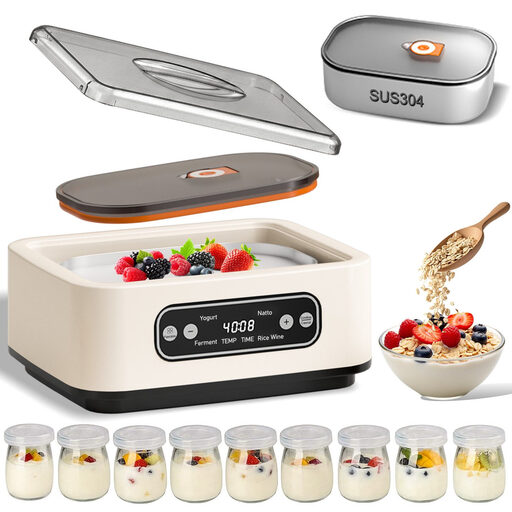
Suitable if you want to prepare yoghurt in individual pots and plan ahead.
The product name lists nine borosilicate glass pots and temperature and timer functions.
 No image available
The pot configuration is a good fit if you want to prepare yoghurt in individual portions.
The product name lists a digital temperature function and a 48-hour timer. Check the manual for the right settings for your recipe.
 No image available
Could suit you if you’re interested in other fermentation recipes as well as yoghurt; check the preparation method for each recipe.
The product name lists fermentation, yoghurt, natto and rice wine, as well as temperature and timer functions.
 No image available
A portion-sized model for preparing individual pots of yoghurt for participants.
Rommelsbacher lists eight 150 ml pots, a timer of up to 18 hours and automatic shut-off. Keep the pots chilled after preparation.
 No image available
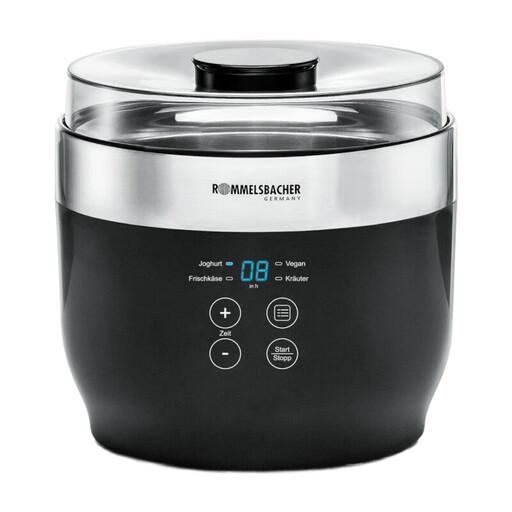
Suitable if you want to scoop yoghurt from a large container for several smoothies.
Rommelsbacher lists a capacity of 1.2 l of natural yoghurt per batch, with programmes for natural yoghurt at 42 °C and vegan or lactose-free yoghurt at 38 °C. The two 1.2 l containers supplied do not add up to the capacity of a single batch.
Plan the preparation in advance and allow time for chilling afterwards. Ariete lists a preparation time of 10–12 hours for the Yogurella 0617/00; this is a model specification, not a fixed time for every recipe. The Dutch Nutrition Centre recommends keeping chilled dairy products at 4 °C.
Keep chilled dairy products in the fridge at 4 °C and don’t leave perishable products out of the fridge for more than 2 hours. These are storage recommendations from the Dutch Nutrition Centre, so make sure you have enough fridge space and only take ingredients out when you need them.
If a food business prepares, processes or sells food, the Netherlands Food and Consumer Product Safety Authority (NVWA) requires an HACCP food safety plan or an applicable hygiene code. According to the NVWA, anyone offering unpackaged food to consumers must provide information about any allergens it contains. Whether these rules apply to your workshop depends on how it is organised and what it involves.
For a purchase by a consumer in the Netherlands, statutory rights apply alongside any manufacturer’s guarantee. ACM ConsuWijzer explains that there is no fixed statutory two-year guarantee period: what you could reasonably expect from the product and whether it was used normally are also relevant. The retailer is your point of contact.