Choose individual, sealable jars if housemates want to store their smoothie portions separately; a larger tub is a better fit if you make several smoothies from one batch. A timer or programme is most useful when you need those settings for your recipe: manufacturers describe features specific to each model, not independently verified differences in yoghurt quality. Whichever type you choose, clean utensils and refrigerated, sealed storage remain important, as advised by the Netherlands Nutrition Centre.
Who is a yoghurt maker suitable for?
Smoothie maker sharing a kitchen
You make your own portions and want to keep them sealed and clearly labelled in a shared fridge. Individual jars can be a good option; using a clean spoon and keeping them chilled are still important. The Netherlands Nutrition Centre recommends handling dairy products hygienically.
Smoothie maker who likes to plan ahead
You make enough yoghurt for several smoothies at once. So compare the stated quantity per batch with the space available for the appliance and yoghurt in your fridge.
Smoothie maker who likes to experiment
You might want to make thicker, strained yoghurt or use a different base. Check which accessories and programmes come with the specific model, and which preparation instructions apply.
What should you look for when choosing one?
Individual jars
Choose this if: you want to seal portions individually and store them separately in the fridge. Severin describes the JG 3518 as having seven 150 ml jars; Rommelsbacher lists eight 150 ml jars for the JG 40.
Bear in mind: there are more parts to fill, wash and store.
A larger tub
Choose this if: you usually make several smoothies from the same batch. The Rommelsbacher JG 80 comes with two glass tubs, each with a capacity of 1.2 litres, and four portion cups; Ariete describes tubs and a filter basket for the Yogurella 0621/10.
Bear in mind: a shared tub needs to be scooped from with clean utensils and requires enough space in the fridge. A filter is mainly useful if you want to strain your yoghurt; thicker yoghurt won’t necessarily suit every smoothie.
Adjustable programmes
Choose this if: you want to select from different recipes described by the manufacturer for that model. Severin lists five automatic programmes for the JG 3521.
Bear in mind: a programme doesn’t guarantee results with every starter culture or plant-based drink; follow the preparation instructions for your specific model.
| What to consider |
What to look for when buying |
Who is it most important for? |
| Hygienic preparation and storage |
Check whether the tub and removable parts can be cleaned as described in the manual, and whether sealed yoghurt will fit in your fridge. A lid doesn’t replace clean utensils or refrigeration. |
If I share yoghurt with housemates, I want to be able to handle it hygienically and keep it sealed in the fridge. Around 36% of consumers prioritise hygienic preparation and storage. |
| Individual portions |
Compare the number and capacity of the jars, and whether they have lids, with how you plan to use them; more jars also mean more washing-up and storage space. |
If I want to store portions for my smoothies separately, individual jars with lids are practical. Around 29% of consumers prioritise individual portions. |
| Quantity per batch |
Compare the stated yield per batch and the space available for the appliance and yoghurt; don’t assume the capacity of the supplied tubs adds up to the yield of one batch. |
When I make several smoothies in advance, I want to know how much yoghurt one batch actually makes. Around 21% of consumers focus mainly on batch size. |
| Texture and ingredients |
Choose a filter only if you want to strain your yoghurt. If using different ingredients, check which starter culture is suitable and consult the model’s manual. |
If I want to try thicker yoghurt or a different base, I want to know whether the filter, programme and starter culture are suitable. Around 14% of consumers prioritise texture or choice of ingredients. |
Common buying mistakes
-
Adding up the capacity of all the tubs as the yield of one batch
Rommelsbacher states that the JG 80 makes up to around 1,200 g of yoghurt per batch, and that it comes with two glass tubs, each with a capacity of 1.2 litres. So the combined capacity of the tubs doesn’t, by itself, tell you how much yoghurt one batch makes.
Compare the stated yield per batch, and also check which tubs you use during preparation.
-
Assuming sealable jars mean you don’t need to handle food hygienically
A lid helps keep yoghurt sealed during storage, but it doesn’t replace clean hands, surfaces and utensils. The Netherlands Nutrition Centre recommends these hygiene measures when preparing and eating dairy products.
Check the cleaning instructions and, in a shared kitchen, agree how to scoop out the yoghurt hygienically and keep it chilled.
-
Assuming a programme guarantees a particular result
A programme for making plant-based yoghurt doesn’t mean every drink or starter culture will produce the same result. The Netherlands Nutrition Centre also points out that plant-based alternatives differ from dairy in their nutritional content.
Check the instructions for the ingredients and starter culture, and compare the nutritional information on the label.
-
Taking a product title as proof of the exact appliance
A product description on Joybuy Netherlands with JG 80 in the title mentions model IB 05 and describes a freezer bowl. So the title alone isn’t enough to identify the appliance.
Before buying, check the full model name and product specifications on the product detail page.
Brands to consider
Severin
The JG 3518 and JG 3521 models have different strengths: individual portions or automatic programmes.
- According to Severin, the JG 3518 comes with seven 150 ml jars with lids.
- Severin lists five automatic programmes for the JG 3521.
- According to the manufacturer, the JG 3518 doesn’t have a display. This is a difference in how it’s operated, not an established comparison of quality.
Rommelsbacher
The JG 40 is designed for individual portion jars; the JG 80 combines larger tubs with portion cups.
- According to Rommelsbacher, the JG 40 comes with eight 150 ml jars and a timer of up to 18 hours.
- The JG 80 comes with two glass tubs, each with a capacity of 1.2 litres, and four 125 ml cups.
- Rommelsbacher states that the JG 80 makes up to around 1,200 g of yoghurt per batch; the capacity of both tubs isn’t automatically the yield of one batch.
Ariete
The Yogurella 0621/10 is an option if you want a filter basket for strained, thicker yoghurt as well as standard yoghurt.
- Ariete describes the Yogurella 0621/10 as including tubs and a filter basket.
- This model isn’t a set of individual glass portion jars. A filter also won’t automatically give you the thickness you want in every smoothie.
Yoghurt makers at Joybuy
These Joybuy products are suited to individual portions in separate jars or larger batches for several smoothies.
 No image available
Rommelsbacher yoghurt maker JG 40
A good fit if you want to store smoothie portions in individual jars.
Rommelsbacher lists eight 150 ml glass jars with lids. The timer can be set from 1 to 18 hours; eight jars also mean more parts to wash and store.
View at Joybuy
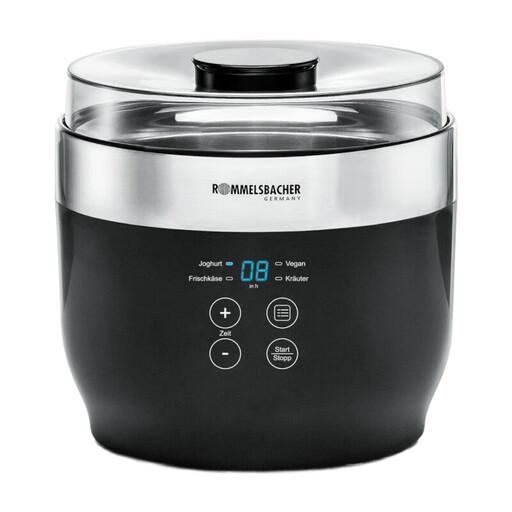 No image available
Rommelsbacher yoghurt and cream cheese maker JG 80
A good fit if you want to make larger batches and also use separate portion cups.
The description lists two glass tubs, each with a capacity of 1.2 litres, and four 125 ml portion cups with lids. Rommelsbacher states that the appliance makes up to around 1,200 g of yoghurt per batch; so don’t add the capacity of both tubs together as the yield of one batch.
View at Joybuy
Frequently asked questions
What should you bear in mind when using a yoghurt maker in a shared kitchen?
Use clean hands, a clean worktop and clean utensils, and keep dairy products sealed and refrigerated. The Netherlands Nutrition Centre recommends hygienic handling when preparing and eating dairy products; a yoghurt maker doesn’t replace these steps.
How long can you keep homemade yoghurt for smoothies?
Don’t automatically use the storage guidance for standard yoghurt as the shelf life for every homemade batch. The Netherlands Nutrition Centre says opened full-fat yoghurt keeps for 5–7 days in the fridge and recommends using a clean spoon; this isn’t a confirmed shelf life for every homemade batch.
Are yoghurt makers always covered by exactly two years’ statutory guarantee in the Netherlands?
No. The Dutch government doesn’t specify a fixed statutory guarantee period for the Netherlands. Any manufacturer’s guarantee is separate; if there’s a fault, contact the retailer and check the terms of the guarantee.


