
Host with a large number of guests
Wants to make as many individual portions as possible in one batch, so compares the number of jars. Severin lists fourteen jars for the JG 3520; Rommelsbacher lists eight for the JG 40.


Start by checking how many jars the yoghurt maker can handle per batch, then look at the capacity of each jar. Severin lists fourteen 150 ml jars for the JG 3520, while Clatronic lists seven 160 ml jars for the JM 3344 and Lagrange lists nine 220 ml jars for the Ligne 459002. A timer with automatic switch-off can help you plan, but yoghurt needs to be kept chilled after preparation. Also check the requirements for the specific appliance and the parts that come into contact with yoghurt.
Wants to make as many individual portions as possible in one batch, so compares the number of jars. Severin lists fourteen jars for the JG 3520; Rommelsbacher lists eight for the JG 40.
Checks the capacity of each jar, not just the total number. Clatronic lists 160 ml per jar for the JM 3344; Lagrange lists 220 ml for the Ligne 459002.
Prepares yoghurt before the gathering and wants to know how the appliance works, and how the jars can be sealed and kept chilled. Rommelsbacher lists a timer with automatic switch-off for the JG 40; Moulinex advises putting the prepared yoghurt in the fridge once the jars have been sealed.
Start by working out how many portions you want to make at once. Then check that the capacity of each jar and the space you’ll need in the fridge fit your plans.
If you’re planning yoghurt portions for a family gathering, here are four points to consider when choosing a yoghurt maker.
| What to consider | What should you check? | Who is this important for? |
|---|---|---|
| Portions per batch | Compare the number of jars supplied with the number of guests who’ll each have their own portion. | If I want to give everyone their own jar in the same batch, I compare the number of jars with my guest list. Around 36% of consumers prioritise having enough individual portions per batch. |
| Capacity per jar | Compare the stated capacities: the models listed have jars of 150 ml, 160 ml or 220 ml. | For a small taster portion, I need not only enough jars but also the right capacity for each one. Around 29% of consumers put portion size first. |
| Sealing and storage | Check whether lids are included, what cleaning instructions apply and whether all the filled jars will fit in your fridge. | If I make the yoghurt in advance, I want to be able to seal the jars and keep them chilled, with an amount of washing-up that suits me. Around 21% of consumers prioritise storage and cleaning over capacity, jar size and timer. |
| Controls and planning | Check whether the exact model has a timer, automatic switch-off or just an on/off switch. | When I make the yoghurt well before the gathering, I want to know how much I’ll need to set or keep an eye on myself. Around 14% of consumers make their choice mainly based on the controls and timing. |
Nine 220 ml jars give you a different portion size from 150 or 160 ml jars. So a model with more jars won’t necessarily be right for smaller tasting portions.
Before you start, note down both how many portions you want and how much you’d like to serve each guest.
If the jars are too large, more yoghurt may be left over per guest than intended; if there aren’t enough jars, you’ll need to make extra batches.
Clatronic lists an on/off switch for the JM 3344. Don’t assume it has an adjustable timer or temperature control without checking.
Check the specifications or manual for the exact model you’re considering.
An appliance that stops the preparation process won’t keep the yoghurt chilled afterwards.
Make space in the fridge and put the sealed jars in to chill after preparation, following the instructions for use. The Netherlands Nutrition Centre advises setting your fridge to 4 °C.
The models listed differ mainly in the number of jars per batch.
According to Rommelsbacher, the JG 40 is designed to make eight individual portions per batch.
The JM 3344 is worth comparing if seven jars per batch are enough for you.
The Yogurteo YG231E32 combines individual glass jars with controls for timed preparation.
The Ligne 459002 is worth considering if you want to use nine larger jars.
These product choices are suited to making individual yoghurt portions for a gathering. Compare the jar capacity and number of portions for each model, and check the required CE marking and the applicable requirements for parts that come into contact with yoghurt.
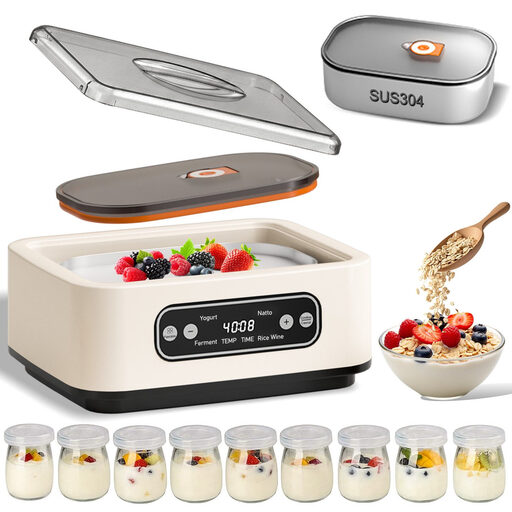 No image available
Suitable if you’re planning to make nine individual small portions.
Joybuy’s product information lists nine 100 ml borosilicate glass jars and a 1.6 L inner pot. It also mentions temperature control, a programmable timer and automatic switch-off.
 No image available
An option to compare if you’re planning to make eight individual portions per batch.
Joybuy’s product information lists eight jars, a stated capacity of 1440 ml, adjustable temperature, a timer of up to 48 hours and automatic switch-off.
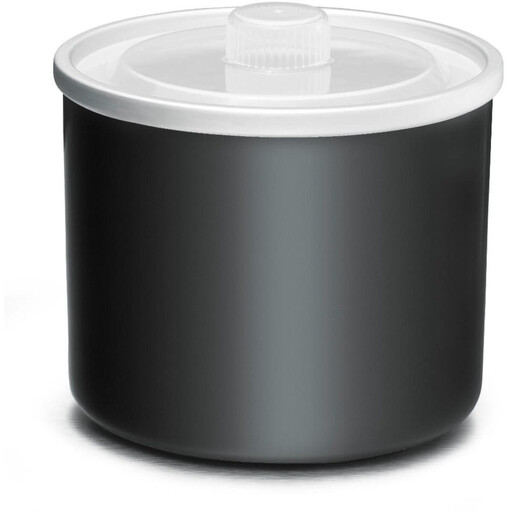 No image available
Worth considering if you’re looking for an appliance that, according to its product name, makes yoghurt and cream cheese.
 No image available
Suited to planning eight individual portions per batch.
Rommelsbacher lists eight 150 ml glass jars with lids, plus a timer of up to 18 hours with automatic switch-off.
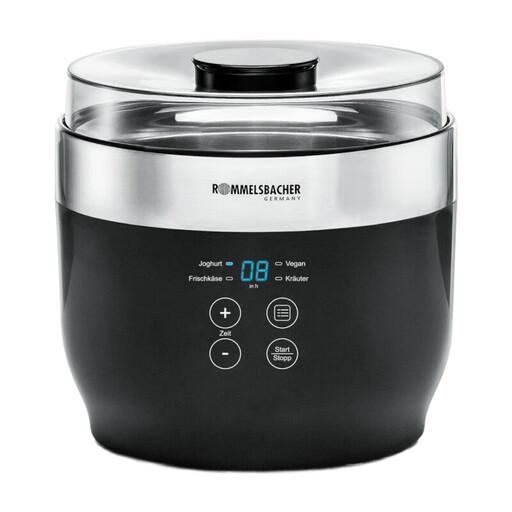 No image available
An option to consider if you want to compare small individual portions with an appliance that also includes larger containers.
Joybuy’s product information lists four 125 ml ceramic cups with lids, two 1.2 L glass containers and a timer with automatic switch-off.
Divide the number of portions you want by the number of jars per batch, then round up. For the specific models listed, Severin states that the JG 3520 holds fourteen jars, Rommelsbacher’s JG 40 holds eight, Clatronic’s JM 3344 holds seven and Lagrange’s Ligne 459002 holds nine.
Follow the manufacturer’s instructions for your jars. For its individual jars, Moulinex advises removing the lids before using them in the yoghurt maker, then sealing the prepared yoghurt and putting it in the fridge. The Netherlands Nutrition Centre advises setting your fridge to 4 °C. Don’t automatically apply the recommended storage time for opened yoghurt to homemade yoghurt.
For the specific model, check that it has the required CE marking and that the jars and lids are suitable for contact with food. The Netherlands Food and Consumer Product Safety Authority (NVWA) outlines the CE requirements for electrical products and the applicable rules for food contact materials. Requirements depend on the product category and its intended use.
If you’re replacing a jar, check that the manufacturer confirms it’s suitable for your exact model. According to the Dutch Government, if there’s a problem with a product you’ve bought, the seller must provide a solution under the statutory guarantee. Any manufacturer’s guarantee is separate.