
Anyone who wants to store yoghurt in individual portions
If you want to make and chill yoghurt in separate, lidded jars straight away, compare the capacity of each jar, the number of jars and how much space they take up together.


Choose individual jars if you want to store your yoghurt in separate portions straight away. Check the capacity of each jar, as well as how much space the appliance and the complete set will take up. A model with one bowl is a better fit if you prefer to portion out the yoghurt yourself and have fewer individual jars to manage. For the specific model, also check for a CE mark and make sure any parts that come into contact with food are suitable for that purpose.
If you want to make and chill yoghurt in separate, lidded jars straight away, compare the capacity of each jar, the number of jars and how much space they take up together.
Measure the space where you plan to use the appliance beforehand. Small portions don’t necessarily mean the yoghurt maker itself takes up little room.
If you want the preparation to stop at a set time, check that the exact model has both a timer and automatic shut-off.
Choose this if: you want to store yoghurt straight away in small, covered portions.
Bear in mind: you’ll have several jars and lids to fill, wash and store.
Choose this if: you’d rather portion out the yoghurt yourself from one batch.
Bear in mind: you’ll also need suitable containers if you want separate portions to take with you.
Choose this if: you want to make both small portions and larger batches.
Bear in mind: extra containers and a sieve also need storage space, and may be unnecessary if you only make small portions of yoghurt.
| What to consider | What should you check? | Who should pay particular attention? |
|---|---|---|
| Storing small portions | Compare the number of jars, the capacity of each jar and the space needed for the complete set. Severin lists seven 150 ml jars for the JG 3518; Rommelsbacher lists four 125 ml cups for the JG 80. | I want to store yoghurt straight away in small, lidded portions, rather than having to divide it up afterwards. Around 36% of consumers put portion size first. |
| Worktop space | Measure the available width and depth, and consider where you’ll store the jars and lids. Severin lists dimensions of 12,8 × 24 × 24 cm for the JG 3518; Rommelsbacher lists 19,5 × 19,5 × 19 cm for the JG 80. | I want to know in advance whether the appliance will fit on my worktop and where I’ll keep the separate parts afterwards. Around 29% of consumers focus mainly on worktop space. |
| Timer and automatic shut-off | Check that both features are available on the exact model. Moulinex lists a timer of up to 15 hours and automatic shut-off for the Yogurteo YG231E32; Rommelsbacher lists these features for the JG 40 too. | I want to be able to set the preparation time without having to keep track of when to switch the appliance off. Around 21% of consumers prioritise automatic operation. |
| Cleaning and separate parts | Check how many jars and lids you’ll need to clean after use, and follow the instructions for the specific model. Moulinex says the glass jars supplied with the YG231E32 are dishwasher-safe; the Severin JG 3518 manual says not to immerse the electrical base. | I want to clean and store as few parts as possible after each batch. Around 14% of consumers put ease of cleaning first. |
A small portion doesn’t tell you how much space the appliance and complete set will take up. For example, the stated dimensions differ between the Severin JG 3518 and the Rommelsbacher JG 40.
Measure your worktop and think about where you’ll store all the filled jars, lids and accessories.
A timer and automatic shut-off are features of specific models, not standard features on every yoghurt maker.
If you don’t want to keep track of when preparation is finished, check the manual or product information for the exact model.
According to the Dutch government, there is no fixed statutory guarantee period in the Netherlands. This doesn’t mean your rights expire after a standard period; if there’s a problem with a product, contact the seller to find a solution.
Raise any issue with the seller and consider what you could reasonably expect from the product.
The JG 3518 is designed for anyone who wants to make yoghurt directly in individual portion jars.
The JG 80 combines portion cups with larger containers, while the JG 40 is designed for individual glass jars.
The Yogurteo YG231E32 is a model with individual jars and automatic shut-off.
According to Ariete, the Yogurella 0617/00 has individual glass jars and measures 19,5 × 19,5 × 22 cm.
The JM 2 is worth comparing if making a larger quantity matters more to you than making a small batch.
These Joybuy picks are designed for individual portions of yoghurt: the JG 40 has separate jars, while the JG 80 combines portion cups with larger containers.
 No image available
A good choice if you want to make yoghurt directly in individual portions; Rommelsbacher lists eight 150 ml glass jars with lids.
The product description lists an adjustable timer from 1 to 18 hours and an LED display. Do not immerse the electrical base in water or any other liquid.
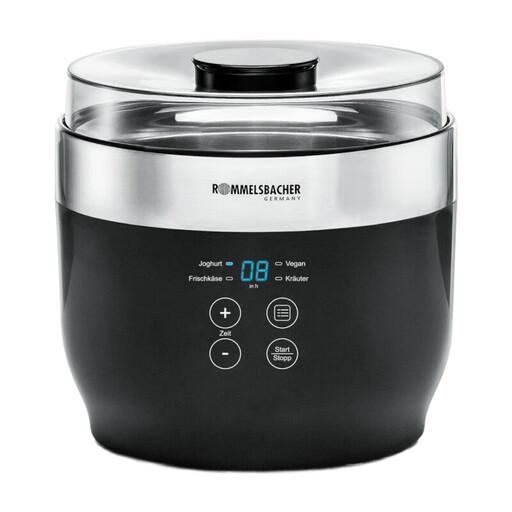 No image available
A good fit if you want the option of making small portions as well as larger batches.
Rommelsbacher lists four 125 ml ceramic cups, two 1,2 l glass containers and a sieve. The stated dimensions are 19,5 × 19,5 × 19 cm.
Refrigerate the yoghurt after making it and use a clean spoon. The Voedingscentrum advises putting opened full-fat yoghurt back in a 4 °C fridge promptly; this advice doesn’t automatically guarantee how long every homemade batch will keep.
Not with the Severin JG 3518: the manual says not to immerse the electrical base and to clean the jars and lids after use. For other models, follow the relevant manual.
No. According to the Dutch government, there is no fixed statutory guarantee period in the Netherlands; what you can expect from a product depends, among other things, on the product itself. If there’s a problem, contact the seller to find a solution.
For the specific appliance, check for a CE mark. For jars and other parts that come into contact with food, check that they’re suitable for food contact. The NVWA explains when CE marking is mandatory for electrical products; according to the European Commission, food-contact materials on the European market must comply with Regulation (EC) No 1935/2004. A general product listing doesn’t prove that the specific model meets these requirements.