What should you look for when choosing?
Start with the number of individual portions you want to make in one batch. Then check that the controls, fridge space and choice of ingredients fit your plans.
| What to consider |
What should you check? |
Who should give this more thought? |
| Number and size of portions |
Compare the number of jars included and their capacity with the number of guests. Also check whether suitable replacement jars are available. |
If I want to set out an individual pot for every guest, I look at the number of jars per batch. Around 33% of consumers prioritise portion capacity. |
| Chilling and serving |
Check how many filled jars will fit in your fridge and plan when to take them out. The Netherlands Nutrition Centre recommends a fridge temperature of 4 °C and leaving perishable food out of the fridge for no more than two hours. |
If I want to prepare portions in advance, I need space to keep them chilled until just before serving. Around 27% of consumers prioritise chilled storage. |
| Preparation time and controls |
Check the exact model for a timer, automatic shut-off and display. Remember to allow time for chilling after preparation, too. |
If I want the yoghurt ready in time for my get-together, the controls will affect my planning. Around 20% of consumers prioritise finishing on time. |
| Ingredients and dietary needs |
Check that the recipe works with your chosen milk and starter. If you’re hosting guests, keep track of the ingredients and any allergens in the toppings, too. |
If guests have different dietary needs, I want to know which ingredients are in each portion. Around 13% of consumers prioritise their choice of ingredients. |
| Cleaning, storage and replacement jars |
Check the cleaning instructions and make sure replacement jars fit the exact model. Jars from different models aren’t necessarily interchangeable. |
If I plan to use the appliance regularly, washing up and storage space matter as well as the portions for my get-together. Around 7% of consumers prioritise maintenance and storage. |
Yoghurt makers at Joybuy
This selection includes a yoghurt maker with eight individual small jars and a model with four small cups and two larger containers, for anyone who’d rather serve portions themselves.
 No image available
Rommelsbacher JG 40 yoghurt maker
Ideal if you want to prepare eight small portions in one batch.
Includes eight 150 ml glass jars with lids.
The product specifications list an adjustable timer from 1–18 hours.
Unplug the appliance before cleaning and don’t immerse the heating base in water.
View at Joybuy
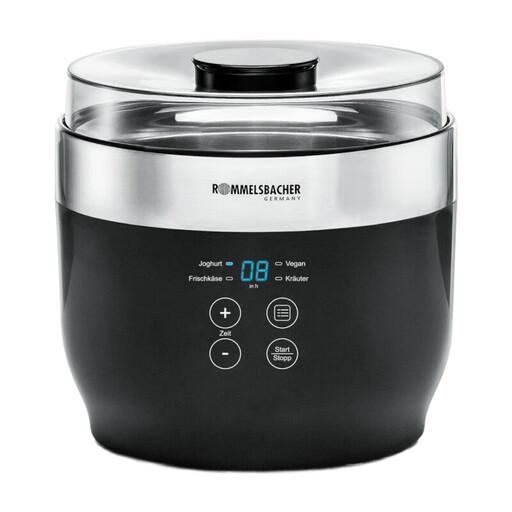 No image available
Rommelsbacher JG 80 yoghurt and cream cheese maker
Ideal if you want to make larger quantities and serve portions from them; four small cups are included.
Includes four 125 ml ceramic cups and two 1.2-litre glass containers.
The product specifications list four programmes with different temperatures.
View at Joybuy
Frequently asked questions
How do I know if one batch will be enough?
Compare the number of individual portions you want with the number of jars included, not just the total capacity. Seven jars will make seven portions in one batch; for more guests, you’ll need to make another batch or choose a model with more jars.
When should I put the yoghurt in the fridge?
Follow the instructions for your chosen model while making the yoghurt, then keep it chilled. The Netherlands Nutrition Centre recommends a fridge temperature of 4 °C and leaving perishable food out of the fridge for no more than two hours. Take portions out only just before serving.
Can I use the same replacement jars with every brand?
Don’t assume they’ll fit; check compatibility with the exact model. Severin lists EG 3513 and EG 3514 for the JG 3518, while Rommelsbacher lists JG 8 for the JG 40.
What can I do if my yoghurt maker develops a fault?
In the Netherlands, the seller must provide a solution if a product is faulty. According to the Dutch government, there’s no fixed statutory guarantee period; a manufacturer’s guarantee doesn’t replace your statutory rights.
Do I need to register or provide allergen information for a neighbourhood get-together?
That depends in part on whether you’re sharing food privately or selling it or offering it commercially. The NVWA outlines food safety rules for selling food from home and at events, as well as requirements for allergen information on unpackaged food that’s sold or offered. So first establish how the food is being offered before applying those rules to your get-together.


