
Cook with limited worktop space
You want to make your own natural yoghurt and need to consider the appliance’s external dimensions and where it will sit while in use.


First, measure the worktop space available. Then choose between making one larger batch or using individual jars, depending on how you want to portion and store your yoghurt. Manufacturer specifications show that dimensions vary: the Ariete Yogurella 0621/10 has a footprint of 17 × 17 cm, while models with individual jars can be wider. A timer or automatic shut-off is a separate convenience feature and, on its own, says nothing about the quality of the yoghurt produced.
You want to make your own natural yoghurt and need to consider the appliance’s external dimensions and where it will sit while in use.
You want to make and store several small portions in individual jars, so you compare portion sizes, total capacity and cleaning requirements.
You want to set the preparation time or use automatic shut-off, and bear in mind that not every basic model offers these controls.
When making natural yoghurt in a small kitchen, the main considerations are worktop space, portion sizes, controls and hygienic storage.
| What to consider | What should you check? | Who is this most important for? |
|---|---|---|
| Worktop space | Measure the available width and depth, then compare them with the dimensions of the exact model. | If my worktop is narrow, I want to know whether the appliance will fit there while it is in use. That is why around 36% of consumers give available worktop space top priority. |
| Quantity and portions | Check the amount made per batch, the number of jars and the capacity of each jar. | If I want to store yoghurt in portions, I compare individual jars with one larger container. Around 29% of consumers prioritise the quantity they want to make and how it is portioned. |
| Preparation controls | Check whether the model has a timer and whether it switches off automatically. | If I want to set the finish time, I check which controls the exact model offers. Around 21% of consumers give timer functions or automatic shut-off top priority. |
| Cleaning and chilled storage | Count the separate parts you need to clean and check whether the filled container or jars will fit in your fridge. | If I want to put the yoghurt away easily after making it, I consider the number of parts and the fridge space required. Around 14% of consumers prioritise cleaning and chilled storage. |
Capacity does not tell you how much worktop space the appliance needs. The stated external dimensions vary by model.
Measure the space where you plan to use the appliance, then compare both its width and depth with the dimensions of the exact version.
The number of jars varies by version. For example, Severin lists seven jars for the JG 3518 and fourteen for the JG 3520.
Check the full model code and which containers, jars and lids are actually included with that version.
A yoghurt programme does not prove that raw milk is heated sufficiently to prevent harmful bacteria.
Voedingscentrum advises boiling raw milk before drinking it or using it in a dish. Ideally, choose pasteurised milk and follow the instructions for preparation and cleaning.
The Yogurella 0621/10 is worth comparing if a small footprint is important and you want to make yoghurt in a container.
The JG 3518 and JG 3520 are versions with individual portion jars; check the model code so you get the right number of jars.
The JG 40 is designed for portions and has timer controls, while the JG 80 combines a smaller stated footprint with several programmes.
The JM 2 comes with plenty of glass portion jars; compare its dimensions with the worktop space you have available.
These models are suited to making natural yoghurt in a small kitchen: the JG 40 offers individual portion jars and timer controls, while the JG 80 combines a smaller stated footprint with a choice of preparation options.
 No image available
A good fit if you want to make yoghurt directly in individual portions and value the ability to set the preparation time.
Eight 150 ml glass jars; timer up to 18 hours and automatic shut-off. The stated dimensions are 34,50 × 18,50 × 13,50 cm.
Unplug the appliance before cleaning and do not immerse the heating base in water.
 No image available
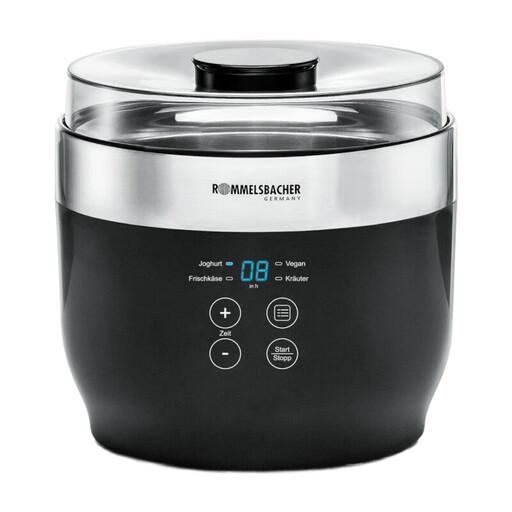
A good fit if you have limited worktop space and want to use other preparation programmes as well as making natural yoghurt.
The manufacturer lists dimensions of 19,50 × 19,50 × 19 cm and a natural yoghurt programme at 42 °C. The included accessories comprise an inner container, four portion cups and two glass containers.
The extra programmes are not essential if you only make natural yoghurt. Also check whether the included containers will fit in your fridge.
Compare the width and depth of the exact appliance with the space where it will sit while in use. According to the manufacturer, the Ariete 0621/10 has a base measuring 17 × 17 cm; the Rommelsbacher JG 40 measures 34,50 × 18,50 cm in width and depth.
No, you do not need a filter to make natural yoghurt. Ariete describes the filter container for the Yogurella 0621/10 as an extra option for straining yoghurt. For natural yoghurt, focus on checking which standard container comes with the model.
According to Voedingscentrum, return the yoghurt to a fridge at 4 °C soon after use and always use a clean spoon. Also check in advance that the filled container or jars will fit in your fridge.
Do not assume the yoghurt programme heats raw milk safely. Voedingscentrum advises boiling raw milk before drinking it or using it in a dish; ideally, choose pasteurised milk.
According to the Netherlands Food and Consumer Product Safety Authority, electric yoghurt makers sold in the Netherlands must carry CE marking. This general requirement does not confirm that a specific listing complies; check the marking and product information for the item you want to buy.