Who is a yoghurt maker right for?

Breakfast maker with limited cupboard space

You want to make your own yoghurt, but need to fit the appliance and its accessories into a small cupboard. That makes both the appliance’s dimensions and the number of separate parts important. Manufacturers such as Ariete and Severin publish these details for specific models.

Meal planner who likes individual portions

You want to divide breakfast into individual pots in advance, so you’ll want to check how many portions you can make at once and whether they’ll fit in your fridge. Severin, Rommelsbacher and Steba list the number and capacity for specific models.

Choosing ingredients or different preparations

You also want to make strained yoghurt or another preparation supported by the manufacturer, and are considering the accessories you’ll need. Ariete lists a strainer basket for strained yoghurt; Rommelsbacher mentions additional programmes for the JG 80.

What should you look for when choosing one?

What to consider What should you check? Who will this matter most to?
Cupboard space for the appliance and accessories Measure the available width, depth and height, and include tubs, pots and any strainer. If I have limited cupboard space, I need room for all the separate parts too, not just the appliance. For around 36% of consumers in this breakfast scenario, storage space comes first.
Number of breakfast portions per batch Compare the number of pots and the capacity of each one; also check that the filled pots will fit in your fridge. If I want to prepare breakfast in advance, I need to know how many portions I can make and chill per batch. That’s the main reason to buy for around 29% of consumers.
Ease of preparation when planning ahead Check whether the exact model has a timer and automatic switch-off, and follow the instructions for use and cleaning. If I want to plan the preparation time in advance, I prefer a straightforward routine. For around 21% of consumers, convenience comes first.
Other yoghurt styles and preparations Check which programmes and accessories come with the version you’re considering; only choose extra features if you plan to use them. If I also want to make strained yoghurt or other supported preparations, I’ll only accept extra parts if I’ll actually use them. For around 14% of consumers, this versatility is the top priority.

Common buying mistakes

  • Comparing only the appliance’s external dimensions

    An appliance with a small footprint may come with several separate tubs, pots or accessories that also need storage space.

    Check everything included in the box and measure the space you have for all the parts.

  • Assuming a timer means the yoghurt will be chilled

    A timer or automatic switch-off ends the set preparation cycle, but it doesn’t chill the yoghurt. The Netherlands Nutrition Centre advises keeping chilled dairy products in the fridge at 4 °C.

    Make room in the fridge for after preparation and follow the instructions for your chosen model.

  • Assuming a manufacturer’s warranty is the same as your full statutory guarantee

    According to ACM ConsuWijzer, your statutory rights apply alongside any seller’s or manufacturer’s warranty. The rights that apply depend on the circumstances.

    Before choosing additional cover, read what it actually includes and compare it with your statutory rights.

Brands and specific models

Ariete

The Yogurella 0621/10 is an option if you’re looking for a compact appliance and an accessory for making strained yoghurt.

  • Ariete says the appliance measures 17 × 17 × 19 cm and includes two 1-litre tubs and a strainer basket.
  • The tubs and strainer need storage space as well as the appliance.

Severin

The JG 3518 is designed for making yoghurt in individual breakfast portions.

  • According to Severin, this model measures 24 × 24 × 12,8 cm and comes with seven 150 ml pots.
  • The pots take up space in the fridge and cupboard.

Rommelsbacher

The JG 40 is designed for individual pots and has a timer; the JG 80 adds programmes and different containers.

  • Rommelsbacher says the JG 40 comes with eight 150 ml pots and automatic switch-off. For the JG 80, the manufacturer lists four programmes, individual portion pots, large tubs and a strainer.
  • The JG 80’s extra parts need separate storage; these differences apply to these models, not the brand as a whole.

Steba

The JM 2 is an option if you want to make a larger batch in individual pots and have the space for it.

  • Steba lists twelve 0,2-litre pots and a timer with automatic switch-off. According to the manufacturer, the appliance measures 31 × 25 × 12,5 cm.
  • The twelve pots need extra storage space.

Yoghurt makers at Joybuy

These models suit anyone who wants to prepare yoghurt in advance: one has individual pots, while the other offers several preparation programmes.

Rommelsbacher JG 40 yoghurt maker

Rommelsbacher JG 40 yoghurt maker

A good choice if you want to portion out breakfast into individual pots in advance.

Rommelsbacher lists eight 150 ml pots, a timer of up to 18 hours and automatic switch-off.

Allow space to store the separate pots. A timer doesn’t chill the yoghurt, so keep it refrigerated after preparation.

Before buying, check the product information for this specific model, including the required CE marking.

View at Joybuy
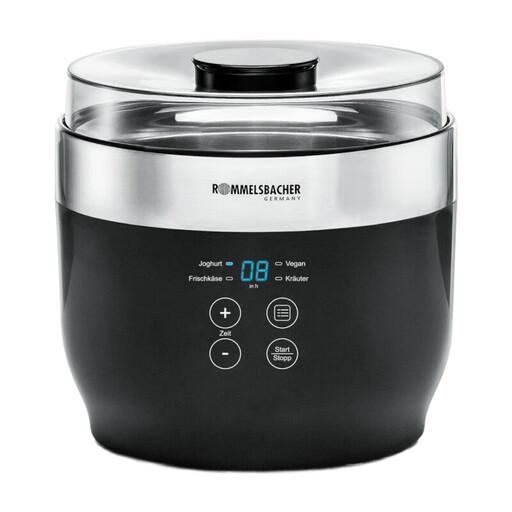
Rommelsbacher JG 80 yoghurt and cream cheese maker

Rommelsbacher JG 80 yoghurt and cream cheese maker

A good choice if you want to use this model’s additional functions as well as making yoghurt.

Rommelsbacher lists four programmes, four 125 ml ceramic portion pots, two 1,2-litre glass tubs and a strainer. The stated dimensions are 19,5 × 19,5 × 19 cm.

The tubs and strainer included need separate storage; also check the instructions for the ingredients you want to use.

Before buying, check the product information for this specific model, including the required CE marking.

View at Joybuy

Frequently asked questions

Does a yoghurt maker need to run overnight for you to have yoghurt in the morning?

Not necessarily: you can plan the preparation in advance and allow for the preparation time stated in the instructions. A timer or automatic switch-off, such as the one Rommelsbacher lists for the JG 40, doesn’t remove the need to keep the yoghurt chilled.

How do I make and store yoghurt safely?

Use clean hands, surfaces and kitchen utensils. The Netherlands Nutrition Centre advises using pasteurised or sterilised milk; boil raw milk before use. After making it, keep chilled dairy products in the fridge at 4 °C. The storage guidance for shop-bought yoghurt after opening doesn’t automatically apply to homemade yoghurt.

Do I need an extra warranty package?

Not necessarily. According to ACM ConsuWijzer, your statutory rights apply alongside any seller’s or manufacturer’s warranty. If a product breaks sooner than you could reasonably expect under normal use, the seller must resolve the issue under the applicable conditions; check what additional cover offers on top.

What safety rule applies when buying an electric yoghurt maker in the Netherlands?

According to the Dutch government, electrical appliances placed on the EU market must meet the applicable safety requirements and carry the required CE marking. Check the information for the specific model before buying.
