
Cooking in a small kitchen
You want to make natural yoghurt at home and need to fit the appliance and its separate parts into a small cupboard.


First measure the space available for the appliance and its separate parts, then decide whether you want to store one batch of yoghurt or individual portions. A model with a large container keeps things simple, while jars portion out the yoghurt straight away but need extra storage space. Additional programmes are mainly useful if you plan to use them.
You want to make natural yoghurt at home and need to fit the appliance and its separate parts into a small cupboard.
You want to make several portions at once and store them separately, and have room for the jars and lids.
You want to make plain yoghurt and are weighing up straightforward controls and cleaning against extra programmes.
Choose this if: you mainly want an appliance with a small footprint and make yoghurt in one batch.
Trade-off: you’ll need to spoon out individual portions yourself; an included strainer may go unused if you make plain yoghurt.
Choose this if: you want to portion out the yoghurt straight away and have enough room for the appliance, jars and lids.
Trade-off: separate jars take up space even when not in use and need to be cleaned individually.
Choose this if: you want the option of making a larger batch or using portion cups, and have room to store the complete set.
Trade-off: extra programmes and accessories aren’t necessarily needed if you only make natural yoghurt.
| What to consider | What should you check? | Who is this important for? |
|---|---|---|
| Space for the complete set | Measure the shelf and compare the appliance dimensions with the space needed for all separate containers, jars and lids. Ariete lists the Yogurella 0621/10 appliance dimensions as 17 × 17 × 19 cm; this is not the size of the stored set. | If I have limited cupboard space, I also want to know where the separate parts will go; around 36% of consumers prioritise storage space. |
| Container or portion jars | Compare the capacity and number of jars with the portions you want to store, and check that they’ll fit in your fridge. | If I want to store yoghurt in separate portions straight away, I look at the number of jars and lids; around 29% of consumers prioritise portioning. |
| Controls for natural yoghurt | Check how to set the programme for plain yoghurt and whether you’ll actually use a timer or additional programmes. | If I only make plain yoghurt, I don’t want to pay for extra settings I don’t need; around 21% of consumers prioritise simple controls. |
| Batch size | Match the stated capacity to how much you use and the fridge space you have available. Follow the appliance instructions for chilled storage. | If I want to make an amount that suits my needs, I look at the capacity of the container or jars; around 14% of consumers prioritise batch size. |
The appliance may fit on the shelf, but the containers, filters or jars might not.
Measure the available shelf space and decide where you’ll store all the included parts.
Extra features for making other foods won’t automatically solve your storage problem, and they may not be useful if you only make natural yoghurt.
Choose based on the amount you want to make and how you plan to store it; think of other programmes as an option, not a requirement.
The Voedingscentrum warns that raw milk may contain harmful bacteria.
The Voedingscentrum says pasteurised milk is the safest choice. If you choose to use raw milk in a dish, boil it before use.
The Yogurella 0621/10 is a model with a small stated appliance footprint and 1-litre containers.
The JG 3518 is a model with portion jars; the JG 3521 is a separate digital version.
The JG 40 is a model with portion jars; the JG 80 comes with a large container and smaller cups.
This selection focuses on yoghurt makers for natural yoghurt: a JG 80 with large containers and portion cups, and a JG 40 with separate jars.
 No image available
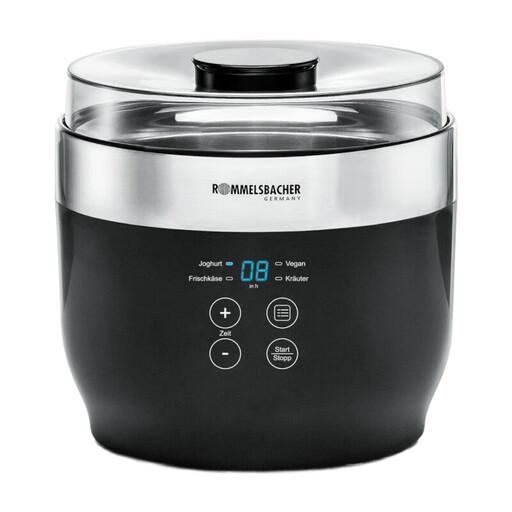
It’s a good fit if you want to choose between making a larger batch and using portion cups, and have room for the complete set.
The set includes two 1.2-litre glass containers and four 125 ml portion cups. The stated appliance dimensions are 19,5 × 19,5 × 19 cm. The model has a natural yoghurt programme and an adjustable preparation time; the separate parts also need storage space.
 No image available
It’s a good fit if you want to make yoghurt directly in individual portions and have a long, narrow space for the appliance.
The set includes eight 150 ml glass jars. The timer can be set from 1–18 hours. The stated appliance dimensions are 31,5 × 17,5 × 12,5 cm; remember to allow storage space for the jars too.
Not if you don’t plan to use those settings. Compare the controls for plain yoghurt: Severin states that the JG 3518 has no display, while the Rommelsbacher JG 80 has a separate natural yoghurt programme and an adjustable preparation time.
Follow the instructions for your chosen model for preparation and cleaning. The Rommelsbacher JG 80 manual says that the glass jars and yoghurt cups are dishwasher-safe, and that all parts must be completely clean and dry before next use.
The Voedingscentrum says pasteurised milk is the safest choice and advises boiling raw milk before using it in a dish. A yoghurt maker doesn’t replace this step; follow the appliance’s preparation instructions afterwards.
Refrigerate the yoghurt after preparation, following the appliance instructions. The Voedingscentrum recommends a fridge temperature of 4 °C; its storage advice for opened full-fat yoghurt doesn’t automatically apply to every homemade batch.
CE marking is compulsory for electrical equipment covered by the Dutch Commodities Act Decree on Electrical Equipment. For the applicable low-voltage rules, the Netherlands Food and Consumer Product Safety Authority specifies a range of 50–1000 V AC. Check the marking on the specific product; a listing in a webshop doesn’t by itself prove that the item being sold complies.