
Cook with limited worktop space
You only have a small clear area to use while the yoghurt is being made, so you’re comparing width and depth, not just the amount of yoghurt it makes.


Start by checking how much worktop space you have and how much yoghurt you want to make at a time. The Rommelsbacher JG 80 has a stated footprint of 19.5 × 19.5 cm and comes with four 125 ml pots. A model with individual glass jars, such as the Severin JG 3518, offers a different way to portion your yoghurt. For the Rommelsbacher JG 40, the manufacturer recommends filling unused jars with water when making a small batch.
You only have a small clear area to use while the yoghurt is being made, so you’re comparing width and depth, not just the amount of yoghurt it makes.
You want to make a few portions and store them separately, rather than automatically filling a whole set of jars with yoghurt.
You want to schedule the process with a timer or try different recipes, and weigh these features against the worktop and storage space required.
First measure the available worktop space, then decide how many individual portions you need and which controls are genuinely useful to you.
| What to consider | What should you check? | Who should consider this? |
|---|---|---|
| Space for use and storage | Compare the width and depth with the available space; also leave room for jars, lids and other parts. | If I only have a small area of worktop free, I want the machine to fit there and have somewhere to put the parts afterwards too; around 34% of consumers prioritise the space required. |
| Small yield per batch | Compare the capacity and number of pots or jars, and check the instructions for making a partial batch with the specific model. | I only want to make a few portions and store them separately, without assuming that every machine works with a partially filled set; around 33% of consumers give small yields top priority. |
| Scheduling the process | Check which timer settings the model offers and follow the instructions for the preparation time. | If I want to fit the process around my routine, I look at the timer and controls; scheduling matters most to around 20% of consumers. |
| Other preparations | Check which programmes and accessories come with that exact model, and consider whether you’ll actually use them. | I want to try making things other than plain yoghurt, but I don’t want to store extra parts unnecessarily; around 13% of consumers prioritise this flexibility. |
The number of jars supplied doesn’t, by itself, tell you how many need to be filled. For the JG 40, Rommelsbacher recommends inserting all the jars and filling the empty ones with water when making a partial batch.
If you usually want to make just one or two portions, read the instructions for partial batches for the exact model.
A yoghurt maker can make a small amount of yoghurt and still take up a large part of your worktop while it’s running. You’ll also need somewhere to store the jars and accessories afterwards.
Measure the available space and compare the stated width and depth; also allow room to operate and store the machine.
ACM ConsuWijzer explains that a commercial manufacturer’s warranty is not the same as your statutory rights against the retailer.
Check your rights and contact the retailer if a product doesn’t do what you could reasonably expect it to.
Voedingscentrum gives a storage time of 5–7 days in the fridge for opened full-fat yoghurt. This isn’t a guaranteed shelf life for every homemade yoghurt or recipe.
Follow the instructions for your preparation and store the yoghurt as directed.
The JG 80 and JG 40 offer different ways to portion your yoghurt and take up different amounts of worktop space.
The JG 3518 is a straightforward option with individual jars, while the JG 3521 has digital programmes.
The JM 3 is worth comparing if you want to set the temperature and time yourself.
The Ligne 459002 is an alternative to compare if you’re looking for a set of larger portion jars.
This selection includes yoghurt makers for small batches, with a focus on the worktop space available and how you want to store your portions.
 No image available
An option if you’re looking for a compact stated footprint and individual portion pots.
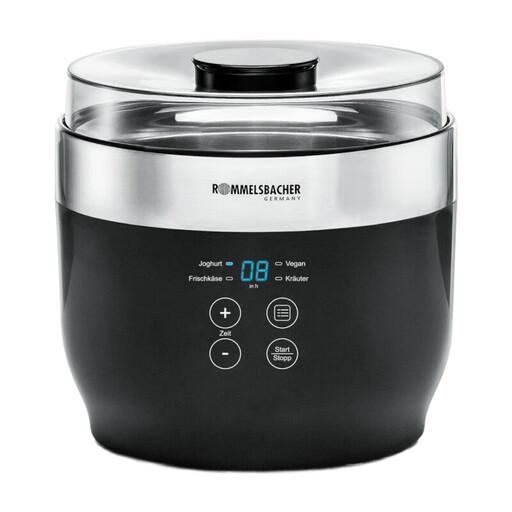
Rommelsbacher lists a footprint of 19.5 × 19.5 cm, four 125 ml ceramic pots, two 1.2-litre glass containers and a strainer with lid. The manufacturer lists four programmes and a timer of up to 24 hours. Make room to store the larger containers and the strainer.
 No image available
An option if you want to store yoghurt in individual jars and have a long, narrow space on your worktop.
Rommelsbacher lists eight 150 ml jars and a timer adjustable from 1–18 hours. The stated footprint is 34.5 × 18.5 cm. For a partial batch, the manufacturer recommends filling unused jars with water.
According to Rommelsbacher, you can theoretically make a batch with fewer jars, but the manufacturer recommends inserting all the jars and filling the empty ones with water. Don’t automatically apply this advice to other yoghurt makers.
Follow the storage and preparation instructions for your recipe and appliance. Voedingscentrum recommends keeping opened full-fat yoghurt in the fridge for 5–7 days; this isn’t a guaranteed shelf life for every homemade batch.
Check the product information and the applicable CE marking for the specific model. Your Europe explains that CE marking is only required for products covered by harmonised EU rules; this general rule doesn’t prove that a particular product on offer meets the requirements.
No. A commercial two-year warranty doesn’t automatically limit your statutory rights. ACM ConsuWijzer explains that, with normal use, you’re entitled to a product that does what you could reasonably expect; if a product is faulty, contact the retailer.
Voedingscentrum names pasteurised milk as the safest choice and recommends boiling raw milk before using it. Extra care is important for pregnant people, young children, older people and anyone with a weakened immune system.