What should you look for when choosing?
First decide how much yoghurt you want to make at a time, and where you can put the machine and filled jars. Then compare the controls and cleaning requirements.
| What to consider |
What should you check? |
Who should pay particular attention? |
| Small batches and portion size |
Check the capacity and number of jars, and what the manual says about using fewer filled jars. For the Rommelsbacher JG 40, the manufacturer recommends filling unused jars with water. |
If you mainly want to make one or a few portions, choosing a suitable batch size should be your top priority. Around 33% of consumers prioritise making a small batch. |
| Space for the appliance and yoghurt |
Measure the space on your worktop and allow for storage space in the fridge for the filled jars, too. |
If you share your kitchen and fridge, you’ll want to know whether there’s room for both the machine and the prepared portions. Around 27% of consumers give space the highest priority. |
| Timer and switch-off |
Compare the timer and automatic switch-off on the exact model, and check what needs to be done once it finishes. |
If you need to fit preparation around lectures or sleep, scheduled switch-off may be important. Around 20% of consumers put scheduling first. |
| Cleaning and chilled storage |
Check the cleaning instructions for each part, and make space in a fridge kept at around 4 °C, as recommended by the Voedingscentrum. |
If you have little time for washing up or share limited fridge space, cleaning and storage matter. Around 20% of consumers give these practical considerations priority. |
Products at Joybuy
These models are yoghurt makers with individual portion cups; the JG 80 set also includes larger tubs.
 No image available
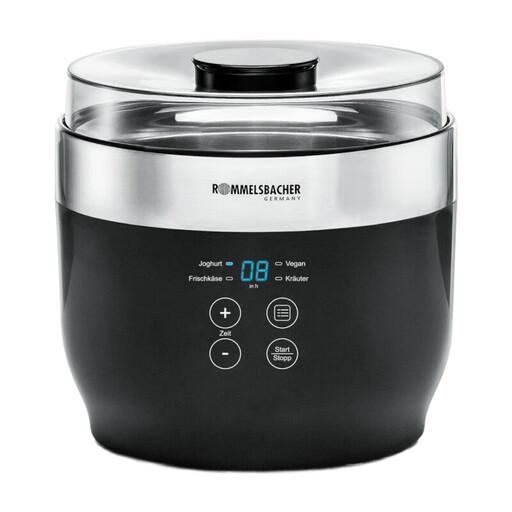
Rommelsbacher JG 40
A good fit if you want to prepare yoghurt in individual portions and schedule the start time.
According to Rommelsbacher, the JG 40 has eight 150 ml glass jars and a timer of up to 18 hours with automatic switch-off. The manufacturer recommends filling unused jars with water if you’re using fewer jars for yoghurt.
View at Joybuy
 No image available
Rommelsbacher JG 80
A good fit if you want to use larger tubs as well as making small portions, although the extra parts need more storage space.
According to Rommelsbacher, the set contains four 125 ml ceramic portion cups and two 1.2-litre glass tubs. The manufacturer also lists additional programmes.
View at Joybuy
Frequently asked questions
Do I need to fill every jar with yoghurt?
That depends on the model, so follow the manual. For the JG 40, Rommelsbacher says you can theoretically make yoghurt using fewer filled jars, but recommends filling unused jars with water to help distribute the temperature evenly.
What should I do with the yoghurt once it’s ready?
Put the yoghurt in the fridge once it’s ready. The Voedingscentrum recommends keeping your fridge at 4 °C and using a clean spoon to serve it. The 5–7 day storage period on the cited Voedingscentrum page applies to an opened product; it isn’t a general shelf life for homemade yoghurt.
Does a timer also chill the yoghurt?
No. A timer or automatic switch-off stops the appliance, but doesn’t chill the yoghurt. Make space in the fridge for the jars or tub in advance.
Who should I contact if an appliance bought in the Netherlands is faulty?
According to the Dutch Government, if a product is faulty, you should contact the seller. There’s no fixed statutory warranty period covering all products in the Netherlands; a manufacturer’s guarantee doesn’t replace your statutory right to a product that works properly.
What should I check for electrical product safety?
The Dutch Government says that electrical appliances placed on the market in the EU must carry a CE mark. Check the mark, the electrical specifications and the safety instructions for the version on offer; the model name alone doesn’t prove that the product being sold meets the requirements.


