
Planning breakfast for a large group
You want to know in advance whether one batch will make enough yoghurt for all your guests. Manufacturers such as Rommelsbacher and Steba list different batch sizes and portion formats.


Choose a yoghurt maker based on how much you want to make at once and how you plan to serve it at your family breakfast. Individual pots are handy for preparing portions in advance, while a large tub is ideal for everyone to help themselves. Also check the preparation time, and make sure you have enough space and time to chill the yoghurt before breakfast.
You want to know in advance whether one batch will make enough yoghurt for all your guests. Manufacturers such as Rommelsbacher and Steba list different batch sizes and portion formats.
You want to plan the preparation and have the yoghurt chilled and ready to serve. A timer can help you keep track of when a cycle ends, but it won’t chill the yoghurt for you.
You want to choose between sealed pots for individual portions and a large tub that guests can serve themselves from. Brands such as Rommelsbacher and Steba offer examples of both styles.
Start with how you plan to serve the yoghurt and how much you need. Then check whether the preparation and chilling times fit your guests’ arrival time.
| What to consider | What should you check? | Who is this important for? |
|---|---|---|
| Quantity | Compare the amount you need with the capacity per batch and the number of portion pots. | If I’m organising breakfast for a group, I want to know in advance whether one cycle will make enough; around 33% of consumers put total capacity first. |
| Timing and chilling | Check the preparation time and whether the model has a timer or automatic shut-off. Make sure you also have space in the fridge. | If you’re serving breakfast early, you’ll need to plan the preparation and chilling in good time; around 27% of consumers say this is their main concern when buying. |
| Serving style | Compare the number of sealable pots with the individual portions you want to serve, or check the capacity of the large tub. | If I’d rather give guests their own pots than have them serve themselves from one shared tub, I focus on the serving style; around 20% of consumers put this first. |
| Recipe you want to make | Check the manual to see whether the exact model has a suitable programme for your recipe and ingredients. | If you want to make a particular type of yoghurt, you’ll want to know whether the settings are suitable; around 20% of consumers say this is their main concern when buying. |
The Rommelsbacher JG 80 comes with two tubs, each with a capacity of 1.2 litres, but the manufacturer lists a capacity of 1.2 litres per batch.
Compare the amount you need with the stated batch capacity of the exact model.
A timer or automatic shut-off tells you when preparation has finished; perishable dairy products still need to be chilled afterwards.
As well as allowing time for preparation, make sure you have time and fridge space to store the yoghurt before breakfast.
The title alone doesn’t always tell you whether the appliance on offer is the model you’re looking for.
Before ordering, compare the brand, full model number and key feature on the product page with the manufacturer’s details.
The JG 40 is designed for individual portions, while the JG 80 combines large tubs with a stated capacity of 1.2 litres per batch.
The JM 2 is designed for individual portions in glass pots.
The JG 3520 and JG 3521 have different strengths: included portion pots on one model and automatic programmes on the other.
The AD 4476 comes with individual glass pots for breakfast portions.
This selection of Joybuy products includes yoghurt makers with individual portion pots and a model with large tubs. Compare the number of portions and the stated capacity per batch with the amount you need for breakfast.
 No image available
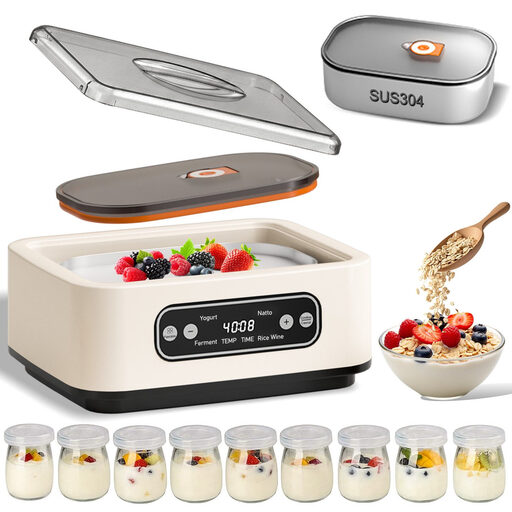
The individual pots are ideal for preparing breakfast portions in advance.
The product description lists nine 100 ml pots, an adjustable temperature of 21–48 °C and a timer settable from 1 to 99 hours.
 No image available
The included pots are a handy option if you want to portion the yoghurt in advance.
The product name lists a combined pot capacity of 1440 ml. The product description mentions a timer of up to 48 hours, automatic shut-off and an adjustable temperature of 20–55 °C.
 No image available
The JG 40 is a good choice if you want to prepare individual breakfast portions in advance.
Rommelsbacher lists eight 150 ml glass pots with lids and a timer settable from 1 to 18 hours.
 No image available
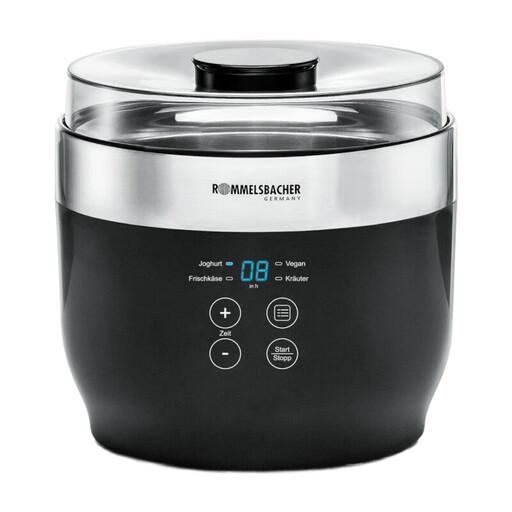
The large tubs are ideal for serving yoghurt for everyone to help themselves, provided the batch capacity meets your needs.
Rommelsbacher lists a capacity of 1.2 litres per batch and includes two glass tubs, each with a capacity of 1.2 litres. The product description mentions four programmes and a timer with automatic shut-off.
First, work out how many guests will have yoghurt and how much you want to serve per person. Compare this with the capacity per batch, rather than just the total capacity of the storage tubs supplied. Rommelsbacher lists two tubs, each with a capacity of 1.2 litres, for the JG 80, but the capacity per batch is 1.2 litres.
Keep perishable dairy products chilled and use clean utensils. The Netherlands Nutrition Centre recommends keeping your fridge at 4 °C. If you’re serving yoghurt from a shared tub, use a clean spoon and return it to the fridge after serving.
The Netherlands Nutrition Centre recommends always boiling raw milk from a farm before use. Wash your hands before preparing dairy products, and use clean utensils and work surfaces.
According to the Dutch Government, the seller must provide a solution if a product is faulty. The Netherlands has no fixed statutory guarantee period; a separate manufacturer’s guarantee or paid extended warranty does not replace your statutory rights.
According to the Dutch Government, online purchases from a business are often covered by a 14-day cooling-off period. Check the seller’s information and the terms and conditions that apply to your purchase.