
Host catering for a larger group
Wants to make enough plain yoghurt for everyone before the meal and compares the stated batch capacity with the number of guests. Rommelsbacher and Steba specifications show examples of different container sizes.


Choose based on the number of portions you need and the space available to chill the yoghurt before serving. Individual jars are handy for pre-portioned servings, while a large tub is ideal for sharing. Also check the preparation time and the containers included, and use clean equipment and suitable milk.
Wants to make enough plain yoghurt for everyone before the meal and compares the stated batch capacity with the number of guests. Rommelsbacher and Steba specifications show examples of different container sizes.
Wants to make yoghurt in lidded jars for each guest and have it chilled and ready to serve. Severin and Rommelsbacher list models supplied with portion jars and lids.
Wants to plan preparation and serving around hygiene, milk choice and chilling, especially when vulnerable guests are joining the meal. The Netherlands Nutrition Centre offers advice on handling dairy safely.
First work out how much yoghurt you want to serve. Then choose between individual portions and one large tub, and plan how to keep the prepared dairy chilled.
| Consideration | What to look for | Who is this most important for? |
|---|---|---|
| Enough yoghurt for everyone | Work out the volume you want per guest and compare the total with the stated batch capacity and the containers supplied. | When I’m cooking for a group, I want to know whether one batch will be enough for everyone. This is a priority for around 36% of consumers who put yield first. |
| Individual portions or sharing | Check the number and capacity of the jars and whether lids are included. For a tub model, see how you can keep the yoghurt covered. | I want to choose in advance between sealed portions for guests and one tub for the table. Around 29% of consumers put portioning first. |
| Preparing in advance and chilling | Make room in the fridge for the whole batch, and use clean hands and kitchen utensils. If you’re using raw milk, follow the Netherlands Nutrition Centre’s advice on heating it. | If I make the yoghurt in advance, I want to keep it properly chilled until serving. This is a priority for around 21% of consumers who put safe preparation first. |
| Controls and cleaning | Compare the controls and parts of the exact model, and check the manual to see how the containers can be cleaned. | I prefer to keep preparation straightforward and want to know how much cleaning the chosen containers involve. Around 14% of consumers put ease of use first. |
With a model that comes with large containers and portion cups, the total capacity of all the containers does not necessarily mean they can all be used in one preparation cycle.
Before working out whether there’s enough for your guests, check the manual to see which combination fits in the appliance and what the usable batch capacity is.
A timer ends the set preparation time, but it does not chill the yoghurt. If you’re serving dairy later, you’ll need to keep it chilled.
Make room in the fridge for the prepared yoghurt in advance. The Netherlands Nutrition Centre recommends 4 °C for chilled fresh milk products.
A Joybuy listing with ‘JG 80’ in the title describes an accessory with model number IB 05, according to the product specifications, not the JG 80 yoghurt maker.
Before ordering, check the product category, full model number and included parts on the product detail page.
These models offer examples of individual portion jars and larger tubs. The product specifications apply to the models listed, not automatically to the entire brand.
According to Severin, the JG 3518 is designed for individual portions and comes with seven 150 ml jars with lids.
The JG 40 comes with portion jars, while the JG 80 combines larger containers with smaller portion cups, according to Rommelsbacher.
The JM 4 FERMENT is a model with a 2 l yoghurt container, according to Steba’s product specifications.
According to the Belgian manufacturer’s specifications, the Yogurteo YG231E32 comes with seven 160 ml glass jars.
These models suit two ways of preparing yoghurt for a shared meal: individual portions, or a combination of larger containers and smaller portion cups.
 No image available
Suited to anyone who wants to prepare yoghurt in individual portions in advance.
Supplied with eight 150 ml glass jars with lids. The timer can be set from 1 to 18 hours; Rommelsbacher lists automatic switch-off.
The timer does not chill the yoghurt, so make room in the fridge for it after preparation.
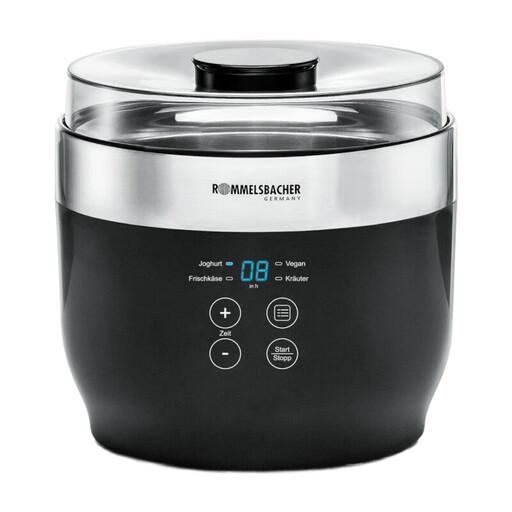 No image available
Suited to anyone who wants to choose between a larger container and smaller portions, depending on the meal.
The set includes two 1.2 l glass containers and four 125 ml ceramic portion cups, all with lids. The adjustable timer runs for up to 24 hours; the product description lists automatic switch-off and a plain yoghurt programme.
The stated capacity of all the containers does not automatically equal the yield of one cycle. Check the manual to see which combination fits at the same time.
Multiply the amount of yoghurt you want per person by the number of guests, then compare the total with the stated usable batch capacity. Don’t add together the capacities of the containers supplied without checking whether they all fit in the appliance at the same time.
Keep the dairy covered in the fridge. The Netherlands Nutrition Centre recommends 4 °C for chilled fresh milk products. Make sure you have room for the whole batch, and don’t leave the yoghurt out of the fridge for a long time.
Boil raw milk from a farm before use, as advised by the Netherlands Nutrition Centre. The Centre notes that raw milk can pose a particular risk to pregnant people, young children, older people and those with weakened immune systems, among others. Making yoghurt in a yoghurt maker does not replace this advice to heat the milk.
According to the Dutch government, the Netherlands has no fixed statutory guarantee period, but when you buy as a consumer you are entitled to a product that works as it should. If a product is faulty, the retailer is your point of contact. A manufacturer’s guarantee is in addition to your statutory rights.
No. According to the European Commission, the manufacturer uses the CE mark to indicate that the product meets the relevant EU product requirements; there is no central EU body that issues a certificate for this. The mark alone says nothing about taste or batch yield.