If you want to make natural yoghurt in individual portions and seal them straight away, choose a model with jars; for a larger quantity, a model with one large container may suit you better. Compare the capacity and controls of the specific model with how you plan to use it, and bear in mind that cleaning or dividing the yoghurt may involve extra steps. If you buy milk at a market, check whether it has been pasteurised: the Netherlands Nutrition Centre advises boiling raw milk before using it in a dish.
Who is this choice for?
For anyone who wants to store yoghurt in individual portions
If you like to seal and chill natural yoghurt in individual portions after making it, focus on the number of jars, their capacity and how easy they are to clean. Severin and Rommelsbacher list jars with lids for specific models.
For anyone who buys milk at a market
If you buy milk at a market, check whether it has been pasteurised before making yoghurt. The Netherlands Nutrition Centre advises boiling raw milk before drinking it or using it in a dish.
For anyone who prefers to make a larger quantity
If you want to make one larger batch of yoghurt and divide it up later, compare the capacity of the large container with that of the portion jars. With a large container, you will need to divide the yoghurt yourself after making it if you want to store it in individual portions.
What should you look for in a yoghurt maker?
| What to consider |
What to look for |
Who is this important for? |
| Portions and storage |
Check how many jars are included, their capacity, whether they have lids and how they should be cleaned. |
If you want to make and chill yoghurt in individual portions straight away, the jars and lids are key. Around 33% of consumers say portions are their top priority when buying. |
| Milk from a market |
Check whether the milk has been pasteurised. Boil raw milk before using it in a dish, as advised by the Netherlands Nutrition Centre. |
If you are unsure how the milk you bought has been treated, find out before you start making yoghurt. Around 25% of consumers put the safe handling of market milk first. |
| Controls and timing |
Check whether the specific model has a timer and automatic shut-off; an on/off switch is not a programmable timer. |
If you want to set the preparation time, check which controls the model actually offers. Around 25% of consumers give adjustable controls top priority. |
| A large batch |
Compare the capacity of the large container with any smaller cups, and consider how you want to store the yoghurt after making it. |
If you prefer to make one larger quantity and divide it later, weigh up the capacity of a large container against the extra step of portioning it out. Around 17% of consumers choose making one large batch as their top priority. |
Pitfalls when buying and using a yoghurt maker
-
Assuming fermentation makes raw milk safe
The Netherlands Nutrition Centre advises boiling raw milk before drinking it or using it in a dish. A yoghurt maker does not replace this step.
Ask the seller whether the milk has been pasteurised. If it is raw, boil it before use in line with the advice from the Netherlands Nutrition Centre.
Boiling raw milk takes extra time and involves an extra step before you start making yoghurt.
-
Looking only at the total capacity
A large container and individual portion jars offer different ways to divide and store yoghurt. So the total capacity alone does not tell you whether the layout suits how you plan to use it.
Compare the capacity of each container or jar and check which parts are included with the specific model.
If you want to store yoghurt from a large container in individual portions, you may need to divide it into extra storage containers.
-
Assuming a manufacturer’s guarantee defines the limits of your rights
According to the Government of the Netherlands, there is no fixed statutory guarantee period in the Netherlands. A manufacturer’s guarantee does not automatically cover all the rights you have if a product is faulty.
Keep your proof of purchase and check what any additional manufacturer’s guarantee covers.
Brands to consider
Severin
The JG 3518 and JG 3520 are models with individual portion jars. Severin says the JG 3518 comes with seven 150 ml jars and the JG 3520 with fourteen 150 ml jars.
- Severin lists suitable replacement jars for the JG 3518.
- Check the controls on the specific model; the specifications of one model do not automatically apply to others.
Rommelsbacher
According to the manufacturer, the JG 40 is a model with portion jars. The JG 80 has large containers and additional programmes, including one for natural yoghurt at 42 °C.
- The manufacturer lists a timer and automatic shut-off for the JG 40; the JG 80 comes with large containers and smaller cups.
- Not everyone will need the extra programmes on the JG 80. These are model specifications, not independently measured performance figures.
Adler
According to the manufacturer, the AD 4476 comes with seven glass jars, each with a capacity of 200 ml.
- The stated capacity per jar may be useful if you want larger individual portions.
- The manufacturer’s information does not provide an independent comparison of temperature stability or yoghurt quality. Check the details of the appliance on offer.
Ariete
Ariete lists seven glass jars and a total capacity of 1,3 l for the Yogurella 0617/00.
- The manufacturer describes making yoghurt using the jars supplied.
- The stated preparation time is a manufacturer’s specification, not a guarantee for every type of milk and starter. Do not assume there is an adjustable timer unless this is confirmed in the model specifications.
Yoghurt makers on Joybuy for individual portions or a large batch
These Joybuy products offer two ways to make natural yoghurt: in individual jars or in a larger container. Before buying, check which parts are included and the product details for the specific appliance.
 No image available
Rommelsbacher yoghurt maker JG 40
Ideal if you want to make natural yoghurt straight into individual jars.
Eight 150 ml glass jars with lids; adjustable timer from 1–18 hours and automatic shut-off according to the product description.
Check the CE marking and required product details for the specific appliance before buying.
Joybuy
 No image available
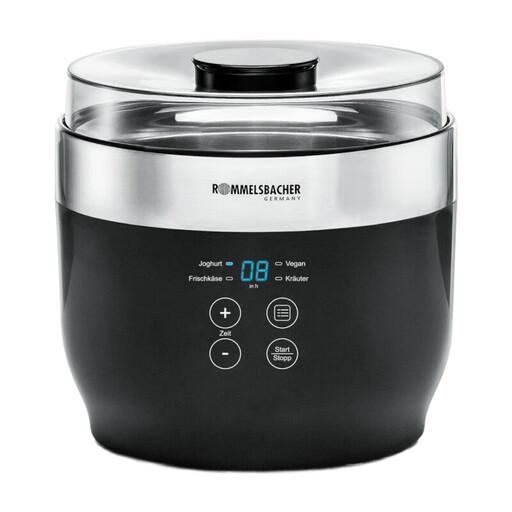
Rommelsbacher yoghurt and cream cheese maker JG 80
Ideal if you want to make a larger quantity of natural yoghurt and portion it out yourself afterwards.
Two glass containers, each with a capacity of 1,2 l, and four ceramic cups, each with a capacity of 125 ml, with lids. The manufacturer lists a programme for natural yoghurt at 42 °C.
The large containers do not automatically replace individual portions. Check the CE marking and required product details for the specific appliance before buying.
Joybuy
Frequently asked questions
Can I use raw milk from a market straight in the yoghurt maker?
No. The Netherlands Nutrition Centre advises boiling raw milk before drinking it or using it in a dish. So check first how the milk has been treated.
How should I store yoghurt and clean the jars?
Keep dairy products chilled: the Netherlands Nutrition Centre advises storing chilled dairy products at a fridge temperature of 4 °C. Follow the cleaning instructions for the specific model’s jars and lids; the Severin manual says to clean the jars and lids of the JG 3518 and JG 3520 after every use.
Is a manufacturer’s guarantee the full guarantee I have in the Netherlands?
No. According to the Government of the Netherlands, there is no fixed statutory guarantee period in the Netherlands; if a product is faulty, the retailer is your point of contact. A manufacturer’s guarantee may offer additional cover.
Does an electric yoghurt maker need a CE marking in the Netherlands?
CE marking is compulsory for electrical products covered by the relevant rules. The NVWA sets out the safety requirements for electrical appliances. Check the marking and product details for the specific appliance, not just a general description of the product range.


