Start by considering the quantity and how you want to portion it: individual pots divide the yoghurt in advance, while a larger bowl is ideal for serving from one dish. For overnight preparation, a suitable timer and automatic shut-off are useful, but remember to allow time to chill the yoghurt afterwards; a switched-off yoghurt maker is not a fridge. The Voedingscentrum recommends setting your fridge to 4 °C and chilling perishable foods promptly.
Who is this buying guide for?
Host cooking for a large gathering
If you’re making yoghurt for several guests, first decide whether individual portion pots or one larger preparation bowl will work better for the way you plan to serve it. Manufacturers such as Rommelsbacher, Steba and Lagrange state the capacity of each pot or bowl.
Overnight preparer
If you start the preparation before bed, it helps to choose an end time that gives you a chance to chill the yoghurt afterwards. WSU Extension describes fermentation as a separate preparation step; the Voedingscentrum recommends chilling perishable food promptly.
Cook catering for different dietary needs
If you want to make regular dairy yoghurt or try a different preparation, check the recipe, ingredients and starter culture for the exact appliance. The Voedingscentrum describes the bacteria found in yoghurt; Rommelsbacher and Steba list programmes for specific preparations on certain models.
What should you look for when buying?
First, decide how much yoghurt you want to make for your guests and how you plan to serve it. Then check whether the timer suits your overnight schedule and whether the appliance supports the preparation you have in mind with your chosen ingredients.
| What to consider |
What should you check? |
Who is this important for? |
| Quantity and portions |
Compare the capacity of each pot: Rommelsbacher lists eight 150 ml pots for the JG 40; Lagrange lists nine 220 ml pots for the Ligne 459002. For a bowl, check its capacity per batch. |
For a shared celebratory meal, I want to make enough in one batch and choose portions that suit my serving plan. Around 36% of consumers say batch size is their main concern. |
| Overnight scheduling |
Check the programme duration and automatic shut-off for the exact model. Rommelsbacher lists a timer of up to 18 hours for the JG 40; Lagrange lists a programme duration of up to 15 hours for the Ligne 459002. |
If I start the cycle before bed, I want to know when I can chill the yoghurt. Around 29% of consumers prioritise scheduling an overnight cycle. |
| Ingredients and programmes |
Check which preparations the model supports and which recipe suits your ingredients and starter culture. Rommelsbacher lists programmes for the JG 80 at 42 °C for regular yoghurt and 38 °C for vegan or lactose-free yoghurt; this does not guarantee that every recipe will work. |
When I want to use a particular type of milk, plant-based drink or culture, I want to choose a suitable recipe and programme. Around 21% of consumers put their preferred preparation first. |
| Cleaning and reuse |
Check how many parts you need to clean and follow the model’s instructions. Severin lists EG 3513 and EG 3514 as suitable replacement pots for the JG 3518. |
If I plan to use the appliance regularly, I consider how easy it is to clean and whether suitable replacement pots are available. Around 14% of consumers make maintenance and reuse their main concern. |
Avoiding common buying mistakes
-
Confusing the timer with chilling
Automatic shut-off ends the set cycle, but it does not keep the yoghurt chilled. So the yoghurt is not automatically kept safely once the appliance switches off.
Set the end time so you can chill the yoghurt after preparation. The Voedingscentrum recommends a fridge temperature of 4 °C and promptly returning perishable foods to the fridge.
Remember to make room in the fridge and allow time to move the yoghurt there afterwards.
-
Comparing only the number of pots
Seven, eight or nine pots don’t tell you how much yoghurt you can serve unless you also know each pot’s capacity. If a batch is too small, you may need to run another cycle.
Compare both the number of pots and their capacity with the number of guests and your serving plan.
A second batch takes extra preparation time and needs more space in the fridge.
-
Assuming an extra programme guarantees results
A programme for an alternative preparation doesn’t mean that every type of milk, plant-based drink or starter culture will be suitable.
Before starting the cycle, check for a recipe that suits your ingredients and read the instructions for your chosen model.
If a recipe isn’t suited to your ingredients, you may need to start again and spend more time preparing it.
Brands and model differences
The features listed apply to specific models; they are not a general assessment of a brand or of the preparation results.
Rommelsbacher
The JG 40 is designed for making yoghurt in individual portion pots, while the JG 80 has a larger preparation bowl and separate programmes.
- Rommelsbacher lists eight 150 ml pots, a timer of up to 18 hours and automatic shut-off for the JG 40.
- For the JG 80, the manufacturer lists a 1.2-litre bowl per batch and programmes for different types of yoghurt.
- The capacity and programmes apply to the models listed; check the version and the recipe to use with it.
Steba
The JM 3 uses portion pots and has adjustable time and temperature settings; the JM 4 FERMENT has a larger yoghurt pot and several programmes.
- According to Steba, the JM 3 has eight 180 ml pots, an adjustable temperature of 20–55 °C and a timer of 1–48 hours.
- Steba lists a 2-litre yoghurt pot and a separate pot with a sieve for cream cheese for the JM 4 FERMENT.
- The pots supplied and the programmes vary by model; check which parts are intended for your chosen preparation.
Severin
The JG 3518 is a pot-style model for anyone looking for simple operation without a display.
- Severin lists seven 150 ml pots and names EG 3513 and EG 3514 as suitable replacement pots.
- The specifications do not mention a display. Check separately whether the timer and end time suit your overnight schedule.
Lagrange
The Ligne 459002 is a model with several portion pots and a programmable cycle.
- Lagrange lists nine 220 ml pots and a programme duration of up to 15 hours with automatic shut-off.
- These features apply to the Ligne 459002; check the version and product specifications of the model you’re considering.
Yoghurt makers at Joybuy
This selection focuses on Rommelsbacher yoghurt makers for individual portions or preparation in a larger bowl.
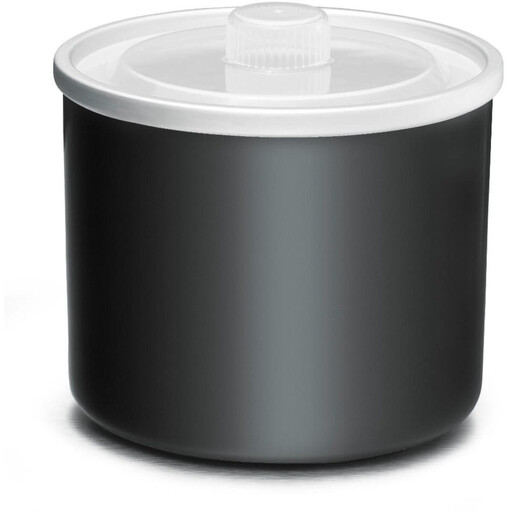 Image unavailable
Rommelsbacher JG 80 yoghurt and cream cheese maker
The larger preparation bowl is ideal if you want to serve yoghurt from one dish.
Rommelsbacher lists a 1.2-litre bowl per batch and a timer of up to 24 hours with automatic shut-off.
View at Joybuy
 Image unavailable
Rommelsbacher JG 40 yoghurt maker
This model is ideal if you want to portion yoghurt into individual pots in advance.
Rommelsbacher lists eight 150 ml glass pots, a timer of up to 18 hours and automatic shut-off. Allow time to chill the yoghurt once the cycle is complete.
View at Joybuy
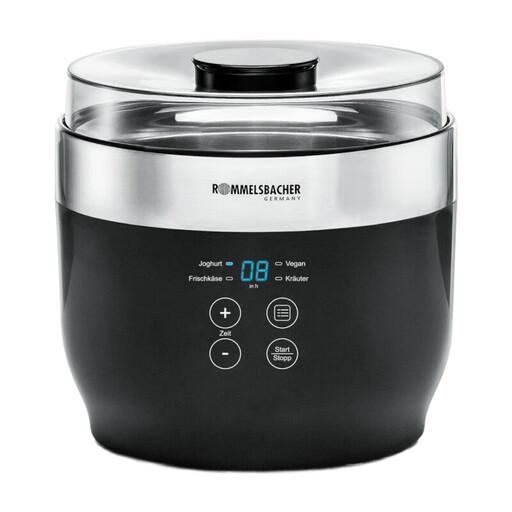 Image unavailable
Rommelsbacher JG 80 yoghurt and cream cheese maker
The larger preparation bowl is designed for anyone who wants to serve yoghurt from one bowl.
For the JG 80, Rommelsbacher lists a 1.2-litre bowl per batch, a timer of up to 24 hours and automatic shut-off. The manufacturer lists programmes at 42 °C for regular yoghurt and 38 °C for vegan or lactose-free yoghurt; check which recipe suits your ingredients.
View at Joybuy
Frequently asked questions
Can yoghurt stay in the switched-off machine after an overnight cycle until the celebratory meal?
Don’t use the switched-off machine to store yoghurt. The Voedingscentrum recommends setting your fridge to 4 °C and chilling perishable food promptly. To end fermentation, also follow the recipe and the appliance instructions.
How should I prepare the milk and pots?
Use clean equipment and follow a suitable yoghurt recipe. WSU Extension describes heating the milk, adding a starter and leaving the mixture to incubate; also follow the instructions for your ingredients and machine. A timer doesn’t take the place of these preparation steps.
Is raw milk a suitable choice if you’re serving guests who are more vulnerable?
The Voedingscentrum advises pregnant women, older people, young children and people with weakened immune systems to avoid raw milk products or heat them thoroughly first. If you’re sharing a meal, don’t assume raw milk is safe for everyone.
In the Netherlands, am I limited to the manufacturer’s warranty after buying?
No. ACM ConsuWijzer explains that statutory guarantee rights apply alongside any manufacturer’s or seller’s warranty. If a product breaks too soon under normal use, the seller must resolve the issue in line with the applicable rules. A fixed manufacturer’s warranty period is not the same as the duration of all your statutory rights.
What product safety should I check for an electric yoghurt maker?
If an appliance falls within the scope of the EU Low Voltage Directive, the relevant safety requirements and CE obligations apply. Check the marking and product information for the specific version; a general model name alone does not confirm that a particular version meets the applicable requirements.


