
For making breakfast portions ahead
You want to prepare individual breakfast portions and keep them chilled, so you don’t have to spoon yoghurt out of a large container in the morning. Severin and Rommelsbacher models come with portion pots.


Choose based on how often you eat yoghurt and whether you want to store individual breakfast portions: pots make portioning easy, while a compact bowl has fewer separate parts. A timer is most useful if you plan the preparation in advance; a strainer or adjustable programmes are worth considering if you’ll actually use them. Before buying, also check the electrical product information and storage instructions.
You want to prepare individual breakfast portions and keep them chilled, so you don’t have to spoon yoghurt out of a large container in the morning. Severin and Rommelsbacher models come with portion pots.
You want to set the preparation time and check whether the appliance switches off automatically afterwards. Check which timer functions the specific model has; Rommelsbacher lists these functions for the JG 40.
You want to strain yoghurt from time to time and don’t mind an extra part and a little more cleaning. Ariete lists a filter basket for the Yogurella 0621/10.
Start with the portion size and the amount you’ll actually use. Then consider extra features such as a timer, strainer or programmes, and factor in cleaning and chilled storage.
| What to consider | What to look for when buying | Who should consider this? |
|---|---|---|
| Portion size | Compare the number of pots and the capacity of each one. Check the manual to see whether you can make a batch with fewer filled pots. | If you prepare yoghurt for several mornings, you’ll want to store portions without making more than you can use. Around 33% of consumers make suitably sized, individually stored portions their top priority. |
| Planning the preparation | Check whether the timer sets an end time and whether the appliance switches off automatically afterwards. | If you want to start the preparation at a set time, an adjustable end time can be useful. Around 27% of consumers put planning at the top of their buying priorities. |
| Type of yoghurt you want to make | Check whether a filter or programmes are included, and follow the manual for the ingredients and method you choose. | If you want to strain yoghurt or try different preparations, look for these extra options. Around 20% of consumers make their preferred type of yoghurt their top priority. |
| Cleaning and storage | Check the cleaning instructions and whether the pots have lids. The Netherlands Nutrition Centre recommends keeping prepared yoghurt chilled; put it in a fridge at 4 °C promptly. | If you want to spend as little time as possible washing up and storing yoghurt carefully, maintenance and aftercare should factor into your choice. Around 20% of consumers put these points first. |
A model with several pots has capacity for multiple portions, but that maximum amount may not suit your breakfast routine.
Plan each batch around how much you use, and check the manual for your chosen model to see whether you can make a smaller batch.
A timer, filter or programme describes a feature of the appliance; by itself, it doesn’t guarantee a specific texture for every recipe.
Choose extra features only if you want to make the preparations they’re designed for, and check which ingredients and accessories the manual recommends.
A product title may sound like a particular model, even when the model number or product category listed is different.
Before buying, compare the model number, product category and included parts with the manufacturer’s information.
The JG 3518 is a model with individual breakfast pots.
The JG 40 is designed for portion pots and has a timer; the JG 80 combines portion pots with larger containers and additional features.
The Yogurella 0621/10 is a bowl model supplied with a filter for making strained yoghurt.
The JM 3 combines portion pots with adjustable temperature and a timer.
The FA-5120-2 is a pot model with adjustable temperature and a digital timer.
These product picks are yoghurt makers with portion pots; the JG 80 also comes with larger containers and a strainer.
 Image unavailable
A good fit if you want to make individual portions and plan the preparation in advance.
The product information lists eight 150 ml glass pots, a 1–18-hour timer and adjustable temperature control.
Allow space for the pots and time to clean them.
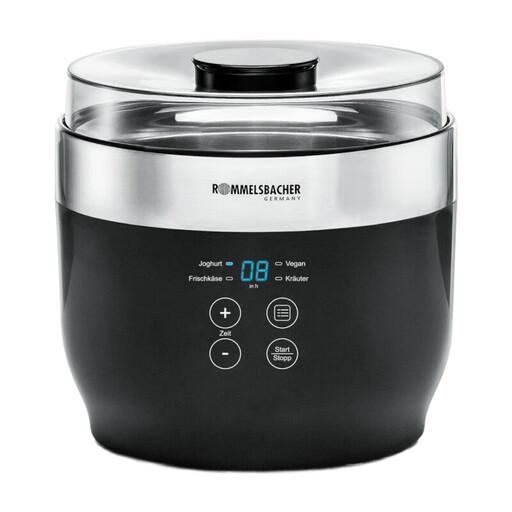 Image unavailable
A good choice if you want to combine portion pots with larger containers and a strainer for different preparations.
Rommelsbacher lists four 125 ml ceramic portion pots, two 1.2-litre glass containers and a strainer.
The extra parts need storage space and cleaning if you use them.
No. The number of pots tells you what comes with the model, not how many you have to fill every time. Check the manual for the exact model to see whether you can use fewer pots, and how to do so.
The Netherlands Nutrition Centre recommends using clean hands, surfaces and kitchen utensils, and keeping dairy products chilled. Boil raw farm milk before use, following the Netherlands Nutrition Centre’s advice. Put prepared yoghurt in a fridge at 4 °C promptly and use a clean spoon. The advice to store yoghurt for 5–7 days on the storage page cited applies to opened full-fat yoghurt and is not automatically the shelf life of every homemade batch.
Check the cost of compatible replacement pots and any delivery charges. According to the Dutch government, you’re entitled to a product that works properly; there is no fixed statutory guarantee period, and the retailer is your point of contact if something is wrong. For eligible online purchases from a business, you generally have a 14-day cooling-off period.
CE marking is required for electrical products covered by the relevant electrical product regulations. The Netherlands Food and Consumer Product Safety Authority (NVWA) states that the low-voltage rules apply to electrical equipment with a nominal AC voltage of 50–1,000 V. Check the marking and product information for the specific appliance: a listing on a webshop or in a ranking does not, by itself, prove compliance.