
For families making one jug of smoothies
You make a larger batch for each meal and don’t want to empty lots of small jars first. So compare the capacity per batch with the amount of yoghurt in your recipe.


If you usually make one jug of smoothies for the family, compare the capacity of a single batch of yoghurt with your recipe; a large container means you won’t have to combine several individual portions. If you want to store or serve yoghurt in individual portions, check the number and capacity of the jars. Extra programmes are mainly worth considering if you plan to make the recipes they’re designed for. Also check the use and cleaning instructions, and the CE marking on the specific model.
You make a larger batch for each meal and don’t want to empty lots of small jars first. So compare the capacity per batch with the amount of yoghurt in your recipe.
You want to store yoghurt separately or serve it by the portion. Individual jars can be handy, but they also need filling, chilling and cleaning.
You want to try making more than just plain yoghurt. Check which programmes and recipe instructions are available for the specific model.
Start with the amount of yoghurt you need for one family meal. Then choose between one large container and individual portions. Extra programmes are mainly worth considering if you’ll actually use them.
| What to consider | What should you look for? | Who is this important for? |
|---|---|---|
| Capacity per batch | Compare the capacity of one container with your smoothie recipe; don’t add together the capacities of separate containers as if they make up one batch. | If you usually make one jug for the family, you’ll want to be able to prepare enough yoghurt in one go. Around 40% of consumers prioritise capacity per batch. |
| Serving individual portions | Check both the number of jars and the capacity of each one. | If you want to store yoghurt for each family member or prepare different portions, individual jars may be more convenient. Around 30% of consumers prioritise separate portions. |
| Other preparations | Check which programmes and recipes are available for the model, and which ingredients are suitable for them. | If you want to try making more than just plain yoghurt, the relevant settings are worth considering. Around 20% of consumers prioritise having a range of preparations. |
| Cleaning and storage | Check the manual to see which parts can be cleaned, and whether the containers or jars will fit in your fridge. | If you want to minimise the number of separate parts to clean after making yoghurt and keep it chilled, consider the layout and cleaning instructions. Around 10% of consumers say this is their top priority. |
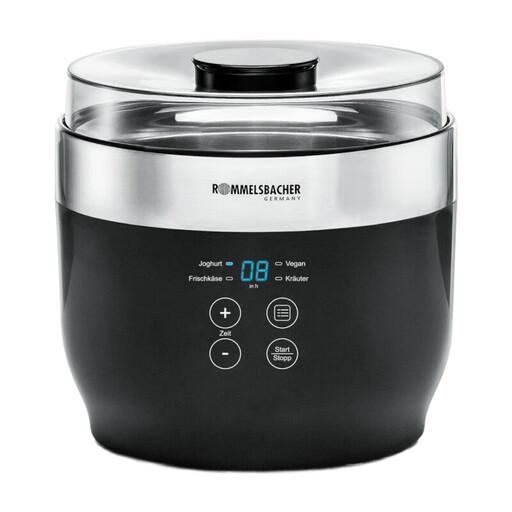
For the Rommelsbacher JG 80, the manufacturer lists two included containers, each with a capacity of 1.2 litres, but the capacity is 1.2 litres of yoghurt per batch. So the combined capacity of the containers doesn’t tell you how much you can make in one go.
Compare the capacity per batch with the amount in your smoothie recipe.
A programme describes a model’s settings, not the result you’ll get with every drink, starter or recipe. The same applies to plant-based preparations.
Check the recipe instructions and which ingredients are suitable for the specific model.
An additional guarantee is not the same as the statutory protection you have if a product is faulty. According to the Rijksoverheid, there is no fixed statutory guarantee period in the Netherlands; the retailer remains your point of contact for a solution if a product is faulty.
Consider what any additional cover offers beyond the rights you already have.
These brands and model features can help you compare different options; their inclusion here doesn’t indicate availability at Joybuy.
Steba offers both models with individual jars and a model with one larger yoghurt container.
Rommelsbacher offers a model for individual portions and another with a larger container and several programmes.
The Severin JG 3518 is a model with separate individual jars.
For the Ligne 459002, Lagrange lists a version with glass jars and a drinking yoghurt function.
These models suit two different approaches to making family smoothies: preparing a larger batch in one container or dividing yoghurt into individual portion jars.
 No image available
Ideal if you want to make enough yoghurt for several smoothies in one batch and try making other yoghurt-based preparations too.
Capacity: 1.2 litres per batch. The manufacturer lists four programmes, including programmes for natural and plant-based yoghurt. Follow the model-specific recipe instructions for the preparation you want to make.
 No image available
Ideal if you want to store or serve yoghurt in individual portions. For one large jug of smoothies, you’ll need to combine the portions.
According to the manufacturer, it comes with eight 150 ml glass jars with lids. The product description lists a timer that can be set from 1 to 18 hours.
Compare the amount of yoghurt in your own recipe with the capacity per batch, not with the combined capacity of the containers provided. Steba lists one 2-litre yoghurt container for the JM 4 FERMENT; Rommelsbacher gives the JG 80 a capacity of 1.2 litres per batch.
Follow the manual for your specific model. The Severin manual says to clean the jars and lids after use, and warns that the electrical base must not be immersed in liquid.
Keep yoghurt chilled. Voedingscentrum recommends keeping opened full-fat yoghurt in the fridge for 5–7 days. This advice applies to the product described and doesn’t establish a shelf life for every homemade preparation. Also follow the instructions for your own recipe and ingredients.
According to the Rijksoverheid, the retailer must provide a solution if a product is faulty. The Netherlands has no fixed statutory guarantee period; consider any additional cover in light of the rights you already have.
Yes. The NVWA states that CE marking is required for electrical products. This general requirement doesn’t prove that a specific product listing is correctly marked, so check the model you intend to buy.