
Host making one large jug of smoothies
Wants enough plain yoghurt for one batch and compares the usable capacity with the amount needed for their own recipe.


First, work out how much yoghurt you need for your smoothies and whether you want to scoop it from one large tub or divide it into portions in advance. Compare the capacity per batch, preparation time and whether a strainer is included. A programme for plant-based or lactose-free preparation doesn’t guarantee that every recipe or finished product will be suitable. Remember to allow time and space in the fridge to chill the yoghurt after it’s made.
Wants enough plain yoghurt for one batch and compares the usable capacity with the amount needed for their own recipe.
Wants to portion or store yoghurt in advance and looks at the number of sealable jars and the space available in the fridge.
Wants to choose ingredients and starter cultures to suit guests who, for example, don’t have regular dairy yoghurt. A programme on its own doesn’t determine whether the finished product is suitable.
Work out how much you need from your smoothie recipe, then choose between making one larger batch or preparing portions to divide up in advance.
| What to consider | What to look for when buying | Who is this important for? |
|---|---|---|
| Capacity per batch | Compare the amount in your recipe with the capacity per batch, not the combined capacity of all the jars supplied. Steba lists a 2-litre yoghurt tub for the JM 4; Rommelsbacher Netherlands states that the JG 80 can make up to 1.2 kg of yoghurt per batch. | If I’m making one smoothie base for a group, I want the amount from a single batch to suit my recipe. Around 29% of consumers prioritise making enough yoghurt in one batch. |
| Dividing into portions | Check how many jars are included, their capacity and whether lids are supplied. Steba lists 12 jars of 0.2 litres for the JM 2; Severin lists seven 150 ml jars with lids for the JG 3518. | If I want to prepare different portions or smoothie variations, I want to be able to divide the yoghurt up in advance. Around 24% of consumers say portioning is their main concern. |
| Ingredients for guests | Check the drink, starter culture and recipe instructions against the specific dietary requirement. Don’t assume something is suitable just because of a programme name. The Voedingscentrum distinguishes between lactose intolerance and cow’s milk allergy. | If guests avoid certain ingredients, I want to know in advance whether the recipe meets their needs. Around 18% of consumers prioritise ingredients that are suitable for their guests. |
| Timing and chilling | Check the preparation time for your recipe and the appliance timer. Moulinex lists a timer of up to 15 hours for the YG231E32; Rommelsbacher lists a timer of up to 24 hours for the JG 80. Then allow time and space in the fridge for chilling. | If the smoothies need to be ready at a set time, I want to be able to plan the preparation and chilling around it. Around 18% of consumers prioritise planning around serving time. |
| Texture you’re after | Decide whether your recipe calls for strained yoghurt, then check whether a strainer or filter basket is included with the model. Steba describes a strainer with the 1.3-litre tub for the JM 4; Ariete lists a filter basket for the Yogurella 0621/10. | If I want thicker yoghurt for my recipe, I look for a model that lets me strain it and factor in the extra step. Around 12% of consumers prioritise the texture of their yoghurt. |
A second tub may be intended for another batch or a different occasion. So the combined capacity of separate tubs doesn’t tell you how much yoghurt you can make in one cycle.
Compare the capacity per batch with the amount your recipe needs for all your guests.
If one batch isn’t enough, you may need to make another. Be sure to allow time for it in your plans.
Automatic shut-off ends the appliance’s set programme; it doesn’t chill the yoghurt afterwards.
Allow time and space in the fridge separately after preparation. The Voedingscentrum recommends keeping yoghurt chilled and putting it back in the fridge promptly after use.
A label for lactose-free preparation doesn’t guarantee that every ingredient or finished product will suit a guest’s needs. Lactose intolerance and cow’s milk allergy are different conditions, according to the Voedingscentrum.
Ask which ingredients your guest avoids, then check the ingredients, starter culture and preparation instructions for the recipe.
A title may not give you enough information to identify the appliance or accessory on offer.
Before buying, check that the model number and product specifications match the yoghurt maker you’re looking for.
Steba offers both a jar model and a model with a large yoghurt tub and a separate tub with a strainer.
According to Rommelsbacher Netherlands, the JG 80 combines larger tubs with portion pots and a strainer.
According to Severin, the JG 3518 is a yoghurt maker with separate glass portion jars.
According to Moulinex, the Yogurteo YG231E32 is a jar model with a digital timer.
Ariete describes the Yogurella 0621/10 as a model with tubs and a filter basket for straining yoghurt.
This selection from Joybuy includes yoghurt makers with separate portion jars and a model for making a larger batch. Choose based on the capacity per batch, how you want to divide the portions and the space you have to chill the yoghurt.
 No image available
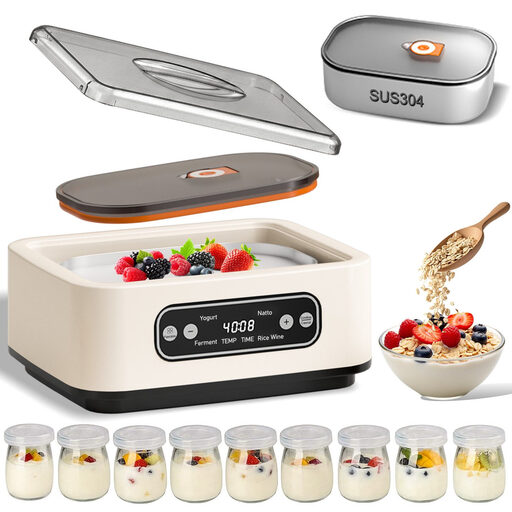
A good fit if you want to divide yoghurt into individual jars in advance. The product title lists a 1.6 l inner pot, adjustable temperature, a timer and 9 borosilicate glass jars.
 No image available
The individual jars may suit anyone who wants to divide portions or variations in advance. The product title lists 8 jars (1440 ml), digital temperature control and a 48-hour timer.
 No image available
A good fit if you want to store yoghurt in individual portions. The product description lists eight 150 ml glass jars with lids.
 No image available
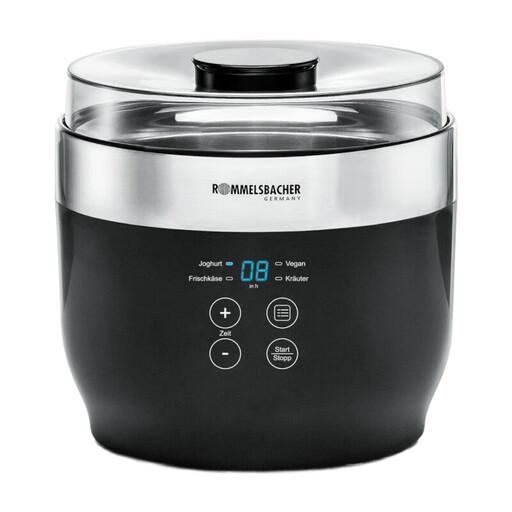
A good fit if you want to make one larger yoghurt base to scoop into smoothies. Rommelsbacher Netherlands lists a maximum of 1.2 kg of yoghurt per batch and an adjustable timer of up to 24 hours.
Work out how much you need from your own smoothie recipe and compare it with the capacity per batch. Check the preparation time for your recipe, then allow separately for the yoghurt to chill, covered, in the fridge. Automatic shut-off isn’t a chilling function.
The Voedingscentrum recommends putting yoghurt back in a 4 °C fridge promptly and using a clean spoon. The advice to use it within 5–7 days applies to opened, full-fat yoghurt; it isn’t automatically a guaranteed storage period for every homemade batch.
The Voedingscentrum says pasteurised milk is the safest choice and advises boiling raw milk before drinking it or using it in a dish. A yoghurt maker doesn’t replace this precaution.
No, you can’t tell that from the programme name. According to the Voedingscentrum, lactose intolerance concerns milk sugar, while cow’s milk allergy is a reaction to milk protein. Check the ingredients and starter culture for the guest in question.
No. According to the Dutch government, there is no fixed legal guarantee period in the Netherlands: a product should last as long as you can reasonably expect it to. If a product is faulty, contact the seller; a manufacturer’s guarantee is separate.