
Families who like to cook ahead
Want to make enough yoghurt in one go for several breakfasts, and weigh up batch size against the space available in the fridge. Rommelsbacher and Steba list different capacities for their models.


Choose a yoghurt maker based on how much yoghurt your family eats at a time and whether you want to portion it into individual servings in advance. Then compare the timer and any programmes with your routine and ingredients. Stated capacities come from the manufacturer and don’t guarantee the same results with every recipe.
Want to make enough yoghurt in one go for several breakfasts, and weigh up batch size against the space available in the fridge. Rommelsbacher and Steba list different capacities for their models.
Want to portion yoghurt into separate jars in advance, so each family member can grab their own. Severin and Steba list models that come with multiple individual jars.
Want to try other settings as well as natural yoghurt, and check that the selected setting suits the milk and starter they use. Rommelsbacher describes several programmes for the JG 80.
Start by considering the batch size and how you want to portion the yoghurt. Then compare the preparation time and any programmes with your breakfast routine and the ingredients you plan to use.
| What to consider | What should you check? | Who is this important for? |
|---|---|---|
| Quantity per batch | Compare the stated batch capacity with how much your family eats, and check whether it applies to one preparation. Steba lists 2.4 litres divided between twelve jars; Rommelsbacher lists 1.2 litres of natural yoghurt per preparation for the JG 80. | If I’m making yoghurt ahead for several breakfasts, I want the quantity to suit what we’ll eat and what we can fit in the fridge. Around 28% of consumers are most concerned about batch size. |
| Individual portions | Check how many jars are included, the capacity of each one and whether suitable replacement jars are available. Severin lists seven 150 ml jars for the JG 3518; Steba lists twelve 0.2-litre jars for the JM 2. | If everyone wants to grab their own portion, I care about how the jars are arranged and stored. Around 22% of consumers are mainly looking for individual portions. |
| Hygienic preparation and storage | Check the cleaning instructions for the exact model, and clean your hands, surfaces and utensils thoroughly. Keep prepared yoghurt refrigerated; don’t assume storage advice for shop-bought yoghurt applies to homemade yoghurt. | When I’m making dairy products for my family, I want to know how to keep the parts clean and store the yoghurt in the fridge after preparation. Around 22% of consumers are most concerned about hygiene and storage. |
| Planning preparation | Compare the timer range and automatic shut-off, and allow time to chill the yoghurt afterwards. Moulinex lists a timer of up to 15 hours and automatic shut-off for the Yogurteo YG231E32. | If I want to fit preparation around my evening and morning routine, an adjustable timer is important. Around 17% of consumers prioritise planning. |
| Other types of milk and recipes | Check which ingredients and methods are covered by the instructions. For the JG 80, Rommelsbacher lists a separate programme for vegan or lactose-free yoghurt; this doesn’t prove that every recipe will work. | If I want to try recipes beyond natural yoghurt, I look for suitable programmes and instructions for my ingredients. Around 11% of consumers are most interested in recipe variety. |
For the JG 80, Rommelsbacher lists two 1.2-litre glass containers as well as an output of 1.2 litres of natural yoghurt per preparation. So the number of containers doesn’t tell you how much yoghurt the appliance makes in one go.
Compare the stated capacity per preparation separately with the list of included containers and jars.
A timer or shut-off function ends the appliance’s cycle, but it doesn’t keep the yoghurt chilled.
Allow time to put the yoghurt in the fridge after preparation.
A Joybuy listing with JG 80 in the title gave the model as IB 05 in the specifications and included an ice-cream maker accessory.
Before buying, check that the model number, product category and included parts match on the product detail page.
The JG 3518 and JG 3520 differ in the number of individual jars included.
The JG 80 combines larger containers with individual portion cups and several programmes.
The JM 2 is designed for individual portions, with a larger set of jars.
The Yogurteo YG231E32 combines smaller portion jars with an adjustable timer.
The Yogurella 0617/00 is designed for individual portions in glass jars.
These product picks suit individual portions and larger batches with the option of using portion cups.
 Image unavailable
Worth considering if you want to portion yoghurt into individual servings in advance and plan when it’s made. Check the product detail page for the number of jars, their capacity and the timer range for this version.
Follow the appliance’s cleaning instructions; the heating base must not be immersed in water.
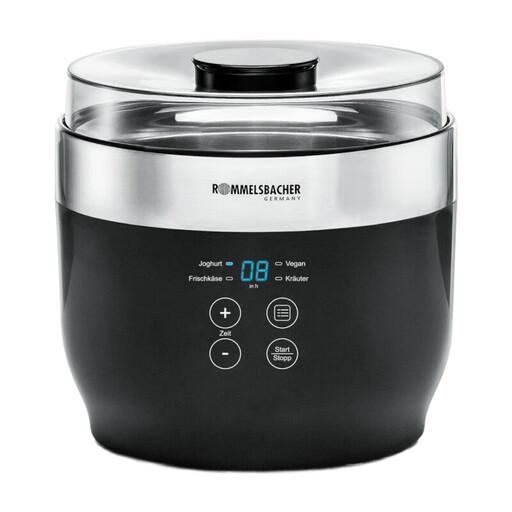 Image unavailable
Suited to anyone who wants to make a larger batch as well as use a few individual portion cups. Rommelsbacher lists 1.2 litres of natural yoghurt per preparation, two 1.2-litre glass containers and four 125 ml ceramic cups.
Rommelsbacher lists separate programmes for natural yoghurt, vegan or lactose-free yoghurt, cream cheese and herb extracts. Follow the instructions for your chosen ingredients; a programme can’t guarantee results with every recipe.
Count how many individual portions you want to prepare at once, then compare the capacity of each jar. For the models in this article, manufacturers list, for example, seven jars of 150 or 160 ml and twelve jars of 0.2 litres. Extra jars are most useful if you’re happy to fill, clean and store them in the fridge.
Follow the instructions for your exact model, and make sure your hands, surfaces and utensils are clean. The Steba JM 2 manual says to wash the parts before first use and not to immerse the appliance in water.
Keep prepared yoghurt chilled and use clean spoons when opening a jar. The Netherlands Nutrition Centre recommends a fridge temperature of 4 °C for chilled dairy products. Storage advice for opened shop-bought yoghurt isn’t a set shelf life for a homemade recipe.
For electrical appliances covered by the relevant European product safety rules, the manufacturer must apply the CE mark and draw up an EU Declaration of Conformity when the product meets the requirements. According to the Dutch government, CE is not an independent quality mark. Check the product information for the version on offer; a mark on another model proves nothing about this one.
The Netherlands Nutrition Centre advises boiling raw farm milk before use. It particularly advises pregnant women, young children, older people and anyone with a weakened immune system against consuming raw milk products. Also follow your recipe and the instructions for your yoghurt maker.