What should you look for when choosing?
First decide how much yoghurt you need and how many individual portions you’ll serve. Then check that you have enough fridge space for the filled tub or pots, and plan when to make the yoghurt.
| What to consider |
What to look for |
Who is this important for? |
| Capacity per batch |
Compare the stated yoghurt capacity with the amount you need; don’t automatically include a separate cheese tub. |
If I’m making yoghurt for lots of guests, I want to know whether one batch will suit my serving plan. Around 36% of consumers prioritise batch size. |
| Number of portions |
Check how many pots there are and their capacity; also consider how many individual pots you’ll need to wash. |
If I want to portion the yoghurt out for each guest in advance, I look at both the number of pots and the portion size. Around 29% of consumers prioritise pre-portioned servings. |
| Fridge space |
Check that your fridge can fit the filled tub or all the pots at once. |
If I’m short on fridge space, I want to know in advance where I can put the yoghurt after making it. Around 21% of consumers prioritise fridge space and safe dairy handling. |
| Planning when to make it |
Check how the machine ends the yoghurt-making process, and allow time and space for the yoghurt to chill afterwards. |
If I’m making yoghurt for a particular serving time, I want to know how to plan when to start. Around 14% of consumers prioritise planning. |
Yoghurt makers at Joybuy
This selection includes yoghurt makers with individual pots and models with tubs, for anyone looking to make and serve plain yoghurt at a gathering.
 No image available
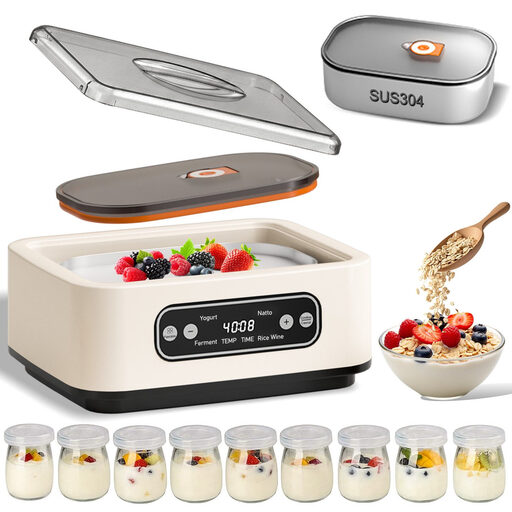
Yoghurt Maker, 1.6 l, SUS304 inner tub and 9 pots
The nine pots are ideal if you want to prepare the yoghurt in individual portions.
The product name lists a 1.6 l inner tub, temperature control, a timer and nine borosilicate glass pots.
View at Joybuy
 No image available
FOHERE Yoghurt Maker with 8 pots, 1440 ml
This model is designed for making yoghurt in eight individual pots.
The product name lists a capacity of 1440 ml, digital temperature control, a timer of up to 48 hours and automatic shut-off.
View at Joybuy
 No image available
Rommelsbacher Yoghurt Maker JG 40
The individual pots are handy if you want to prepare portions in advance.
Rommelsbacher lists eight 150 ml pots for the JG 40. The product description mentions an adjustable timer from 1 to 18 hours.
View at Joybuy
 No image available
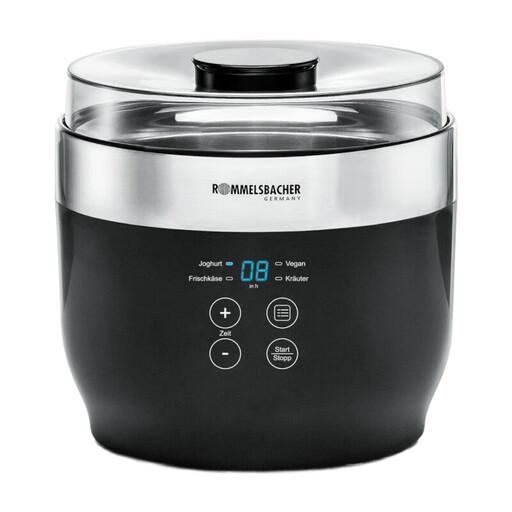
Rommelsbacher yoghurt and cream cheese maker JG 80
The combination of tubs and smaller pots is a useful option if you want to store yoghurt in a tub or prepare individual portions in advance.
Rommelsbacher lists two 1.2 l glass tubs and four 125 ml ceramic pots. Don’t assume the capacity of both tubs can be added together to make one batch without checking.
View at Joybuy
Frequently asked questions
How can I tell whether one batch will be enough?
Work out how many guests you’re expecting and how much yoghurt you want to serve each person, then compare that amount with the stated yoghurt capacity of the exact model. If you’re considering pots, check how many individual portions it makes too. The stated capacity doesn’t guarantee a specific finished yield.
How should I handle milk, pots and homemade yoghurt hygienically?
Use clean hands, surfaces and kitchen utensils, and store chilled dairy products at 4 °C, as advised by the Netherlands Nutrition Centre. Check whether farm milk has been pasteurised; according to the Netherlands Nutrition Centre, raw milk should be boiled before use. Chill the yoghurt promptly after making and serving it.
How long can yoghurt be left out of the fridge while serving?
According to the Netherlands Nutrition Centre, perishable food, including milk, should not be left out of the fridge for more than 2 hours. It’s best to put the yoghurt back in the fridge sooner. This is food safety advice, not a specific shelf-life test for homemade yoghurt.
What can I do if my yoghurt maker breaks too soon during normal use?
According to ACM Consumer Information, the retailer is responsible for providing a remedy under the statutory guarantee if a product is faulty. Depending on the circumstances, the retailer must offer an appropriate solution free of charge, such as a repair, replacement or refund. A manufacturer’s guarantee doesn’t replace this right.
Is CE marking compulsory for an electric yoghurt maker?
This applies to an electric yoghurt maker covered by the relevant Dutch regulations. The Netherlands Food and Consumer Product Safety Authority says CE marking is compulsory for electrical equipment covered by the low-voltage rules, including equipment with a rated AC voltage of 50 V to 1000 V. Check separately that the item you intend to buy carries the marking.


