
Cooking for a large community group
You’ll want to know whether the capacity per batch is enough for your guests. A model with lots of jars can provide portions that are ready in advance.


First, work out how much yoghurt you’ll need for your guests, then compare that with the capacity per batch. Individual jars are handy if you want to prepare covered portions in advance; a large tub is better if you plan to serve everyone from one container. With either option, remember to leave enough fridge space to keep the yoghurt chilled.
You’ll want to know whether the capacity per batch is enough for your guests. A model with lots of jars can provide portions that are ready in advance.
You want to cover the portions, keep them chilled and bring them out when it’s time to serve. Models with individual jars suit this approach.
You want to make plain yoghurt in a larger tub and serve it at the community meal. Clean serving utensils and chilled storage are also part of your serving plan.
If you’re making plain yoghurt for a community meal, your choice will mainly depend on how much you need, how much fridge space you have and how you plan to serve it.
| What to consider | What should you check? | Who should pay particular attention? |
|---|---|---|
| Quantity per batch | Multiply the number of portions by the amount per portion, then compare the result with the capacity per batch. Steba lists twelve 0.2-litre jars for the JM 2, giving a total of 2.4 litres; Rommelsbacher states that the JG 80 makes 1.2 litres of plain yoghurt per batch. | If I’m cooking for a larger group, I want to know whether one batch will be enough before choosing a model. Around 33% of consumers prioritise getting enough volume per batch. |
| Fridge space and serving | Check that all the filled jars or tubs will fit in your fridge, and plan when you’ll put them on the table. The Voedingscentrum recommends setting your fridge to 4 °C and not leaving perishable food out of the fridge for more than two hours. | If I have limited fridge space, I want to plan production and serving around it. Around 27% of consumers prioritise chilled storage and serving. |
| Individual portions or one container | Compare the number of jars, their capacity and whether they have lids with your serving plan. Severin lists seven 150 ml jars with leak-proof lids for the JG 3518; Steba lists twelve 0.2-litre jars. | If I want to prepare covered portions in advance, individual jars are handy; a larger tub is better if I plan to serve from one container. Around 20% of consumers mainly choose according to how they want to portion the yoghurt. |
| Controls for plain yoghurt | Check the controls and the manual for the exact model. Moulinex lists a timer of up to 15 hours and automatic shut-off for the YG231E32; also compare the programmes with what you actually plan to make. | If I mainly want to make plain yoghurt, I want straightforward controls without choosing features I don’t need. Around 20% of consumers prioritise simple, easy-to-plan controls. |
Jars can vary in size, so having more of them doesn’t automatically mean there’ll be enough yoghurt for your group. You’ll also need space in the fridge for the filled jars.
Work out the total amount you need, then check both the number of jars and the capacity of each one.
The shape of the tub doesn’t tell you how much plain yoghurt the machine can make per batch. Rommelsbacher lists a capacity of 1.2 litres per batch for the JG 80; Steba gives the JM 2 a total jar capacity of 2.4 litres.
Compare the stated capacity per batch and take the number of guests into account.
Yoghurt is a perishable dairy product. The Voedingscentrum recommends not leaving perishable food out of the fridge for more than two hours.
Make room in the fridge, use clean serving utensils and put out smaller amounts at a time.
A listing with JG 80 in the title may, according to the product details, be for an IB 05 accessory rather than the yoghurt maker.
Before buying, check the model number, product category and which parts are included.
The JM 2 is an option if you want to prepare several portions in one batch.
The JG 80 is designed for making yoghurt in a larger tub; the JG 40 comes with individual jars.
The Yogurteo YG231E32 is a compact option with individual portions.
The JG 3518 is a compact model with individual jars; the JG 3521 is a separate model.
This selection at Joybuy includes individual jars for preparing portions in advance and a larger tub for yoghurt you plan to serve from one container.
 No image available
Ideal if you want to prepare individual portions and cover them separately.
Each of the eight included glass jars holds 150 ml, giving a total nominal jar capacity of 1.2 litres. The adjustable timer runs from 1 to 18 hours.
Do not immerse the heating base in water, and do not use the appliance without the glass jars.
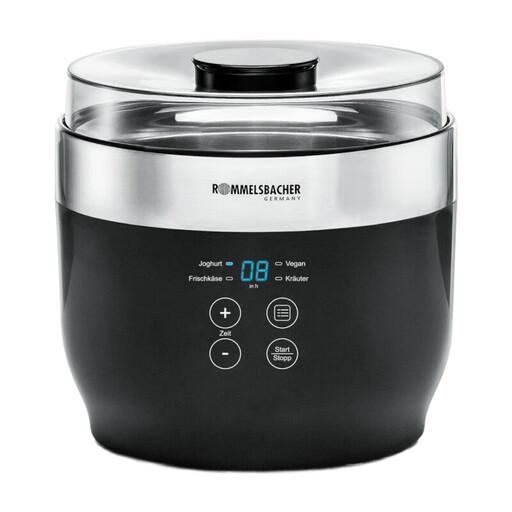 No image available
Suited to a serving plan where you portion out plain yoghurt from one larger tub.
Rommelsbacher lists a capacity of 1.2 litres of plain yoghurt per batch and four programmes, including one for natural yoghurt. The product description also mentions an adjustable timer and automatic shut-off.
Multiply the number of portions you need by the amount per portion, then compare the result with the capacity per batch. According to the stated manufacturer specifications, the twelve 0.2-litre jars of the Steba JM 2 have a combined nominal capacity of 2.4 litres. Remember to allow space in the fridge to keep the yoghurt chilled.
You’ll need milk and a suitable yoghurt starter, or yoghurt containing live cultures. A recipe from University of Illinois Extension also describes heating and cooling the milk, working cleanly, fermenting it at a controlled temperature and chilling it afterwards. Follow a suitable recipe and your appliance’s manual for instructions.
Keep the yoghurt chilled and don’t leave perishable dairy products out of the fridge for more than two hours. The Voedingscentrum recommends a fridge temperature of 4 °C. It’s best to bring out smaller amounts at a time and use clean serving utensils.
You’ll need milk and a suitable starter. If you have a model with individual jars, replacement jars may come in handy: Severin lists suitable replacement jars for the JG 3518, and Steba offers an additional set for the JM 2. Check which parts are compatible with your exact model.
That depends on exactly what you’re offering. For sales and catering from home or at events, the NVWA outlines requirements for preparing and storing food safely and hygienically. If you sell food several times a year, the NVWA says you need a food safety plan. The NVWA also sets out rules on allergen information for businesses offering unpackaged food. So first establish whether you’re organising a private meal, selling food, catering or serving the public. Plain milk yoghurt contains milk, which is an allergen.