
Weekend planner
You want to plan yoghurt-making ahead of breakfast or lunch, so a suitable timer and a practical plan for chilling the yoghurt afterwards are useful.


Choose based on how much yoghurt you actually eat and whether you’d rather store individual portions or one larger batch. A timer with automatic shut-off can help you plan; if you want strained yoghurt, a suitable strainer is more useful than a longer timer. After making the yoghurt, make sure you have time and space to chill it: the Netherlands Nutrition Centre recommends storing chilled dairy products at 4 °C.
You want to plan yoghurt-making ahead of breakfast or lunch, so a suitable timer and a practical plan for chilling the yoghurt afterwards are useful.
You want to store or take yoghurt with you in individual portions, so you compare the number of pots, their capacity and their lids.
You want to serve yoghurt from one larger tub or make thicker, strained yoghurt too. In that case, the right container and, if needed, a strainer are important considerations.
First, work out how much yoghurt you need and how you want to store it. Then compare the timer and any extra parts with the type of yoghurt you actually want to make.
| What to consider | What should you check? | Who is this most important for? |
|---|---|---|
| Planning the process | Check whether the model has a timer and automatic shut-off; also allow time for chilling. | If I want yoghurt ready for a set time at the weekend, I want to be able to plan the process without constantly checking the appliance. Around 33% of consumers prioritise planning. |
| Quantity and portions | Compare the usable batch capacity and the number and capacity of the pots with the portions you need. | For breakfast and lunch, I want to make enough yoghurt without ending up with more than I can use. Around 27% of consumers prioritise quantity and portion size. |
| Desired texture | Check whether a sieve or strainer is included and which recipes are described in the model’s manual. | If I want to make thicker or different types of yoghurt, I look for a suitable strainer and the options it offers. Around 20% of consumers prioritise texture or variety. |
| Cleaning and storage | Check the cleaning instructions for each part and think about where the filled pots or tub will fit in your fridge. | I want to be able to clean the parts properly after use and store the yoghurt in the fridge conveniently. Around 20% of consumers prioritise care and storage. |
For the Rommelsbacher JG 80, the manufacturer states a capacity of 1.2 litres for natural yoghurt. This is not the same as adding together the capacity of all the containers and cups supplied.
Compare the stated preparation capacity, and don’t add accessories together unless it’s confirmed they can all be used in one batch.
A batch that’s too small for your plans could mean making another one.
A timer or automatic shut-off won’t chill the yoghurt after it’s made. The Netherlands Nutrition Centre recommends storing chilled dairy products at 4 °C.
Plan both when you want to serve the yoghurt and where you’ll store it in the fridge.
A Joybuy listing with JG 80 in the title refers to model IB 05 in the product description and mentions an ice-cream dessert freezer basket.
Before buying, check the full model code, what the appliance does and the manufacturer’s details.
Choosing the wrong version could mean buying an accessory instead of the yoghurt maker you wanted.
The JG 3518 is a straightforward model with individual pots for small portions made in advance.
The Yogurteo YG231E32 combines individual pots with a timer.
The JM 2 is designed to make several individual portions at a time.
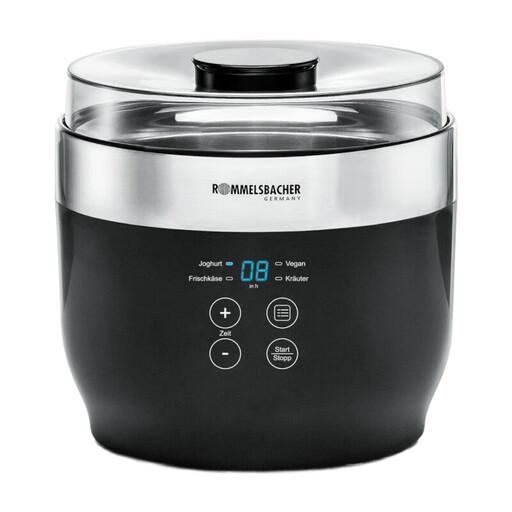
The JG 80 is designed for making yoghurt in a larger tub and also includes a strainer for an extra draining step.
The JM 3344 is a straightforward model with individual portion pots.
These models are suitable for making yoghurt in advance: one for individual portions and one for making yoghurt in a larger tub.
 No image available
An option to compare if you want to prepare yoghurt in individual portions. Check whether the number and capacity of the pots, along with the timer settings, suit your plans.
 No image available
Suitable if you want to serve yoghurt from a larger tub or strain it. Rommelsbacher lists a capacity of 1.2 litres for natural yoghurt and includes a strainer. Make sure you also have space to chill the yoghurt once it’s ready.
Work backwards from when you want to serve it: follow the preparation time in your model’s manual, then allow time for the yoghurt to chill. Automatic shut-off doesn’t mean the appliance has a fridge function.
The Netherlands Nutrition Centre recommends using clean hands, surfaces and utensils, and storing chilled dairy products at 4 °C. If you’re using raw farm milk, first follow the Netherlands Nutrition Centre’s heating instructions; otherwise, follow the appliance’s preparation instructions.
This varies by model and component. Moulinex says the glass pots supplied with the YG231E32 are dishwasher-safe. For the lids and electrical base, check the cleaning instructions for the exact model.
Include milk or starter culture and any replacement pots in your comparison. According to the Dutch government, statutory warranty in the Netherlands has no fixed legal time limit; if a product is faulty, the retailer is your point of contact. A manufacturer’s warranty doesn’t replace your statutory rights.
Electrical equipment covered by European low-voltage rules must meet requirements including CE marking and an EU declaration of conformity. The manufacturer or importer has responsibilities in this respect; a product listing alone doesn’t prove that a particular item meets the requirements. Consult EUR-Lex and Business.gov.nl for the applicable conditions.