Who is a yoghurt maker suitable for?

Anyone who wants to portion out breakfasts in advance

If you want to prepare yoghurt for several breakfasts after doing the shopping, check the number and capacity of the pots, and whether they come with lids. Rommelsbacher lists eight 150 ml pots for the JG 40; Severin lists seven 150 ml pots for the JG 3518.

Anyone who wants to schedule preparation in advance

A timer and automatic shut-off can be useful if you don’t want to be there when the yoghurt is ready. Check which features are included with each model; Rommelsbacher lists both for the JG 40.

Anyone who wants to try different yoghurt-based foods

If you want to strain yoghurt or try making other things, compare the included strainer and the programmes available on the exact model. Ariete lists a filter basket for the Yogurella 0621/10; Rommelsbacher lists four programmes for the JG 80.

What should you look for when choosing one?

What to consider What should you check? Who is this important for?
Individual portions Check the number of pots, their capacity and whether lids are included. If I want to store yoghurt separately for several breakfasts straight away, I look for portions that fit in my fridge. Around 40% of consumers prioritise having individual portions.
Setting it in advance Check whether the model has a timer and automatic shut-off, and look at the adjustable time range too. If I want to schedule preparation without staying by the appliance until it’s finished, I look at the controls. Around 30% of consumers prioritise being able to plan ahead.
Other preparations Check whether a filter basket is included and which programmes the exact model offers. If I want to try thicker yoghurt or another preparation, the included strainer or a suitable programme matters. Around 20% of consumers prioritise having different options.
Space and accessories Compare the appliance’s dimensions and the number of individual pots, containers and accessories. If space is limited, I want to know where I can keep the appliance and its parts after use. Around 10% of consumers prioritise a compact routine.

Things to consider when buying and using one

  • A yoghurt programme doesn’t make raw milk safe to use

    A programme isn’t a substitute for handling raw milk correctly. The Netherlands Nutrition Centre advises boiling raw milk before drinking it or using it in a dish.

    After visiting a market, check whether the milk is pasteurised. If it isn’t, follow the Netherlands Nutrition Centre’s advice to boil it.

  • Container capacity isn’t the same as the amount left after straining

    A container’s capacity tells you how much it can hold, not how much strained yoghurt you’ll end up with. Straining also involves an extra step.

    Choose the container or pot arrangement that suits your routine, and don’t expect a specific amount of strained yoghurt unless you have a recipe and yield information.

  • Extra cover is different from your statutory rights

    An additional manufacturer’s guarantee or paid cover doesn’t replace your statutory protection if a product is faulty. The Dutch Government explains that the seller must provide a solution when a product is faulty.

    Before taking out extra cover, read what additional rights it actually provides.

Brands to compare

Rommelsbacher

The JG 40 uses individual pots, while the JG 80 has larger containers and several programmes.

  • The manufacturer says the JG 40 comes with eight 150 ml pots and automatic shut-off.
  • The manufacturer says the JG 80 has four programmes and comes with different containers.
  • These features apply to the models mentioned and don’t necessarily apply to all yoghurt makers from the brand.

Severin

The JG 3518 is a straightforward model with individual pots; according to Severin, the JG 3521 has automatic programmes.

  • Severin lists seven 150 ml pots with lids for the JG 3518.
  • The manufacturer lists compatible replacement pots for the JG 3518.
  • Programmes for different preparations are a specification of the JG 3521, not the JG 3518.

Ariete

The Yogurella 0621/10 has larger containers and a filter basket for straining yoghurt.

  • The manufacturer specifies two 1-litre containers and a filter basket.
  • This model uses larger containers rather than the individual breakfast pots found with models that use separate pots.

Lagrange

The Ligne 459002 uses individual pots and is designed for making several separate portions.

  • According to the manufacturer, it comes with nine 220 ml glass pots, a programme time of up to 15 hours and automatic shut-off.
  • The product specifications come from the French manufacturer’s range and don’t, in themselves, confirm availability in the Netherlands.

Yoghurt makers at Joybuy

These models are suited to preparing breakfast portions individually, using a timer or trying extra preparation options. If you’re buying an electrical appliance for use in the Netherlands, check the CE marking and safety information for the specific unit.

Rommelsbacher JG 40 yoghurt maker

Rommelsbacher JG 40 yoghurt maker

A good choice if you want to prepare yoghurt in individual pots and set the machine in advance.

The description lists eight 150 ml glass pots with lids and a timer adjustable from 1 to 18 hours. Individual pots mean more washing up and take up more fridge space than one larger container.

Joybuy
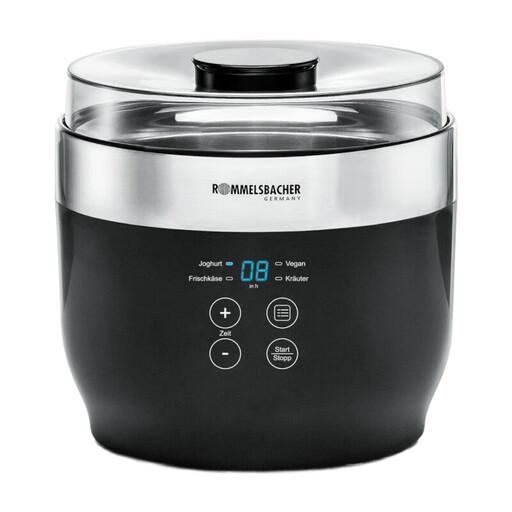
Rommelsbacher JG 80 yoghurt and cream cheese maker

Rommelsbacher JG 80 yoghurt and cream cheese maker

A good choice if you want to try larger batches or other preparations as well as individual portions.

The description lists four portion cups, two larger glass containers, a strainer, four programmes and a timer with automatic shut-off. Check that the ingredients and cultures are suitable for the programme you want to use; a programme name alone doesn’t guarantee a lactose-free end product. The parts need extra storage space, and straining adds another step.

Joybuy

Frequently asked questions

Can I use milk from a market straight in a yoghurt maker?

First check whether the milk is raw. The Netherlands Nutrition Centre advises boiling raw milk before drinking it or using it in a dish; a yoghurt programme hasn’t been shown to replace this step.

How should I store yoghurt once it’s made?

According to the Netherlands Nutrition Centre, put yoghurt back in the fridge promptly after use and keep it at 4 °C. Always use a clean spoon. The 5–7-day guidance applies to opened full-fat yoghurt; don’t automatically apply this timeframe to homemade yoghurt.

What should I check when buying an electrical yoghurt maker in the Netherlands?

The Netherlands Food and Consumer Product Safety Authority says that electrical consumer products on the Dutch market must carry a CE marking. Check the marking and safety information for the specific appliance; a product listing alone doesn’t prove that an individual unit meets the requirements.

Do I need to buy extra cover in case the product is faulty?

No. According to the Dutch Government, the seller must provide a solution if a product is faulty; a manufacturer’s guarantee or additional cover is extra. The Netherlands doesn’t have one fixed statutory guarantee period for all products.

Is a programme labelled ‘lactose-free’ enough for my diet?

No. Rommelsbacher lists a programme for vegan or lactose-free preparations on the JG 80, but the result also depends on the ingredients and cultures used. The Netherlands Nutrition Centre explains that fermentation converts lactose; this alone doesn’t guarantee that the yoghurt you make will be lactose-free.
