
Workshop leaders making small portions of dressing
You ask participants to make a small quantity each and want a beaker and controls suited to that portion. The Netherlands Nutrition Centre’s herb yoghurt dressing recipe is one example.


For a small portion of yoghurt dressing, a suitable beaker and a simple utensil are often all you need; a stick blender isn’t always necessary. Choose a set with a chopper if you’ll also be chopping herbs or other ingredients during the workshop, and check which accessories come with that particular version. The Netherlands Nutrition Centre’s yoghurt dressing recipe is mixed with a spoon, so let the recipe determine whether an appliance will add anything.
You ask participants to make a small quantity each and want a beaker and controls suited to that portion. The Netherlands Nutrition Centre’s herb yoghurt dressing recipe is one example.
You use the same workstation for several preparations and want to be able to detach and clean the blending foot between sessions. The Consumers’ Association discusses cleaning as a point to consider with stick blenders.
You also want to chop herbs during the workshop, so you’re comparing a stick blender on its own with a version that includes a chopper. According to the Consumers’ Association, choppers are designed for tasks such as chopping herbs and nuts.
Choose this if: your recipe calls for yoghurt, milk and finely chopped herbs, and you don’t need a smooth, puréed texture.
Trade-off: you avoid an appliance and extra cleaning, but you’ll need to prepare the herbs yourself.
Choose this if: you mainly mix liquid ingredients and want to use as few separate parts as possible.
Trade-off: without a chopper, you’ll need another way to chop herbs or nuts.
Choose this if: the workshop programme includes recipes with chopped ingredients as well as dressing.
Trade-off: extra attachments need more storage space and cleaning.
| Point to consider | What to look for | Who is this most relevant to? |
|---|---|---|
| Small portions and splashing | Check whether the supplied beaker and blending foot are suitable for the quantity you’re making. Treat claims about reducing splashes as manufacturer claims, not a guarantee. | When I make small portions, I want the blending foot to work well in the beaker and keep the workstation manageable. Around 36% of consumers put this first. |
| Cleaning between preparations | Check whether the blending foot is detachable and follow the cleaning instructions for each part. | When running several workshop sessions, I want to be able to clean the parts thoroughly between them. This matters most to around 29% of consumers. |
| Herbs and other ingredients | Check that the version you’re choosing includes a chopper; a whisk is designed for whisking. | If I’m also chopping herbs, I want to know whether a suitable attachment is included. Around 21% of consumers prioritise preparing ingredients. |
| A straightforward purchase | First decide whether the recipe needs a stick blender, then compare only the features you’ll use. | When I’m making a simple recipe, I don’t want to choose features I don’t need. Around 14% of consumers prioritise simplicity. |
Wattage alone doesn’t determine whether a stick blender is right for a small portion. The Consumers’ Association mentions 600 W as a consideration for heavier tasks such as puréeing and chopping, not as a general requirement for this dressing recipe. Braun lists both 1000 W and 750 W for the MQ50051M on an official product page.
Choose based on the recipe, beaker, controls and attachments you need. If model specifications conflict, ask for clarification before comparing the wattage.
Accessories vary between versions of a model. A chopper and a whisk are also designed for different tasks.
Check the full model code and the contents of the box before you buy.
The Dutch product information includes basic versions of the ErgoMixx.
The MultiQuick 5 range includes versions with a variety of accessories. For the MQ50236M, Braun lists a chopper, whisk and measuring beaker, among other items.
The Quickchef+ HB67MB30 is described as a stick blender with a range of attachments.
This selection includes stick blenders and sets for making dressing and other workshop recipes, with a range of beakers and attachments.
 No image available
The supplied measuring beaker may be suitable for mixing dressing, while the chopper is designed for additional preparations.
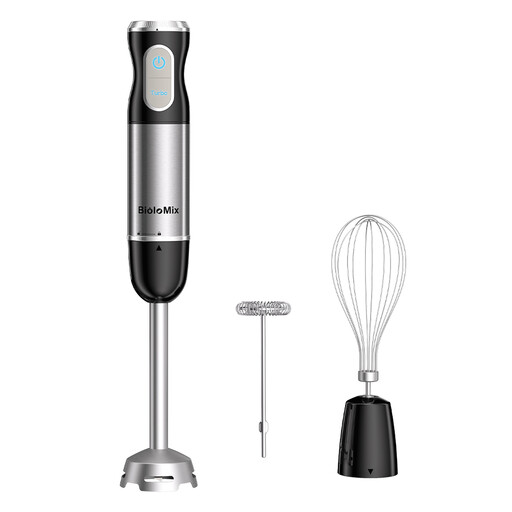
The product information lists a 700 ml measuring beaker, two speeds, two whisks and a detachable stainless steel blending foot.
 No image available
The detachable design suits anyone who wants to remove the blending foot after use for cleaning.
The product name specifies a detachable design.
 No image available
The listed measuring beaker is an option for anyone who wants to mix dressing in a beaker; the chopper is designed for other ingredients.
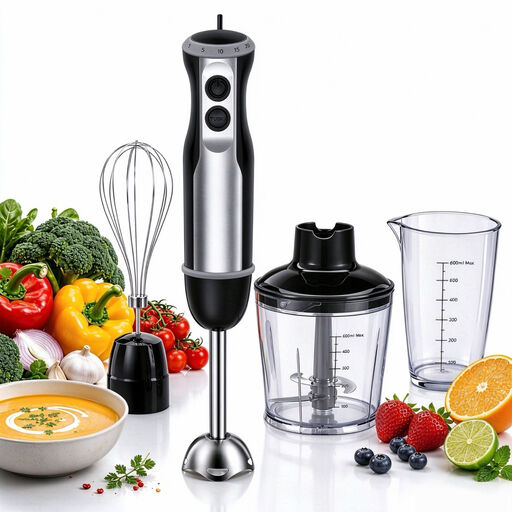
The product information lists a 600 ml measuring beaker, six speeds, a turbo function, a 500 ml chopper and a whisk. The accessories are described as dishwasher-safe.
 No image available
The product information mentions a blending foot for sauces, which may suit anyone who also wants to mix dressing.
The product name lists 450 W and five speeds. The product information also mentions a stainless steel blending foot and a turbo function.
 No image available
The product information mentions a measuring beaker for small portions, including salad dressing, and a chopper for additional preparations.
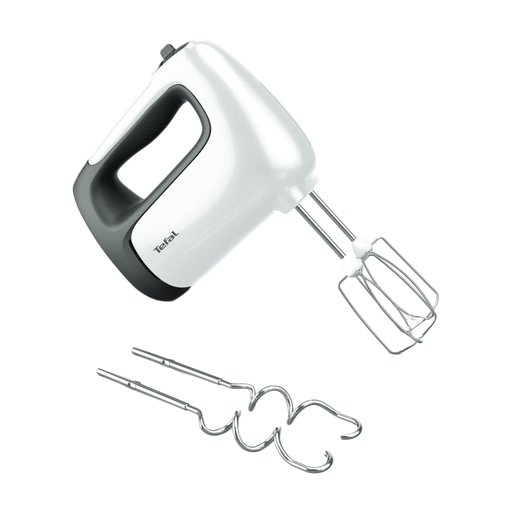
The description lists 25 speeds, a chopper, an EasyClick system and dishwasher-safe parts.
No, not for every recipe. In the Netherlands Nutrition Centre’s recipe for herb yoghurt dressing, yoghurt and milk are mixed together and finely chopped herbs are stirred in. Use a stick blender only if the method you want to use calls for one.
Unplug the appliance before changing or cleaning any parts, and don’t immerse the motor unit. Braun lists these warnings for the MQ50051M. For other models, check the manual to see which removable parts can go in the dishwasher.
Return perishable dressing to the fridge promptly and don’t leave it out of the fridge for more than 2 hours. The Netherlands Nutrition Centre recommends keeping your fridge at 4 °C; using a stick blender doesn’t change this storage guidance.
According to the Dutch Government, you’re entitled to a product that meets the terms of your agreement; the Netherlands has no fixed statutory guarantee period. A manufacturer’s guarantee is an extra benefit, and if a product is faulty, the retailer is your point of contact. For a business purchase, also check the applicable contract terms.
According to the NVWA, a business that prepares, processes or sells food must work with an HACCP food safety plan or a hygiene code. Anyone offering unpackaged food to consumers must also provide information about allergens present, including milk. Whether these rules apply to a workshop depends on how it is run.