
Dressing maker who wants a smooth blend
You want to blend yoghurt and flavourings without unnecessary attachments. A comfortable blending foot and a suitable beaker matter more than an extensive set.


If you mainly want to blend your yoghurt dressing until smooth, a hand blender with a suitable beaker is usually all you need. A chopper is useful if you also want to chop herbs, onion or nuts. If you’re making a larger quantity, check the usable blending capacity and work in batches if needed: a beaker’s total capacity isn’t necessarily the safe filling capacity. Keep the dressing chilled until serving, as advised by the Netherlands Nutrition Centre for perishable dairy products.
You want to blend yoghurt and flavourings without unnecessary attachments. A comfortable blending foot and a suitable beaker matter more than an extensive set.
You’re making dressing for several people and want to minimise spills or work in batches. Consider the shape of the beaker, the controls and the space available for blending.
You also want to chop herbs, onion or nuts, or use the hand blender for other tasks. The attachments included with the exact model will help determine which one is right for you.
Start with the dressing itself, then decide whether you need extra features such as chopping or whisking. The Dutch Consumers’ Association describes a chopper as useful for herbs, onion and nuts, among other things, and a whisk for whisking.
| What to consider | What to look for when buying | Who is this most important for? |
|---|---|---|
| Controlled blending | Check the controls, splash protection, shape of the blending foot and beaker on the exact model. | If I want to blend a smooth dressing without unnecessary spills, I’ll look at the controls and blending foot; around 33% of consumers rank controlled blending as their top priority. |
| Portions for a group | Check the total capacity and, if stated, the usable blending capacity. Don’t assume a safe fill level that hasn’t been specified. | For a neighbourhood meal, I want to prepare several portions in a controlled way; around 27% of consumers rank having enough dressing for the group as their top priority. |
| Chopping fresh ingredients | Check what’s included in the box for the full model number; not every version in the same product range comes with the same attachments. | If I also want to chop herbs or onion with the appliance, a chopper is useful to me; around 20% of consumers rank chopping and extra preparation tasks as their top priority. |
| Cleaning | Check the manual to see which parts can be detached and whether any are dishwasher-safe. | After blending with yoghurt, I want to be able to clean the food-contact parts thoroughly; around 20% of consumers rank ease of cleaning as their top priority. |
A blending foot is designed for blending; a chopper mainly adds a separate function for ingredients such as herbs, onion and nuts.
Start with what you want to do for this meal and for other recipes. Check what’s included in the box for the exact model.
Extra attachments take up storage space and need cleaning after use.
A stated total capacity doesn’t automatically tell you how much you can blend safely; an overfilled beaker may spill while blending.
Follow any fill markings and the manufacturer’s instructions. If necessary, prepare the amount you need for the group in smaller batches.
Braun Household NL lists both 1000 W in the description and 750 W in the technical specifications for the MQ50001M and MQ50236M models. Wattage alone also doesn’t tell you which attachments are right for your recipe.
Don’t use wattage that’s listed inconsistently for these models as the deciding factor. Instead, compare the features and parts you need for the dressing.
Braun Household NL describes different versions of the MultiQuick 5 range, each supplied with different attachments.
Bosch Netherlands’ product range includes ErgoMixx, CleverMixx and ErgoMaster models, among others.
Philips describes the 5000 Series HR2683/00 as a hand blender with a compact chopper.
Tefal describes the Quickchef+ HB67MB as a set with a beaker, whisk and chopper blender.
This selection of Joybuy products includes hand blenders and sets for blending dressing, with some models featuring extra attachments for chopping or whisking.
 No image available
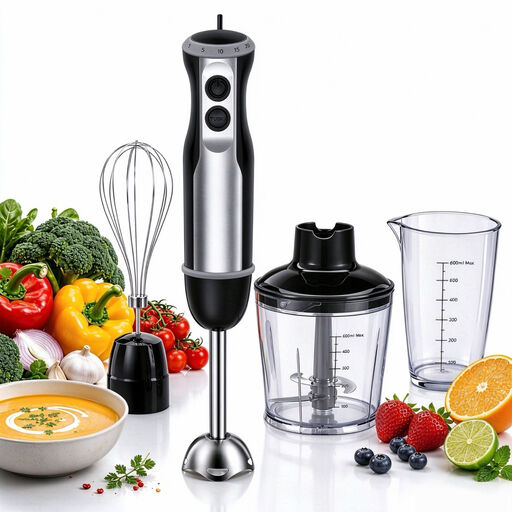
A set for blending dressing, as well as chopping or whisking ingredients.
The product information lists a 500 ml chopper, a 700 ml measuring beaker and two whisks.
 No image available
A stick blender for mixing sauces, with attachments for extra preparation tasks.
The product information lists 6 speeds, a turbo function, a 500 ml chopper and a 600 ml beaker.
 No image available
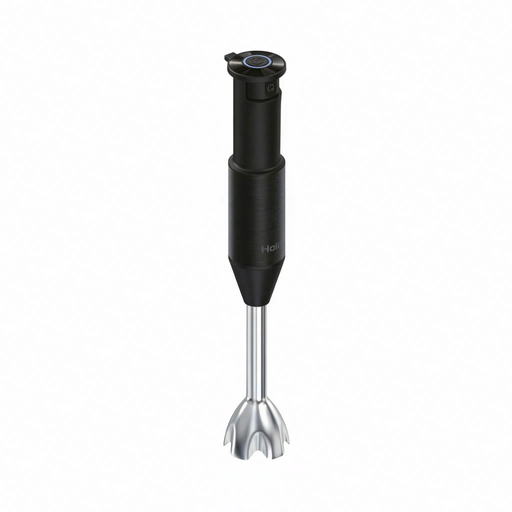
A hand blender with a chopper for anyone who wants to chop ingredients as well as make dressing.
The product information lists 25 speeds, a turbo function, SplashControl and a chopper.
 No image available
A hand blender with a beaker for mixing dressing, so you can tailor portions to the available blending capacity.
The product title lists three blades and a 0.9-litre beaker.
 No image available
A set for making dressing and preparing other ingredients, with a chopper and whisk as well as the hand blender.
The product title lists 600 W, 2 speeds, a 500 ml chopper and an 800 ml beaker.
No, not for this light blending task alone. The Dutch Consumers’ Association recommends at least 600 W for heavier tasks such as puréeing and chopping, not as a general minimum for every dressing. When comparing a specific model, also consider the controls, beaker and attachments included.
Clean the food-contact parts you’ve used before using them again. Clean a detachable blending foot according to the manual and check whether each part is dishwasher-safe. Keep the motor unit out of water.
Keep yoghurt dressing chilled and take it out of the fridge shortly before serving. The Netherlands Nutrition Centre recommends keeping your fridge at 4 °C and not leaving perishable food out of the fridge for more than 2 hours; discard it after that. This is food safety advice, not a feature of the hand blender.
For a consumer purchase, the Dutch Government says you’re entitled to a product that works as it should; there’s no fixed statutory warranty period in the Netherlands. If a product is faulty, the seller must provide a solution. Any manufacturer’s warranty is in addition to these rights.
The Netherlands Food and Consumer Product Safety Authority’s guidance on food safety when selling food from home doesn’t automatically apply to a private neighbourhood meal. If you’re actually selling food, check the requirements that apply to that activity. If allergies are a concern, discuss the ingredients you’ve used with your guests.