
Vandaag of morgen in huis

Kwaliteit gegarandeerd

Welkomstaanbiedingen ontgrendelen: GRATIS bezorging | Tot 80% korting | Gratis 30 dagen JoyPlus-proefperiode
Download de app
A yoga mat seems simple: you roll it out and start moving. Yet many disappointing purchases are caused by features that are made to sound more significant in product titles than they are in practice. For example, a non-slip yoga mat may offer less grip on a dusty tiled floor, while an extra-thick mat is not always comfortable for poses where balance is important.
Pay particular attention to these three common pitfalls:
By deciding in advance how you will use the mat, which dimensions you need and how much storage space you have, you can make a more targeted choice between a yoga mat, Pilates mat, fitness mat or exercise mat.
The right thickness depends on the exercises you do and how much cushioning you prefer.
Pay attention to the actual unit of measurement. 0.6 cm is 6 mm and 1.0 cm is 10 mm. Also check whether the stated thickness applies across the entire surface rather than only at the thickest point.
A TPE yoga mat is made from thermoplastic elastomers. In product information, TPE is often described as flexible, lightweight and low-odour. These are product specifications or brand claims; the exact experience may vary from person to person. TPE is often a practical choice for use at home, in the gym and on the go.
PVC is a widely used plastic material. A PVC mat with a textured surface can be easy to wipe clean and often provides a firm base. However, check that the mat offers enough cushioning for your workouts.
A cork yoga mat generally has a cork top layer with a TPE or other plastic underside. According to Miss Lulu’s product description, the cork layer is intended to absorb moisture and support grip when the surface is more humid. This is a claim from the brand’s product information, not a universal guarantee for every training situation.
A standard size of approximately 183 × 61 cm is suitable for many yoga and Pilates exercises. If you make bigger movements or want extra space for fitness, you could consider an extra-wide yoga mat measuring, for example, 190 × 80 cm.
When checking the grip, ask yourself:
A yoga mat with a carrying strap is useful for commuting, classes and gym sessions. For travellers, a foldable yoga mat may be more practical than a rolled model. Pay attention to the folded dimensions: a compact mat is easier to store, but may have more visible fold lines.
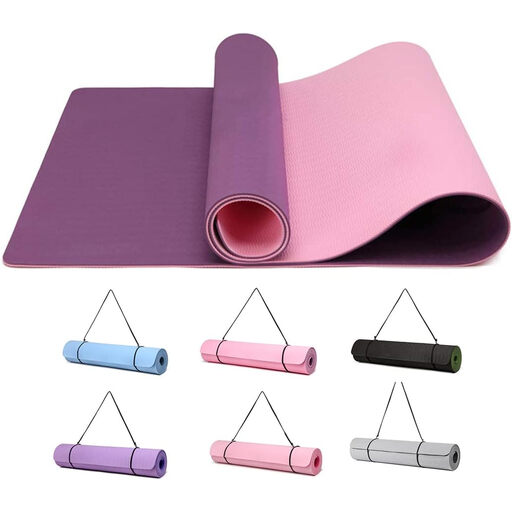
Why it suits this profile: The standard size, 6 mm thickness and stated weight of approximately 0.7 kg make this an accessible choice for yoga at home, Pilates and general fitness.
The product information mentions a lined structure on the top and a wave pattern on the underside. Still, check the grip on your own floor.
TPE material, 6 mm thickness and an included carrying strap; suitable for yoga, Pilates, HIIT and stretching.

Why it suits this profile: The combination of cork, TPE and a polyester middle layer appeals to users who pay attention to the material construction and want a firm surface for yoga and Pilates.
The product description identifies the individual layers and recommends cleaning with a damp cloth. This makes it clearer what you are buying than a general material claim.
Cork on the top, TPE on the underside, 6 mm thickness and a weight of approximately 750 grams.

Why it suits this profile: The 10 mm version is aimed at users looking for a softer surface during Pilates, stretching and floor exercises.
The thickness is clearly stated. This helps you avoid buying a soft mat when you actually need a firm, low-profile mat for balance.
TPE, dimensions of 183 × 61 cm, dual texture for the top and underside, and a carrying strap; the product range also lists a 6 mm version.
We have put together a complete, up-to-date list of products that fully meet these strict selection criteria and the applicable European safety regulations.
A yoga mat will last longer if you wipe it down after use with a damp cloth and mild soapy water. Allow the mat to air-dry completely before rolling or folding it. Avoid harsh cleaning products, prolonged exposure to direct sunlight and sharp objects. When using an exercise mat, regularly check for tears, layers coming away or permanent deformation.
Use the mat on a flat, stable surface. A non-slip texture is no substitute for good floor hygiene or correct positioning. With a foldable yoga mat, it is best to unfold it fully before carrying out dynamic exercises.
For many beginners, a 6 mm yoga mat is a practical choice because it offers a balance between cushioning and stability. If you mainly do gentle floor exercises or prefer more softness, you could consider 10 mm. For balance poses, 6 mm may feel more direct.
Wipe the surface with a damp cloth and, if necessary, a small amount of mild soapy water. Always follow the product instructions. The models mentioned are not intended for machine washing; allow them to dry completely in a well-ventilated room before storing them.
Its lifespan depends on how often it is used, body weight, the surface, cleaning and storage. Replace the mat when the grip noticeably decreases, the surface begins to tear or the mat no longer lies flat. A carrying strap and a dry storage place help preserve the material and shape.
