
Vandaag of morgen in huis

Kwaliteit gegarandeerd

Welkomstaanbiedingen ontgrendelen: GRATIS bezorging | Tot 80% korting | Gratis 30 dagen JoyPlus-proefperiode
Download de app
A good kitchen knife should suit the way you cook. Yet many buyers focus mainly on the brand, the black finish or the words “extra sharp”. As a result, they sometimes end up with a knife that’s too large, difficult to maintain or unsuitable for everyday use.
With this buying guide to Wüsthof knives, you can compare practical features such as blade length, steel type, handle and care requirements. That makes it easier to choose between a Wüsthof kitchen knife, chef’s knife, santoku knife, paring knife or complete knife set.
A 20 cm kitchen knife gives you room to work with large vegetables, meat and herbs. On a small kitchen worktop, though, it may feel less manoeuvrable. A 16 cm kitchen knife is often more practical for everyday chopping and gives beginners greater control.
So don’t just look at the blade length: check the overall length and weight too. According to the product information, a 20 cm knife can measure almost 32 to 34 cm in total.
A new knife may arrive sharp, but every cutting edge needs care. Cutting hard on glass, stone or metal can damage the edge. A dishwasher can also affect the handle, coating or sharpness.
Hand-washing with warm water and mild washing-up liquid is recommended for several Wüsthof models. Always check the care instructions for the specific model. A stainless steel knife isn’t automatically dishwasher-safe.
A set may seem convenient, but it can include several knives for tasks you rarely do. For many home cooks, a chef’s knife, bread knife and small utility knife are enough. A Wüsthof knife set makes most sense if you’re starting from scratch, sharing a kitchen or regularly tackling a range of cutting tasks.
Check exactly what’s included. A “6-piece set”, for example, may contain several knives, a honing steel and a storage case, with fewer cutting knives than you might expect.
Many Wüsthof knives in this range use X50CrMoV15 stainless steel. This is a widely used steel type for German kitchen knives. The designation tells you something about the composition, but it doesn’t tell you everything about how the knife will cut. The sharpening angle, blade thickness, hardness and construction also play a part.
Some models have a forged blade made from a single piece of steel and a full tang. This can contribute to balance and strength, but always check that it’s stated in the product details.
A sharpening angle of 14 degrees per side is listed for several Wüsthof models. A smaller angle can give you a finer cutting feel, but it also calls for careful use. Use a wooden or plastic chopping board and avoid hard surfaces.
Brands may use their own testing methods for claims such as “20% sharper”. According to Wüsthof’s own information, some knives are sharpened using laser-guided techniques. Treat this as a manufacturer’s product specification, not a universal guarantee for every use.
An ergonomic handle should feel secure in your hand without you having to grip it tightly. Look out for:
According to the product description, an anti-slip or honeycomb texture can provide extra grip. However, a knife is still a sharp tool that can become slippery when wet. Always concentrate and keep the handle dry.
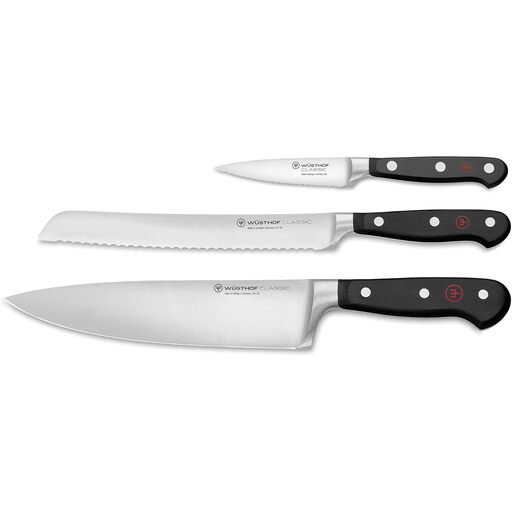
Why it suits this profile: This set includes three practical knives for everyday cooking: a chef’s knife, bread knife and utility knife. That way, you won’t pay upfront for knives you’re unlikely to use.
The set has a clearly defined selection of knives for essential tasks. Before buying, check the dishwasher guidance, as hand-washing generally helps protect the cutting edge.
Three knives for different kitchen tasks; ergonomic plastic handle according to the product description.

Why it suits this profile: This santoku knife combines a 17 cm blade with X50CrMoV15 steel, a synthetic handle and a sharpening angle of 14 degrees per side.
The specifications list both the steel type and dimensions. This lets you compare the knife based on control and use, rather than appearance alone.
17 cm blade; X50CrMoV15 stainless steel; half bolster for sharpening more of the blade.
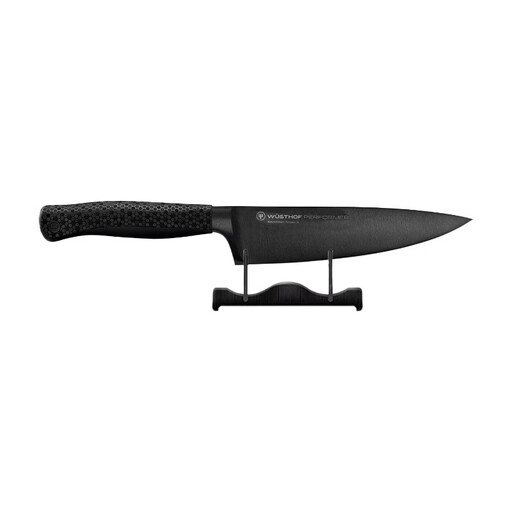
Why it suits this profile: The 20 cm blade is suited to larger ingredients and frequent chopping. The hexagonal handle with a honeycomb texture is designed to provide extra grip.
The blade length and overall dimensions are listed, so you can decide in advance whether the knife suits your worktop and cutting style. A 20 cm knife needs more space and control than a 16 cm model.
20 cm blade; X50CrMoV15 steel; anti-slip honeycomb handle according to the product information.
Ideally, wash the knife by hand, dry it straight away and store it in a knife block, protective sheath or drawer insert. Use a honing steel only if it’s suitable for the cutting edge. For more extensive care, a suitable sharpening stone or professional sharpening service is more practical.
A paring knife or utility knife with a 7 to 9 cm blade is designed for peeling, garnishing and small cutting tasks. Don’t use a thin blade like this on hard bones or frozen food. Use a bread knife with a sawing motion rather than chopping ingredients with it.
We’ve put together a complete, up-to-date list of products that meet these strict selection criteria and current European safety regulations.
Yes, the available models are designed for a range of everyday kitchen tasks. Choose a 16 or 17 cm knife for general food preparation, or a 20 cm chef’s knife if you often cut large vegetables, meat or herbs. Always check the product specifications and care instructions.
That depends on how you use it, your chopping board, your cutting technique and how well you maintain it. A knife will generally stay pleasant to use for longer if you avoid glass, stone and metal, wash it by hand and have the edge touched up regularly. There’s no set lifespan that applies to every model and user.
It varies by model. Some product pages say that a knife is dishwasher-safe, while others recommend hand-washing, particularly for models with a DLC coating. Always check the information for the specific Wüsthof kitchen knife before buying.
