
Vandaag of morgen in huis

Kwaliteit gegarandeerd

Welkomstaanbiedingen ontgrendelen: GRATIS bezorging | Tot 80% korting | Gratis 30 dagen JoyPlus-proefperiode
Download de app
A sharp kitchen knife makes everyday cooking more enjoyable, but a well-known brand name alone won’t tell you which model is right for you. Wüsthof kitchen knives vary by blade length, handle, steel type and care requirements. If you focus only on appearance or claims such as ‘extra sharp’, you could end up with a knife that’s too heavy, too large or difficult to maintain.
This buying guide will help you compare German kitchen knives objectively and choose the right one for everyday use, home cooking or a professional kitchen.
A product description may mention a particular sharpening angle or claim that a knife is sharper than standard models. Treat this information as a product specification or brand claim, rather than a guarantee that it will suit every user. Wüsthof says that some models are sharpened using laser guidance and then finished by hand. In practice, a knife’s lifespan also depends on your chopping board, cutting technique and care.
A sharp knife without a comfortable grip or a suitable blade length won’t automatically be right for your kitchen.
A Wüsthof knife set may seem appealing because you get several knives in one purchase. In practice, though, you’ll often reach for a chef’s knife, paring knife and bread knife most often. Check which knives are actually included before you buy. A set of six knives isn’t always more useful than three carefully chosen models.
Stainless steel resists corrosion, but heat, moisture, detergents and contact with other cutlery in the dishwasher can put strain on the edge and handle. Hand washing is recommended for many Wüsthof models, even if the product description says the knife is dishwasher-safe. Always check the care instructions for the specific product.
The right length depends on your worktop, hand size and cutting habits.
A longer blade won’t automatically make cutting easier. It also needs more space and a steady cutting technique.
Many Wüsthof models are made from X50CrMoV15 stainless steel. The product information describes it as high-carbon stainless steel. This material combines corrosion resistance with an edge that can be maintained regularly.
Also consider the construction:
A European edge of around 14 degrees per side, as listed for several Wüsthof Classic models, offers precision but calls for a suitable sharpening technique. Use a wooden or plastic chopping board and avoid glass, stone and metal. Store your knife in a knife block, protective sheath or drawer insert.
A serrated knife, such as a Wüsthof bread knife, also needs to be sharpened differently from a smooth-edged chef’s knife. So choose based not only on sharpness, but also on the food you usually prepare.
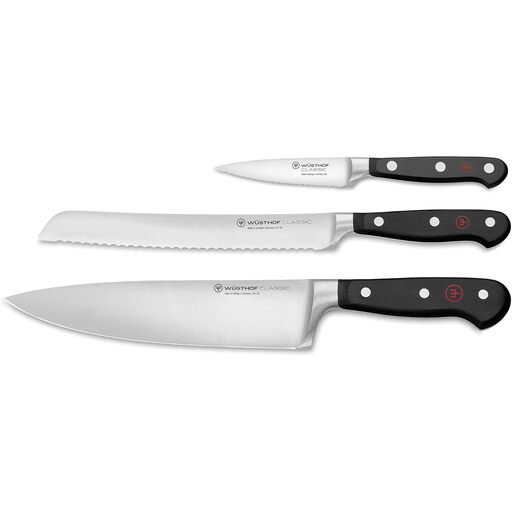
Why it suits this user: This set covers three everyday tasks: chopping vegetables, slicing bread and small-scale food prep. That means beginner cooks won’t pay for knives that end up unused in a drawer.
The set is clearly described as containing three functional knives. Do check the care information: the product description mentions dishwasher use, but hand washing remains the safest choice for a longer lifespan.
Three commonly used knife types, stainless steel blades and ergonomic plastic handles.

Why it suits this user: The 17 cm blade is a good choice if control matters to you and you often prepare vegetables, herbs, fish and meat. The Classic Ikon range has a full-tang construction and a POM handle.
The choice isn’t based on a sharpness claim alone: the blade material, length and handle are all clearly specified. Hand washing is recommended to protect the edge.
X50CrMoV15 steel, a 17 cm blade, a weight of around 170 grams and an edge angle of 14 degrees per side, as stated in the product information.
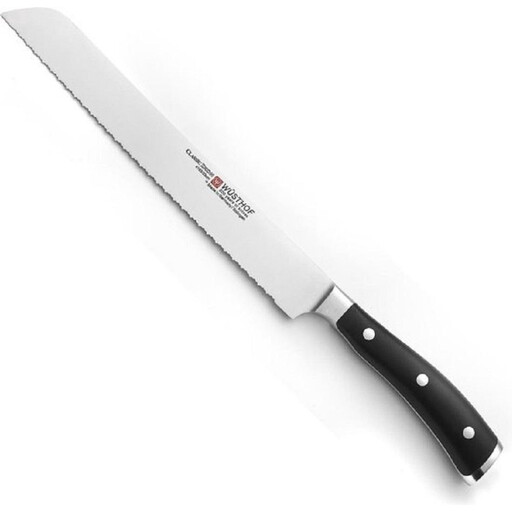
Why it suits this user: This Wüsthof bread knife is designed for bread, cake and foods with a hard rind. Its long serrated edge is practical for households and kitchens where slicing is a daily task.
Use a serrated knife for the job it’s designed for, rather than forcing a smooth-edged chef’s knife through a hard crust. The product description recommends hand washing and safe storage.
A 23 cm blade, double serration according to the product information, and a half bolster for control and easier maintenance.
If you’re looking for a classic Wüsthof chef’s knife, you could also consider the Wüsthof Classic Chef's Knife, 16 cm. For a modern handle profile and DLC-coated steel, the Wüsthof Performer Chef's Knife, 20 cm is another option. The Wüsthof Performer Vegetable Knife, 9 cm is a shorter knife for peeling and precise tasks.
We’ve put together a complete, up-to-date list of products that meet these strict selection criteria and the applicable European safety requirements.
Yes. A 16 or 20 cm chef’s knife is designed for common tasks such as chopping, slicing and dicing. Choose 16 cm if you want more control or have limited worktop space. A 20 cm blade is better suited to larger ingredients and longer cutting movements.
Wash the knife by hand, dry it straight away and use a suitable chopping board. A honing steel can help realign the edge regularly; for proper sharpening, you’ll need a whetstone or a suitable sharpening tool. Store the knife so that its edge doesn’t touch other cutlery.
It depends on what’s included and how you’ll use it. A compact set can be practical for a beginner, while individual knives may be a better fit if you already have a good chef’s knife. Before deciding, always compare the lengths, materials, handles and care instructions of the individual knives.
