
Mug washer with limited worktop space
You’re looking for an appliance that fits on your worktop and lets you load your mugs without obstructing the spray arm.


First, measure the space on your worktop and check that your mugs fit the rack layout: the number of place settings won’t tell you that. Choose a model with a water reservoir if you don’t have a fixed water supply, but make sure you can also drain it. For small loads, compare energy and water use too, and consider washing up by hand. Milieu Centraal points out that a mini dishwasher isn’t automatically the most energy-efficient choice.
You’re looking for an appliance that fits on your worktop and lets you load your mugs without obstructing the spray arm.
You want to fill a reservoir and plan ahead for where the waste water will go.
You sometimes wash mugs with other dishes and weigh up the capacity you need against the space on your worktop and the energy and water used per cycle.
Start by checking the available space and whether your mugs will fit. Then consider the water connection, the amount of washing up per cycle and how much energy and water the appliance uses for your routine.
| What to consider | What should you check? | Who is this for? |
|---|---|---|
| Space and mug fit | Measure the available width, depth and height, including clearance for the door and hoses. Compare your mugs’ dimensions with the actual rack layout. | I want the appliance to fit on my worktop and my tallest mug to stand upright without obstructing the spray arm. Around 33% of consumers prioritise fit. |
| Water supply and drainage | Check whether each model has a reservoir or a fixed water supply, and follow the manual’s instructions for the drain hose and drainage set-up. | Without a fixed water supply, I want to know whether I can fill the appliance and drain the waste water safely. Around 27% of consumers are mainly looking for a practical connection set-up. |
| Amount of washing up per cycle | Compare the load you typically wash with the rack layout. MEDION lists two place settings for the MD 37217; Klarstein lists six place settings and a width of 55 cm for the Amazonia 6. | I want to wash mugs with other dishes without taking up more worktop space than necessary. Around 20% of consumers prioritise washing mixed loads. |
| Energy and water use | Compare kWh per 100 eco cycles and water per eco cycle on the same label basis. Also consider how often you run a full load. | If I only have a few mugs, I want to know whether waiting for a full load or washing up by hand better suits my routine. Around 20% of consumers prioritise running costs. |
Milieu Centraal recommends running a full dishwasher load on the eco programme and warns that compact models can use relatively high amounts of energy. For washing up by hand, Milieu Centraal says that using a washing-up bowl with a small amount of hot water is usually better for the environment than using a dishwasher. This doesn’t automatically apply to every way of washing up or every appliance.
A place-setting specification doesn’t tell you whether your tall or wide mugs will fit in the rack.
Measure your tallest and widest mug and compare them with the rack layout. Also check that the spray arm can turn freely.
A poor fit could mean extra wash cycles or leave you unable to use the appliance for the mugs you bought it for.
A reservoir can remove the need for a fixed water supply, but the used water still needs to be drained.
Check the manual for the exact model and decide where the drain hose will go before buying.
An unsuitable location may require adjustments or extra connection fittings.
Frequent small cycles or half-full loads may make a dishwasher less suited to your washing-up habits.
Compare energy-label figures for the same programme and think about how often you can run a full load. For just a few mugs, you could also consider washing up in a bowl with a small amount of hot water, as Milieu Centraal recommends.
Bomann describes the TSG 5701 as a compact model with an integrated water reservoir.
MEDION says the MD 37217 can be used with or without a fixed water supply and has capacity for two place settings.
Klarstein describes the Amazonia 6 as a wider worktop model for people who want to wash mugs with more dishes.
This selection includes worktop dishwashers for small kitchens, with models that have a water tank and models for washing mugs alongside other dishes. Check the connection requirements for each model and make sure your mugs fit the rack layout.
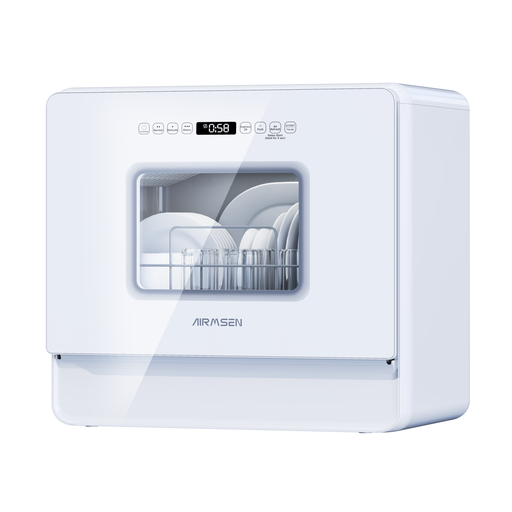 No image available
An option for washing mugs with other dishes if you’re looking for a worktop model with a built-in water tank. Check that the rack has enough room for your mugs.
The product name lists a built-in 5-litre tank, a two-level rack, three spray arms and a 12-hour delay start.
 No image available
A model to consider if you’re looking for a worktop dishwasher with a tank. Before buying, check how to arrange drainage according to the product instructions.
The product name lists a built-in 5-litre tank, 5+1 wash cycles and a double-tempered-glass door. When using the tank, the product information says waste water drains through a hose into a container.
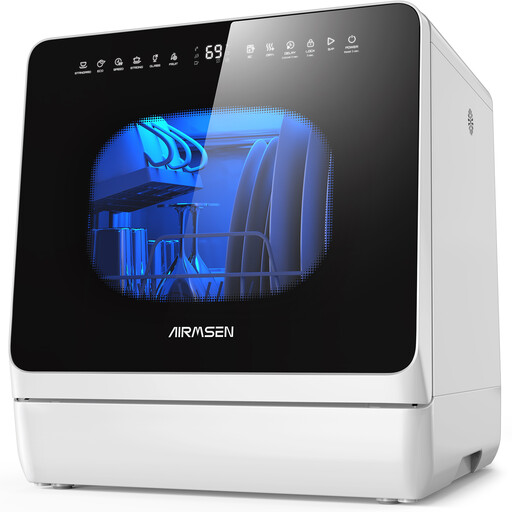 No image available
An option to compare if you’re looking for a worktop model for mugs and other dishes. Check that it fits your mugs and has the right connection for your kitchen.
The product name lists eight wash programmes, an integrated water softener, a delay start and a child lock.
 No image available
A compact model to consider if you want to wash a small number of mugs with other dishes. Check that the rack layout suits your mugs.
The product name lists three place settings, seven programmes, a 5-litre tank and operation with or without a water connection.
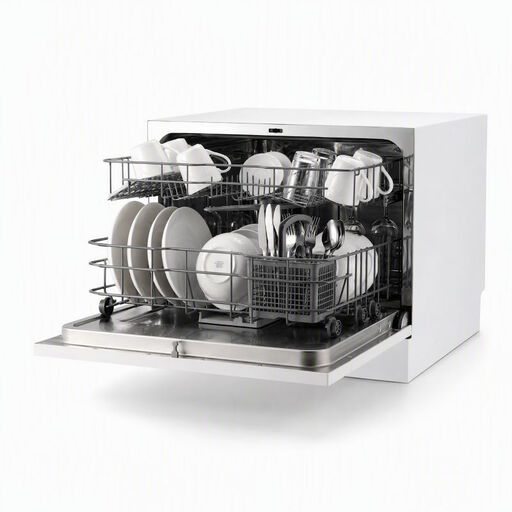 No image available
A model to consider if you want to wash mugs with other dishes. Check that you have enough worktop space and that the rack layout suits your kitchen.
The product name lists capacity for six standard place settings, a 30-minute quick wash programme, a 24-hour delay start and eight functions.
Place mugs upside down and keep the spray arm clear. If a mug has a rim, angle it if necessary so water doesn’t collect inside. Consumentenbond recommends placing cups and glasses upside down. Delicate decorations can still become damaged over time, even if they’re dishwasher-safe.
It depends on the model. Bomann lists an integrated reservoir for the TSG 5701; MEDION says the MD 37217 can be used with or without a fixed water supply. Make sure you also drain the used water according to the manual.
Compare the energy-label figures for electricity per 100 eco cycles and water per eco cycle on the same basis. How often you run a full load affects your total consumption; a claim about saving water compared with washing up by hand won’t necessarily apply to your routine.
Removing any large food scraps is usually enough; according to Consumentenbond, pre-rinsing is generally unnecessary. Clean the filter regularly and follow the manual’s instructions for detergent, salt and rinse aid, taking your local water hardness into account.
No. According to the Dutch government, the Netherlands has no fixed legal guarantee period. What you can reasonably expect from a product depends on factors including the product itself and the information provided at the point of sale. If a product is faulty, contact the seller.