
Students with large dinner plates
If you use large plates, it’s best to measure their diameter and the available worktop space first. Tomado and Daan Tech publish plate dimensions for specific models.


A worktop dishwasher is a suitable choice for dinner plates in a student kitchen only if both the plate diameter and the available space are right. Then choose between a model with a fixed water supply and one with a refillable tank. Either way, you’ll need to dispose of the wastewater in line with the installation instructions. Compare running costs using the same eco programme, and factor in your own tariffs and how often you wash up.
If you use large plates, it’s best to measure their diameter and the available worktop space first. Tomado and Daan Tech publish plate dimensions for specific models.
A model with a refillable tank may work without a fixed water supply, but you’ll still need a suitable spot for the appliance and its drain.
If you want to wash several people’s dishes together, compare capacity and rack layout, and check that your plates will fit too. Inventum and Tomado state the capacity of their specific models.
Choose this when: you have a suitable water supply and drain, and regularly want to wash dishes for several people.
Bear in mind: the connections need to be compatible, and a higher place-setting capacity doesn’t guarantee that large dinner plates will fit in the rack.
Choose this when: a fixed water supply isn’t practical and you mainly have smaller loads.
Bear in mind: you’ll need to fill the tank yourself and still arrange a suitable drain for the wastewater.
Choose this when: there’s no suitable space or drain, or you only have a few dishes.
Bear in mind: washing up by hand takes time. Milieu Centraal says it’s usually better for the environment if you use little hot water, for example by using a washing-up bowl and turning off the hot tap.
Milieu Centraal bases energy labels on the eco programme. So compare consumption figures for the same programme, and work out the costs using your own tariffs and how often you use the machine.
| What to consider | What to look for when buying | Who this matters to |
|---|---|---|
| Plate size and worktop space | Measure your largest plate and the available width, depth and height. Also check how much space you’ll need to open the door. | If I want to keep using my dinner plates, I’ll measure them before choosing a model. Around 29% of consumers prioritise plate size and placement. |
| Water supply and drain | Check how the machine is supplied with water, the drain hose, where the water will drain to and the installation instructions for the exact model. | If a fixed water supply isn’t practical in my kitchen, I’ll want to know how filling and draining work. Around 23% of consumers prioritise being able to connect a machine without a fixed water supply. |
| Capacity per load | Compare the number of place settings with the size of your usual load, and check the plate size and rack layout too. | If I’m washing dishes for several housemates, I’ll want to know whether our usual load will fit. Around 18% of consumers prioritise shared capacity. |
| Running costs | Compare water use per eco cycle and electricity consumption on the same basis. Include any dishwasher detergent you’ll need in your own calculation. | If I use the machine often, I’ll want to weigh up ongoing costs as well as the purchase price. Around 18% of consumers prioritise running costs. |
| Noise in a shared space | Compare the stated noise levels of the exact models and agree on when the machine can run. | If I study or eat in the same room, I’ll want to consider the stated noise level and when I’ll use the machine. Around 12% of consumers prioritise noise when sharing a space. |
A place setting doesn’t guarantee a particular plate diameter. For example, the manufacturer states that the Tomado TDW5501W can fit plates up to 25 cm in diameter.
Measure your largest dinner plate and check the maximum diameter for the exact model before buying.
If your plate doesn’t fit in the rack, you may still need to wash it by hand or use different crockery.
A tank describes how clean water is supplied; the wastewater still needs a suitable route out of the machine.
Check the drain hose, where the water will drain to and the model’s installation instructions before using the appliance.
If there’s nowhere suitable for the drain, you may need to find a different place for the machine.
Milieu Centraal says the energy label is based on the eco programme. Other programmes don’t automatically use the same basis for their consumption figures.
Compare label figures on a like-for-like basis, and use your own tariffs and washing frequency to work out the cost.
Tomado describes the TDW5501W as a worktop model with space for 6 place settings and a fixed water supply and drain.
Inventum describes the VVW5520 as a freestanding compact model for small households, with space for 6 place settings.
The Bob range is worth considering if worktop space is limited and the size of your dinner plates is a priority.
The TSG 5701 is an example of a worktop model with an integrated water tank.
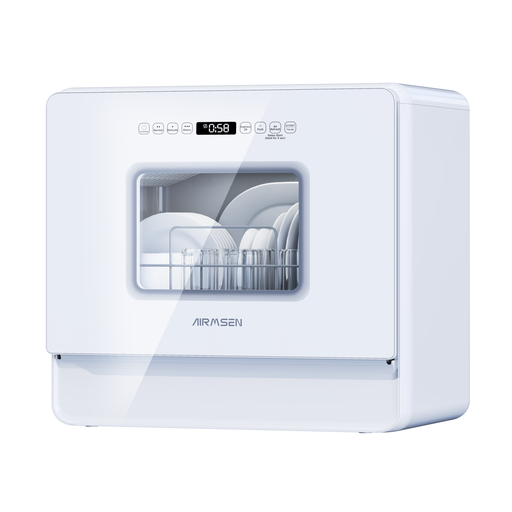
These compact worktop models are designed for small kitchens. The selection includes models with a built-in water tank and options for several place settings. Check the plate size, connection method and space required for each model.
 No image available
A worktop model with a built-in tank, suited to a kitchen where a fixed water supply isn’t practical.
The product name lists a 5 L tank and a two-tier rack. To fit plates up to 300 mm, you’ll need to remove the upper rack.
 No image available
A portable worktop model with a tank, suited to a kitchen where a fixed water supply isn’t practical.
The product name lists 5+1 wash cycles and a built-in 5 L tank. Without a direct water supply, the drain hose empties into a container.
 No image available
A worktop model with a built-in tank, suited to a small kitchen where a tank works as the water supply.
The product name lists a 5 L tank, 9 wash programmes and dimensions of 37 × 50 cm.
 No image available
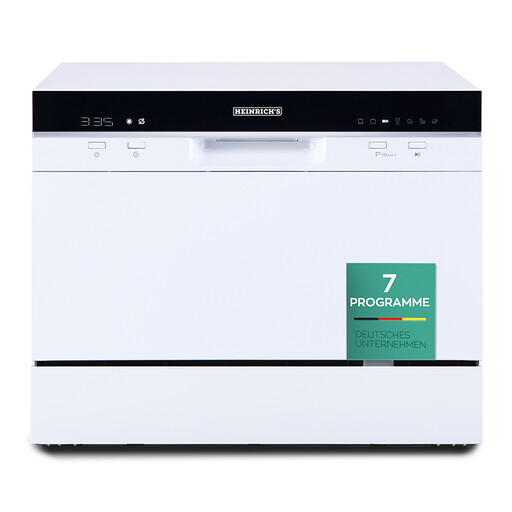
This worktop model in the selection could suit households with several people. Compare its stated capacity with the size of your usual load.
The product name lists 6 place settings, 7 programmes and 47 dB. Also check that the plate size and connection method suit your kitchen.
 No image available
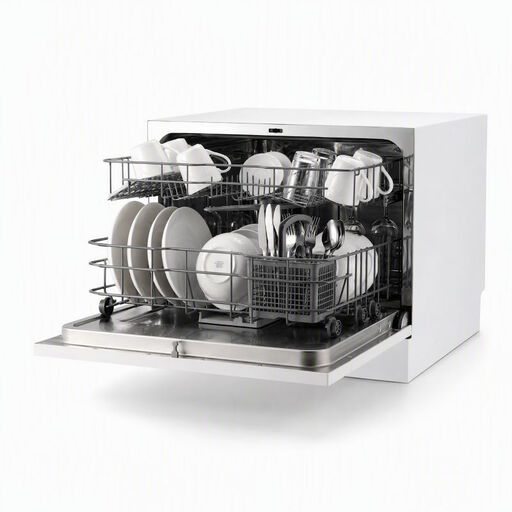
A worktop model with a stated capacity that can help when comparing options for washing several people’s dishes.
The product name lists 6 standard place settings, a 30-minute quick wash and a delay start of up to 24 hours. Check the plate diameter separately.
Measure the diameter of your largest plate and compare it with the specifications for the exact model. Tomado lists a maximum of 25 cm for the TDW5501W; Daan Tech says Bob can fit plates up to 29 cm. Also check for any conditions, such as having to remove a rack.
No. The wastewater still needs a suitable route out of the machine. Check the drain hose, where the water will drain to and the instructions for the exact model before using the appliance.
No. Capacity and maximum plate diameter are different things. Inventum describes a place setting as the cutlery and crockery for one person for one meal. You should also check the model’s maximum plate size and rack layout separately.
It depends on the change. The Dutch government distinguishes between minor alterations that can be reversed without much cost and renovations that require the landlord’s permission. Don’t assume you can make changes to the pipes or kitchen without checking. Consider the specific alteration and, if necessary, speak to your landlord first.
Compare consumption figures on the same basis, using your own tariffs and how often you wash up. Milieu Centraal says energy labels are based on the eco programme. Remember to include the dishwasher detergent you’ll need when weighing up your options.