
Several bowls to wash before lunch
You want to wash all your breakfast dishes in one load. So look at the rack layout and the dimensions of your bowls, not just the stated number of place settings.


Choose a worktop dishwasher based on the space your bowls actually need, then check that the water supply, drainage and setup will work in your kitchen. The stated number of place settings doesn’t guarantee that your deep bowls will all fit in the rack together, so compare the programme duration with when you need them back. If you only have a few bowls, washing them by hand in a washing-up bowl may be more practical: Milieu Centraal says that washing by hand in a bowl with a little hot water is more environmentally friendly than washing up under a running hot tap.
You want to wash all your breakfast dishes in one load. So look at the rack layout and the dimensions of your bowls, not just the stated number of place settings.
You’re looking for a machine that fits on the worktop and has a water supply option that suits your kitchen. Remember to allow for the drain, hoses and space to open the door.
You need your bowls back by a particular lunchtime. Compare the selected cycle’s duration with the time it takes to load and unload the machine, and allow for drying if necessary.
Suitable if: you have a suitable water supply and drain, and want to wash several bowls together.
Bear in mind: the connections and clearance around the machine; also check that your bowls fit in the rack.
Suitable if: a fixed water supply isn’t an option and a smaller load is enough. Daan Tech describes Bob as a standalone model.
Bear in mind: Daan Tech specifies 3 standard place settings for Bob and lists a 20-minute express cycle; its smaller capacity may mean running an extra cycle for several bowls.
Suitable if: you only have a few bowls and don’t want to wait for a machine programme to finish.
Bear in mind: Milieu Centraal says hand-washing in a bowl with a little hot water is more environmentally friendly; this doesn’t necessarily apply if you leave the hot tap running.
Start by checking the rack space and where the machine will go. Then compare the programme duration and consumption with the number of loads your dishes require.
| What to consider | What to look for | Who is this important for? |
|---|---|---|
| Rack space for bowls | Count your dishes, measure your bowls and check the rack layout and permitted dish dimensions for the exact model. | I want to fit all my bowls in at once, so I’m looking at the actual rack space, not just the number of place settings. Around 36% of consumers rank rack space as their top buying priority. |
| Water supply, drainage and space | Measure the space available and check the setup with the door open, as well as the instructions for the water supply, drainage and power. | If there’s no fixed connection, I want to know whether the water supply and drainage will work where I plan to put it, and whether the door can open freely. Around 29% of consumers put connections and positioning first. |
| Clean bowls in time | Compare the duration and requirements of the programme with the time until lunch, allowing for loading and unloading. | I need my bowls back by a particular time, so the whole cycle matters. Around 21% of consumers rank their lunchtime deadline as their top priority. |
| Consumption and small loads | Compare kWh per 100 eco cycles and litres per eco cycle on the same programme basis; also consider how many loads you’ll need. | If I use it regularly, I want to weigh up consumption against the dishes I actually have. Around 14% of consumers put consumption first when considering repeated use. |
The number of place settings refers to standard dishes, but doesn’t tell you how your bowls will fit in the rack or how many will fit at once.
Measure your bowls and check the rack layout and permitted dish dimensions for the exact model before you choose.
A model without a fixed water supply still needs a practical place for the drain, hoses and open door. Tomado specifies a fixed water supply and drain for the TDW5501B, so setup requirements vary by model.
Measure the space and check the manual to see how your chosen model takes in and drains water, and how it needs to be connected.
The number of loads you need and the programme you choose both affect the consumption for all your dishes.
Compare consumption figures on the same eco basis. For a small load, hand-washing in a bowl without leaving the hot tap running may be an alternative; Milieu Centraal includes this condition in its advice on hand-washing.
The TDW5501B is a freestanding tabletop model with 6 stated place settings and a fixed water supply and drain.
The VVW5520 is a compact freestanding dishwasher with 6 stated place settings.
Daan Tech describes Bob as a small worktop dishwasher that can be used on its own when a fixed water supply isn’t suitable.
Klarstein describes the Amazonia Nano as a slim worktop model that doesn’t need a fixed water supply.
These Joybuy picks are worktop dishwashers, including models with a built-in water tank and models with a water connection. For each variant, check that there’s enough rack space for your bowls and that the water supply option suits your setup.
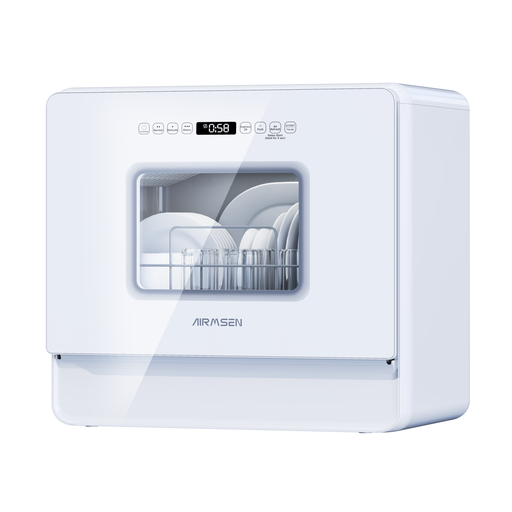 No image available
Suitable if you’re looking for a worktop model and want to choose a water supply option to suit your kitchen; check which setup will work for you.
The description lists 5 place settings, a built-in 5-litre water tank, 5 wash programmes and a 28-minute express programme. It also mentions space for more than 40 pieces of crockery, but that doesn’t confirm that specific bowls will fit.
 No image available
Could suit a kitchen without a fixed water connection; check how the drain can be set up in your kitchen.
The product information lists up to 4 place settings, a built-in 5-litre water tank and 5+1 wash cycles. The description lists a 29-minute quick programme; the number of place settings doesn’t guarantee that your bowls will fit.
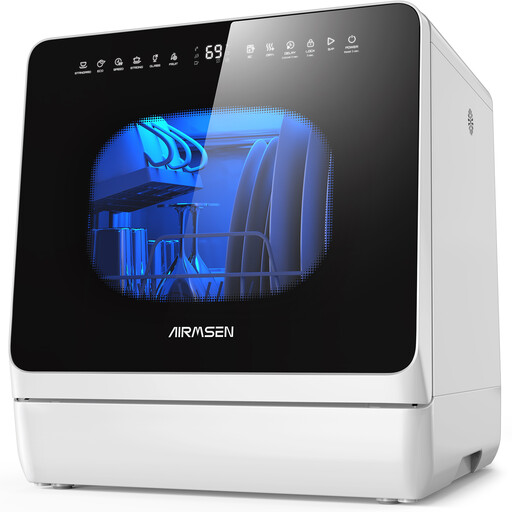 No image available
Worth considering if you’re looking for a worktop model with a quick programme; compare the cycle time with your lunch plans.
The product information lists up to 4 place settings, 8 wash programmes and a 29-minute quick programme. The title says it can be used without a fixed connection, while the description mentions a built-in water tank. Check that your bowls will fit in the rack.
 No image available
Could suit you if you’re looking for a tabletop model with a built-in water tank and several programmes; check the space available and water supply options.
The product information lists a 5-litre water tank, up to 4 place settings and space for dishes up to 26 cm. The title lists dimensions of 37 × 50 cm and a D energy rating. These dish dimensions don’t confirm that your bowls will fit.
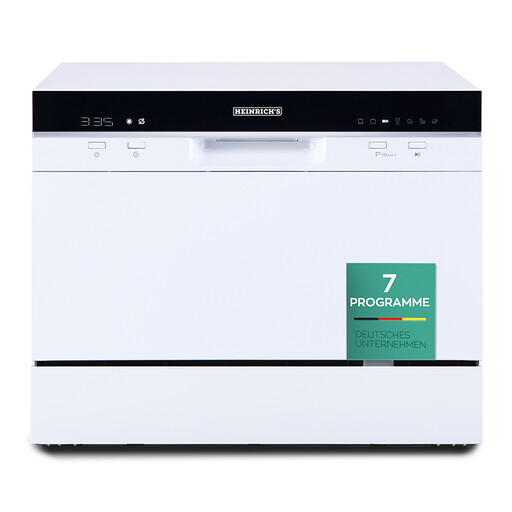 No image available
A tabletop model to compare if you’re looking for several place settings and a short cycle; check that the connection and rack suit your kitchen and bowls.
The product information lists 6 place settings and 7 programmes, including a 30-minute quick cycle and a 215-minute eco cycle. The model has a water connection; the number of place settings doesn’t guarantee that your bowls will all fit together.
Not necessarily. A place setting refers to standard crockery for one person and one meal; deep or wide bowls can reduce the usable rack space. Count and measure your own dishes, and check the rack layout.
It depends on the exact model. Tomado specifies a fixed water supply and drain for the TDW5501B, while Daan Tech describes Bob as a standalone model. Even with a model like this, check the drainage, clearance and manual.
Remove food scraps, but generally don’t rinse your dishes beforehand, advises Milieu Centraal. If you have time, it recommends using a full machine on the eco programme; if you have a lunchtime deadline, check the duration and instructions for the quick programme on your model.
In the Netherlands, there’s no fixed statutory guarantee period; according to the Dutch government, the retailer is your point of contact if a product is faulty. A manufacturer’s guarantee doesn’t replace that right.
EU energy labelling and ecodesign rules apply to household dishwashers within their scope. The label uses classes from A to G and includes details such as kWh per 100 eco cycles, water per eco cycle and programme duration; check the details for the exact model.