First, measure the space on your worktop, then check how many of your own breakfast bowls actually fit in the basket: the stated place-setting capacity won’t tell you that. Next, choose between a model with a permanent connection and a smaller model with a temporary tap connection or manually filled reservoir. Weigh the convenience against the space, connections and need to run small loads.
Who is a worktop dishwasher suitable for?
Small-kitchen cook with limited worktop space
You want to machine-wash breakfast bowls, but need to weigh the permanent worktop space it takes up against the cupboard space available. Consumentenbond describes compact freestanding dishwashers as appliances that can sit on a worktop.
Breakfast eater using several bowls a day
You want to fit in a daily load, so you need to check how your own bowls fit in the basket rather than relying on the place-setting capacity alone. Inventum explains that one place setting includes cutlery and crockery for one person and one meal.
Buyer without a permanent water connection
You’re looking for a practical way to supply and drain water, without assuming that a model without permanent installation needs no tap or drain. Check the connection instructions for the exact model.
What should you look for when choosing?
Washing up by hand
Choose this when: you usually only have a few bowls and can wash them with a little hot water.
The trade-off: you don’t need an appliance or any installation work, but you’ll have to wash up yourself. Milieu Centraal notes that washing up by hand with a little hot water is an important factor when making the comparison.
Tabletop model with a permanent connection
Choose this when: your space and connections are suitable, and you regularly have enough washing up for a full load.
The trade-off: a stated capacity of six place settings is different from two, but it doesn’t tell you how many deep bowls will actually fit. A small or frequently half-full load can use more energy and water per item washed.
Smaller model with a temporary tap connection
Choose this when: width is the main constraint and there’s a suitable tap nearby. Klarstein describes the Aquatica as a 42 cm model for two place settings.
The trade-off: its lower stated capacity may mean you need to run it more often. No permanent installation doesn’t automatically mean no water supply or drainage is needed.
Tabletop model with a manually filled reservoir
Choose this when: there’s no permanent water supply and you’re happy to fill the reservoir yourself.
The trade-off: the product description for a Comfee model on Joybuy lists a built-in 5-litre reservoir. Check how wastewater is drained for the specific model too.
| What to consider |
What to check before buying |
Who it matters to |
| Worktop space |
Measure the width, depth and height, and allow for the door when open, hoses and drawers. |
If you already have little clear worktop space, you’ll want to know whether the appliance will fit there permanently. Around 36% of consumers put available space first. |
| Bowls that fit |
Measure the diameter and height of your bowls, and check the basket layout and clearance for the spray arms. |
You’ll want to fit your own breakfast bowls into a usable load, rather than just looking at a theoretical place-setting capacity. For around 29% of consumers, fitting a suitable load is their main buying concern. |
| Water supply and drainage |
Check the connection type, tap compatibility, drain hose and instructions for the exact model. |
If you don’t have a permanent water supply, you’ll want to know in advance how to add water and drain wastewater. Around 21% of consumers base their choice mainly on these connections. |
| Consumption per load |
Compare kWh per 100 eco cycles and litres per eco cycle, and consider how often you’ll actually run a full load. |
You’ll want to avoid having to run frequent small loads, so look at consumption as well as how well the basket suits your washing up. Around 14% of consumers prioritise consumption per usable load. |
Common buying mistakes
-
Reading ‘no permanent installation’ as ‘no water connection or drainage’
A temporary tap connection still needs a suitable water supply. The wastewater also needs somewhere to go.
Check the manual for the exact model to see how the water supply and drainage work.
-
Assuming the number of place settings equals the number of breakfast bowls
A place setting includes different types of crockery and cutlery. The shape and depth of your bowls also affect how many will fit in the basket.
Measure your bowls and check the basket layout before relying on the stated capacity.
-
Assuming a mini dishwasher will always save money for a few bowls
A machine that is often not full makes less effective use of its capacity. Milieu Centraal recommends running dishwashers when full and suggests washing up by hand with a little hot water as an alternative.
Compare the amount of washing up you have and your habits; don’t assume there’s an overall saving based only on the litres used per machine cycle.
Brands and models to compare
Tomado
The TDW5501B is a freestanding tabletop model for six place settings. It’s worth considering if a permanent water supply and drainage are available where you plan to put it.
- Tomado lists a cutlery basket, five programmes and space for plates up to Ø 25 cm.
- The stated plate diameter doesn’t guarantee that your breakfast bowls will fit. The manual calls for a sturdy, level surface and a spot near a water supply, drain and socket.
Inventum
The VVW5520 is a compact freestanding model for six place settings. Compare its basket and programme layout with the loads you usually have.
- Inventum lists six programmes and 6.5 litres of water per wash.
- This model specification doesn’t prove that the dishwasher is more economical than washing a few breakfast bowls by hand.
Klarstein
The 42 cm Aquatica is rated for two place settings. It could be worth considering if space is limited and there’s a suitable tap nearby.
- Klarstein describes a temporary tap connection and three programmes.
- Its smaller capacity may mean more frequent cycles. Check the instructions for the exact model and don’t assume it has a reservoir unless this is specified for that version.
Bosch
The SKS62E32EU is a compact freestanding model for six place settings, with published figures for the eco programme.
- Bosch lists 61 kWh per 100 eco cycles, 8.0 litres per eco cycle and 49 dB(A) for this model.
- These stated figures aren’t the result of a real-world test and don’t predict consumption for every breakfast load or other programme.
Worktop dishwashers at Joybuy
The options below are tabletop models for a small kitchen. Compare each model’s stated capacity and its water supply and drainage method.
 No image available
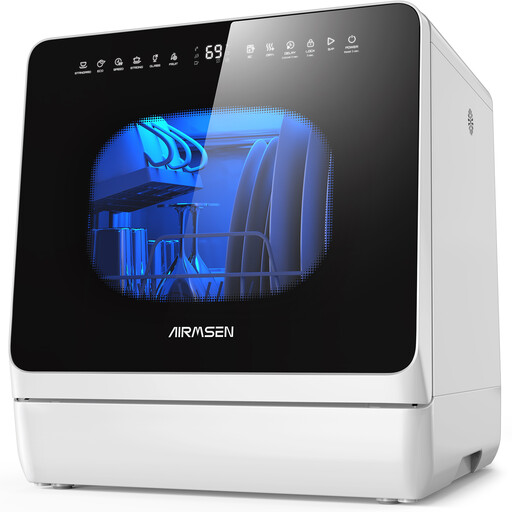
AIRMSEN Portable Countertop Dishwasher, 5+1 Wash Cycles
An option if you’re looking for a tabletop model that, according to the product information, can be filled from a reservoir or supplied with tap water.
Stated capacity: 4 place settings. Reservoir: 5 litres. Dimensions: 45,8 × 42,8 × 42,5 cm. When using the reservoir, wastewater drains through a hose into a container.
Joybuy
 No image available
AIRMSEN Countertop Dishwasher
An option if you want to compare a tabletop model with a reservoir and available width is an important factor.
Stated capacity: 4 place settings. Reservoir: 5 litres. The product title gives a width of 37 cm. An adapter may be needed to connect it to the tap.
Joybuy
 No image available
AIRMSEN Tabletop Dishwasher with Built-in 5L Water Tank
An option if you want to add water by hand and are looking for a compact tabletop dishwasher.
Stated capacity: 4 place settings. Reservoir: 5 litres, filled by hand. The product information lists dimensions of 420 × 435 × 435 mm.
Joybuy
 No image available
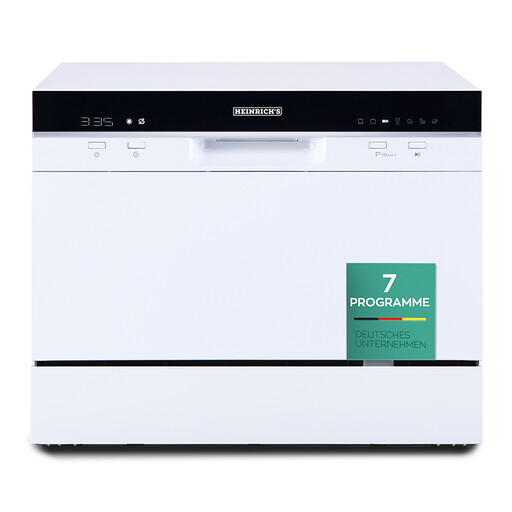
Heinrich's HTG 8840
An option if you want to compare a tabletop model with a stated capacity of six place settings.
The product information lists a water supply hose and drain hose, so make sure you have a suitable water supply and drain.
Joybuy
 No image available
Heinrich's HTG 8855
An option if you want to compare a small tabletop model with a reservoir or direct tap connection.
Stated capacity: 3 place settings. Reservoir: 5 litres, filled by hand; a direct tap connection is also listed as an option. If you use the reservoir, you’ll need to fill it yourself.
Joybuy
Frequently asked questions
Can I tell how many breakfast bowls will fit from a capacity of six place settings?
No, six place settings doesn’t mean six breakfast bowls. Inventum describes a place setting as crockery and cutlery for one person and one meal. Measure your bowls and check the basket in the specific model.
How should I position and maintain a tabletop model?
Follow the manual for the model you choose. The manual for the Tomado TDW5501B calls for a sturdy, level surface and kink-free hoses, among other things. Milieu Centraal recommends removing food scraps to prevent the filter from becoming blocked.
What should I compare when looking at electricity and water consumption?
Compare the label figures for kWh per 100 eco cycles and water per eco cycle, and consider how often you’ll be able to run a full load. The label doesn’t automatically predict your consumption with other programmes or small loads.
Do I lose my right to help once the manufacturer’s guarantee has expired?
No, not automatically. According to ACM ConsuWijzer, your statutory rights exist alongside the guarantee provided by the retailer or manufacturer. If a product breaks sooner than you could reasonably expect under normal use, the retailer is responsible for offering an appropriate solution free of charge.
Is an energy label compulsory for a household dishwasher in the Netherlands?
Yes. The Dutch government lists dishwashers among the appliances that must have an energy label. The European Commission says that the EU label for household dishwashers shows information including energy consumption, water consumption, capacity and noise level.


