
People managing frequently used parts bins
You want codes to remain legible on bins and other surfaces that are handled or cleaned regularly. The label material and how well it sticks to the surface in question are important considerations.


Start with where the label will go. For parts and bins that are handled or cleaned often, a printer with suitable label media is a better choice than one mainly used for paper address labels. Then decide whether you need to print on site, share designs via a computer or phone, or produce larger batches with barcodes. Always check that the printer, tape or roll, surface and connection are compatible.
You want codes to remain legible on bins and other surfaces that are handled or cleaned regularly. The label material and how well it sticks to the surface in question are important considerations.
You want to reuse the same names and designs so that everyone identifies parts in a consistent way.
You want to print larger batches of labels for parts or bins from a fixed workstation, possibly including barcodes. You’ll need to choose a printer model and supplies that suit the job.
First, decide where the label will go and how it will be used. Then choose a material and printer to suit the way you work.
| What to consider | What to look for | Who is this important for? |
|---|---|---|
| Adhesion and legibility | Choose tape or labels to suit the surface and conditions. Check compatibility and test the label on a similar surface. | If bins are handled or cleaned often, I want the text and label to stay in place. Around 36% of consumers prioritise adhesion and legibility. |
| Shared codes | Check whether designs can be saved or created on the devices your team uses, and agree on a consistent format. | If several team members need to find the same parts, I want codes and designs that can be reused consistently. Around 29% of consumers prioritise consistent identification. |
| Printing on site | Check for standalone operation, the power supply and what’s included with the model you choose. | If I want to make labels by the shelving or workbench, being able to operate the printer there matters more than having a centralised workflow. Around 21% of consumers prioritise mobile printing. |
| Batches and barcodes | Check the printing method of the exact model, label size, any ribbons required and the barcode support you need. | If I print lots of labels or barcodes from a fixed workstation, I want the printer and supplies to suit the batch. Around 14% of consumers prioritise batches or barcodes. |
Printers can use different supplies. Brother P-touch models use compatible TZe cartridges, while the Brother QL-700 uses DK rolls. The materials and applications are not the same.
Choosing the wrong option could mean relabelling or buying different supplies. Start with the surface and intended use, then check the printer and exact product.
Zebra offers direct thermal and thermal transfer models. The features of one version don’t necessarily apply to another.
Before buying, check the full model code and make sure the printing method, connection and media suit your application.
You may need a different model, or a compatible ribbon and label material, to suit the way you plan to work.
The Dutch government states that the old-for-new scheme for household appliances does not apply to businesses.
Check whether the purchase and disposal are private or business-related, and follow the appropriate collection route for business waste.
P-touch printers use TZe tapes, which vary by model. The QL-700 is designed for a different workflow using DK rolls.
The M210 is a portable printer for marking, with cartridges selected to suit each application.
The Rhino 4200 is designed for hands-on marking, including in workshops and for cable identification.
The ZD421 desktop series is designed for printing labels and barcodes from a fixed workstation.
This selection includes portable printers for making labels on site, plus a USB printer for printing batches and codes from a fixed workstation.
 Image unavailable
Could suit mobile stock labelling and printing batches or codes via the app.
The product description lists Bluetooth, a rechargeable battery and label widths of 20–50 mm.
The app description mentions batch printing, Excel import and barcodes.
 Image unavailable
Could suit designing labels and creating codes on the go using a phone or tablet.
The product description lists Bluetooth, a rechargeable battery and a label width of 0,59 inch.
The app description mentions barcode and QR code designs, as well as label templates.
 Image unavailable
Could suit mobile labelling from a smartphone or tablet. Check that your chosen label material is suitable for workshop surfaces.
The product description lists Bluetooth, power from four AA batteries and a maximum label width of 1,2 cm.
The description lists paper, plastic, metallic and iron-on labels as options.
 Image unavailable
Could suit making labels by a workbench or shelving. The product details list Bluetooth and control from a mobile device.
The printer is compatible with TZe tape in widths of 3,5, 6, 9 and 12 mm. Brother describes a laminate layer on TZe tape; check the tape is suitable for your chosen surface.
The product details list AAA batteries.
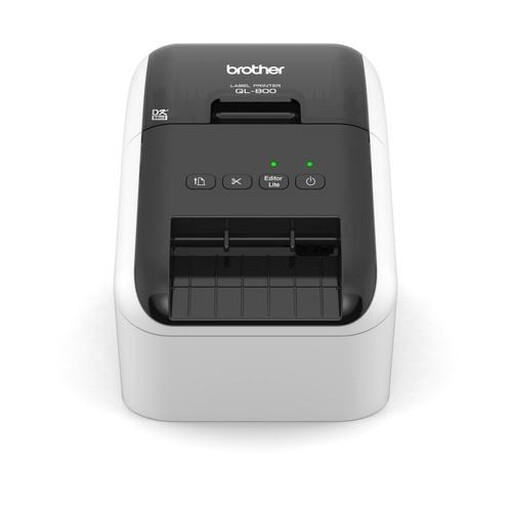 Image unavailable
Could suit printing labels and codes from a fixed workstation. Check that DK labels are suitable for the surface and intended use.
The product description lists USB, direct thermal printing and DK labels up to 62 mm wide.
The description lists support for QR, EAN and UPC codes, among others.
Not always: you can label the part, the bin or both. Choose a material suited to the surface and check how well it sticks there. Brother offers options including standard tape, flexible ID tape and extra-strength adhesive tape.
Agree on a consistent format for part codes and save reusable designs if your printer supports this. Brother says the PT-D460BTVP can store label designs; check whether other models have this feature separately.
Check which tape or rolls you need. For a thermal transfer model, make sure you also choose the right ribbon. Check what’s included and the warranty for the exact model, too. Brady lists a rechargeable battery and a two-year warranty for the M210-KIT EU, but this doesn’t automatically apply to every M210 set.
No. According to the Dutch government, the old-for-new scheme for household appliances does not apply to businesses. A business workshop must follow the rules for commercial waste. The Dutch government also states that empty batteries should not go in the rubbish bin.