Start with soft window light coming from the side of the toy, and use a white card to brighten the shadowed areas if needed. An adjustable continuous LED panel is a practical choice if there’s no window light or it keeps changing. Choose a larger panel if you have room for the setup, or a compact one if storage and portability matter more. Whatever you choose, check the colour settings, power supply, mounting options and included accessories.
Who is this lighting for?
Maker taking colour-critical product photos
If you want wood tones to look consistent across shots, check that the colour temperature is adjustable and set your camera’s white balance deliberately too. Canon Europe describes white balance as a setting that helps in challenging lighting conditions.
Photographer of small toy scenes
To show shapes and details in the wood, position the light at an angle and use a white card to brighten the shadows. Canon Europe recommends a white card or reflector as a way to bounce light back onto your subject.
Photographer without a permanent photo space
If you set up and pack away your kit each time, size, mounting and power all matter. Compare the exact version: a compact battery-powered panel needs a different space and setup from a larger panel.
What should you look for when choosing?
Window light with a white card
Choose this if: you take photos in the same spot during the day and the window provides enough soft light.
Bear in mind: changing daylight can make it harder to keep exposure and colour consistent between shots.
Larger adjustable bi-colour panel
Choose this if: you regularly photograph several toys and have space for a sturdy stand.
Bear in mind: the panel, mount and any diffusion accessories take up space. Check what’s included with each version.
Compact battery-powered panel
Choose this if: you use a small table, pack away your setup or take photos in different locations.
Bear in mind: check that the light output is sufficient at your working distance and find out which colour settings the version you’re considering offers.
| What to consider |
What to look for when buying |
Who is this important for? |
| Soft light and shadows |
Check whether a diffuser is included and whether you can position the light, toys and, if needed, a white reflector card around the table. |
If you want to show small shapes without harsh shadows dominating the image, soft, shaping light should be a priority. Around 36% of consumers prioritise shadow control. |
| Consistent wood colour |
Compare the stated colour temperature and CRI for the exact version. Set the white balance too, and watch out for mixed light colours. |
If you want to capture several items or shooting days consistently, adjustable colour temperature and repeatable white balance are important. Around 29% of consumers prioritise consistent wood tones. |
| Positioning on a small table |
Check the dimensions, weight and mounting thread, and find out whether you’ll need a stand or clamp. Only compare light readings taken at the same distance. |
If there’s little room beside the table, the light needs to be a suitable size and attach securely. Around 21% of consumers prioritise a compact setup. |
| Power and complete kit |
Check what’s included with the exact version, including the adapter, battery, cable, diffuser and stand. |
If you want to get started without buying extra accessories, a suitable power supply and clear details of what’s included are essential. Around 14% of consumers prioritise this. |
Common buying mistakes
-
Comparing a lux rating without checking the measurement distance
Manufacturers may state light output at different distances and settings. A figure on its own doesn’t tell you how the panel will light your toys on the table.
Only compare figures when the measurement distance and light setting are given, and assess the lighting where you’ll be taking photos.
-
Assuming the panel, battery and stand all come as one complete kit
The NEEWER NL660 is available with or without a stand; compatible NP-F batteries are not included. The Godox LEDP260C requires NP-F970 batteries, which must be purchased separately.
Check what’s included with the exact version before buying.
-
Confusing different versions of a model
The Ulanzi VL49 and VL49 RGB have different lighting settings. The Godox LEDP260C and P260C Pro are also separate models, so the specifications for one version don’t automatically apply to the other.
Compare the full model name and product specifications for the version you’re considering, not just the product photo or shared series name.
Brands and models to consider
Godox
The LEDP260C is a bi-colour panel for a permanent product photography setup. The P260C Pro is a separate model with different specifications.
- The Godox manual states that the LEDP260C has a colour temperature of 3300–5600 K and a stated CRI of over 95.
- According to the manual, the LEDP260C is powered by an adapter; NP-F970 batteries are optional and must be bought separately.
- At intermediate colour temperatures, the manual states that dimming starts at 25%; at the end points, it can start at 10%.
NEEWER
The NL660 is a larger bi-colour panel, available as a light on its own or in a version that includes a stand.
- NEEWER states that the NL660 has a colour temperature of 3200–5600 K, a stated CRI of at least 96, a diffuser and a mains adapter.
- A stand is included only with the corresponding version; compatible NP-F batteries are not included.
amaran
The P60x is an adjustable bi-colour panel for a more extensive lighting setup.
- Aputure states that the amaran P60x has a colour temperature of 3200–6500 K and a stated CRI of at least 95.
- The manufacturer gives light readings at specific distances; these don’t necessarily tell you how the light will fall on your table. Active cooling is also worth considering if you’re recording video with sound.
Ulanzi
The VL49 and VL49 RGB are different compact, rechargeable options for situations where a larger panel is difficult to position.
- Ulanzi states that the standard VL49 has a fixed colour temperature of 5500 K and a built-in battery.
- According to Ulanzi, the VL49 RGB offers adjustable colour temperature and RGB functions.
- Don’t confuse the versions; their settings and specifications differ.
Joybuy product pick
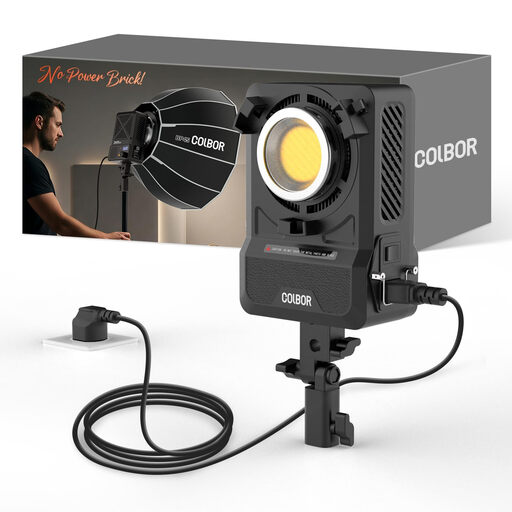
This product selection includes a COB studio light for photography, not an LED panel. Consider this option only if you’re also looking at a different type of studio lighting.
 No image available
COLBOR 200W bi-colour COB studio light
An alternative type of studio lighting if you’re not set on a panel; the product information lists photography and studio use. This is not an LED panel.
200 W; bi-colour setting from 2700–7000 K; COB light source; built-in power adapter; Bowens mount.
For electrical products sold in the Netherlands, check the CE information for the specific listing. The NVWA states that CE marking is mandatory; this alone doesn’t tell you anything about a particular listing.
View at Joybuy
Frequently asked questions
Do I need two panels?
Not necessarily. Try one soft light source at an angle beside the toy, and use a white card to fill in the shadowed side. Add a second light source only if you’re not getting the shadow distribution you want.
How can I keep wood colour consistent between photos?
If possible, use the same lighting setup each time and adjust the white balance to suit the available light. An adjustable colour temperature helps you match the lamp to your needs, but it won’t correct your camera’s white balance automatically.
Do I need to buy a battery or stand separately?
It depends on the version. The Godox manual says that NP-F970 batteries for the LEDP260C must be bought separately. NEEWER offers the NL660 with or without a stand and states that NP-F batteries are not included.
Is CE marking mandatory for an LED photo panel in the Netherlands?
Yes. The Netherlands Food and Consumer Product Safety Authority states that CE marking is mandatory for electrical consumer products sold in the Netherlands. Check the information for the specific panel and power supply; general model specifications don’t confirm that a particular listing has been checked.
What warranty and cooling-off period apply to online purchases in the Netherlands?
For a consumer purchase, the product must meet the standards you can reasonably expect. The Netherlands has no fixed statutory warranty period, and the seller is your point of contact if something is wrong, as explained by the Dutch Government. For a standard online product purchase, you can usually change your mind within 14 days of delivery, subject to statutory exceptions set out by ACM ConsuWijzer.


